
At a Glance
- This guide covers how sports injury clinics and physiotherapy practices should evaluate and source a professional shockwave therapy machine in 2026, including indication mapping, specification requirements, and applicator selection.
- Clinical shockwave therapy machines for sports injury use require a frequency range of 1–22 Hz, radial pressure of 1–5 Bar, and focused electromagnetic capability with a focal depth of 0–60mm for deep tissue applications.
- Radial shockwave is appropriate for superficial tendinopathies (0–30mm depth); focused shockwave is required for deep-lying pathology (insertional tendinopathies, calcific deposits, rotator cuff) at 30–60mm depth; dual-source units cover both.
- Common sports injury indications addressed by shockwave protocol include: plantar fasciitis, Achilles tendinopathy, lateral/medial epicondylitis, rotator cuff tendinopathy, calcific shoulder tendinitis, patellar tendinopathy, and myofascial trigger points.
- There are zero per-session consumable costs beyond coupling gel ($1–$2/session); at $100–$200 per session with 3–6 sessions per patient course, each new patient generates $300–$1,200 in gross course revenue.
- Required certifications for clinical deployment: CE marking, FDA 510(k) clearance, MDR compliance, and ISO 13485 — all must be verified via public registry using traceable certificate numbers.
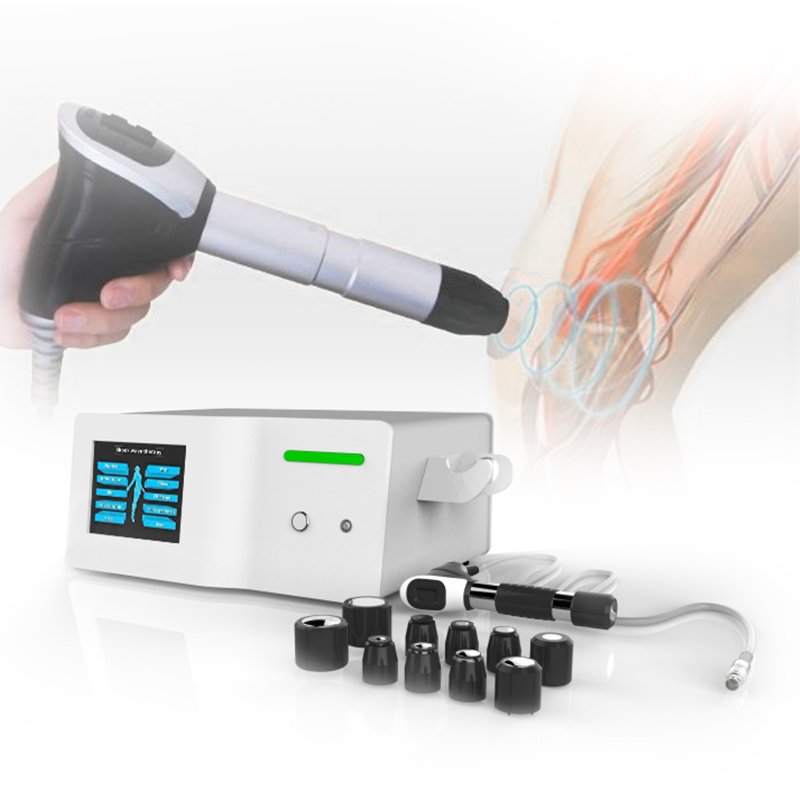
- MNLT Laser manufactures dual-source (radial + focused) shockwave therapy machines with CE/FDA/ISO 13485 certification, 19 years of production experience, and global distribution across 120+ countries.
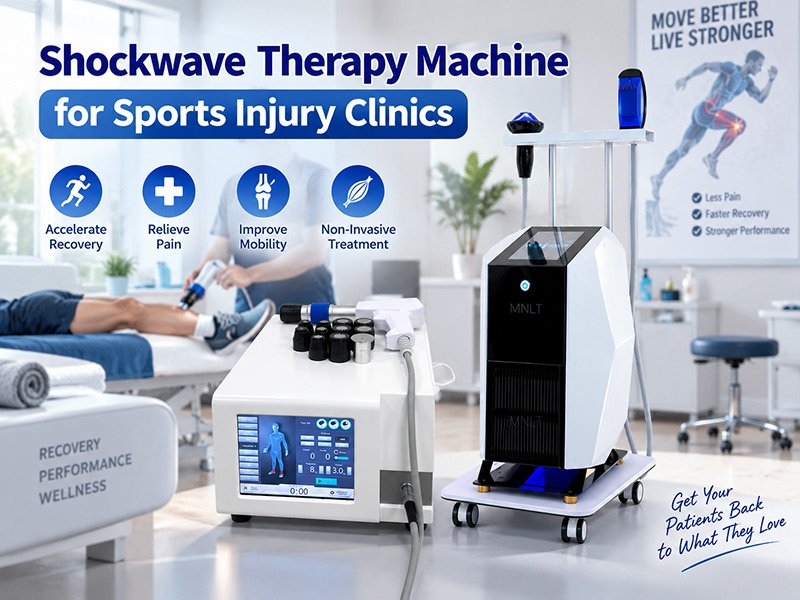
Shockwave therapy has moved from specialist physiotherapy centres into mainstream sports medicine, rehabilitation clinics, and high-performance athletic facilities — and for good reason. The combination of non-invasive delivery, fast session times, strong clinical evidence across multiple musculoskeletal indications, and zero per-session consumable cost makes shockwave one of the highest-ROI modalities a sports injury clinic can add in 2026. But the equipment decision matters enormously: the wrong machine limits your treatable indications, undermines treatment consistency, and constrains your revenue ceiling. This guide gives sports clinic owners, physiotherapy practice managers, and aesthetics equipment distributors a structured framework for sourcing the right shockwave therapy machine in 2026.
Why Shockwave Therapy Belongs in Every Sports Injury Clinic
Sports injury presentations that arrive in physiotherapy and rehabilitation clinics are dominated by a predictable set of chronic tendinopathies, enthesopathies, and soft tissue conditions — many of which respond poorly to conventional treatment and represent the most frustrating cases for both practitioner and patient.
Shockwave therapy addresses this gap directly. The acoustic wave energy delivered by a clinical-grade shockwave machine stimulates mechanotransduction at the tissue level — activating fibroblast activity, promoting collagen synthesis, disrupting calcific deposits, and stimulating local neovascularisation. For chronic tendinopathies in particular, shockwave is the only non-invasive modality with consistent supporting evidence across multiple randomised controlled trials and systematic reviews.
The clinical argument for adding shockwave is compelling. The business argument is equally strong:
- Zero consumable cost: no per-session applicator fees, no disposable components — every session after break-even is full-margin revenue
- Fast session times: 15–25 minutes per treatment area, enabling high daily utilisation at clinic volume
- High repeat-booking rate: standard protocols require 3–6 sessions, creating predictable course revenue per patient
- Premium pricing: shockwave sessions in EU and North American sports medicine markets typically price at 80–80–200 per session, depending on clinic positioning and treatment area.Browse our range of shockwave therapy machines.
Sports Injury Indications: What Shockwave Therapy Addresses
Understanding which conditions your patient population presents determines whether radial, focused, or dual-source shockwave capability is the appropriate equipment investment. The following table maps common sports injury presentations to shockwave protocol requirements:
| Condition | Tissue Target | Recommended Modality | Typical Sessions |
|---|---|---|---|
| Plantar fasciitis | Fascial attachment (deep) | Focused or Radial | 3–5 |
| Achilles tendinopathy (insertional) | Tendon insertion (20–30mm depth) | Focused | 3–6 |
| Achilles tendinopathy (mid-portion) | Mid-tendon (superficial) | Radial | 3–5 |
| Lateral epicondylitis (tennis elbow) | Common extensor origin | Radial | 3–5 |
| Medial epicondylitis (golfer’s elbow) | Common flexor origin | Radial | 3–5 |
| Rotator cuff tendinopathy | Deep rotator cuff (30–50mm) | Focused | 3–6 |
| Calcific shoulder tendinitis | Calcific deposit | Focused (high energy) | 2–4 |
| Patellar tendinopathy | Patellar tendon | Radial or Focused | 3–6 |
| Greater trochanteric pain syndrome | Gluteal tendon insertion | Focused | 3–5 |
| Proximal hamstring tendinopathy | Ischial tuberosity attachment | Focused | 4–6 |
| Tibial stress syndrome (shin splints) | Periosteal surface | Radial | 3–5 |
| Trigger point therapy (myofascial) | Broad muscle groups | Radial | 2–4 |
Clinical note: All application descriptions in this table refer to the clinical application context of the equipment — they do not constitute medical advice or a clinical protocol. Treatment decisions must be made by qualified practitioners based on individual patient assessment.
Machine Specifications: What to Require from a Clinical-Grade Shockwave Device
Not all shockwave machines deliver equivalent clinical capability. Before evaluating any supplier, establish the minimum specification for your clinic’s intended patient population:
| Specification | Clinical Standard | Limitation Flag |
|---|---|---|
| Frequency range | 1–22 Hz (full range) | Fixed frequency or < 15 Hz max |
| Pressure range (radial) | 1–5 Bar | < 3 Bar max — insufficient for deep tissue |
| Focused energy range | 0.03–0.65 mJ/mm² | Single fixed energy level |
| Focal depth (focused mode) | 0–60mm, adjustable | Fixed focal depth only |
| Applicator heads | Radial + focused interchangeable | Single applicator only |
| Pulse count control | 1–5,000 pulses per session | Fixed pulse count |
| Session logging | Yes — energy, pulses, frequency | No documentation output |
| Certification | CE, FDA, ISO 13485 — traceable | Certificate image only |
| Voltage | Dual-voltage (100–240V) | Single voltage |
The frequency range is particularly important for sports injury applications: lower frequencies (1–4 Hz) are used for sensitive or recently injured tissue; mid-range (5–12 Hz) covers standard chronic tendinopathy protocols; higher frequencies (15–22 Hz) are appropriate for large muscle group and myofascial trigger point applications. A machine whose frequency range tops out below 15 Hz cannot adequately serve the full sports injury treatment menu.
The Applicator Decision: Radial, Focused, or Dual-Source?
The single most consequential equipment decision for a sports injury clinic is whether to invest in radial-only, focused-only, or dual-source shockwave capability. This is a clinical decision, not purely a budget decision.
Radial Shockwave — Appropriate For:
Clinics whose patient load is dominated by superficial tendinopathies (mid-portion Achilles, lateral epicondylitis, tibial stress syndrome), myofascial trigger point therapy, and general soft tissue rehabilitation. Radial systems are lower in upfront cost, easier to operate (no focal depth targeting required), and appropriate for the majority of sports injury presentations that involve tissue at 0–30mm depth.
Focused Shockwave — Appropriate For:
Clinics treating deeper-lying pathology: insertional tendinopathies, calcific deposits, rotator cuff conditions, proximal hamstring attachments, and greater trochanteric presentations. Focused shockwave concentrates acoustic energy at a defined depth (adjustable to 60mm), enabling treatment of tissue that radial delivery cannot reach at therapeutic energy levels.
Dual-Source (Radial + Focused in One Unit) — Recommended For:
Most sports injury clinics will encounter both superficial and deep presentations across their patient population. A dual-source shockwave machine eliminates the need to purchase two separate devices — and eliminates the clinical limitation of a single-modality system. The incremental cost over a radial-only unit is typically 25–40% at factory-direct pricing, which is recovered within weeks at standard session pricing.
For a detailed technical comparison of radial and focused shockwave mechanisms, see our Radial vs Focused Shockwave Therapy clinic guide.

5 Criteria for Evaluating a Shockwave Machine Supplier
1. Certification Traceability
CE marking, FDA clearance, MDR compliance, and ISO 13485 are the regulatory baseline. The critical requirement is traceability: request the certificate number for each credential and verify it through the issuing body’s public database. A certificate image is not evidence of current certification status.
2. Applicator Range and Compatibility
Confirm the full applicator head ecosystem available from the supplier: standard radial heads (various diameters for different treatment areas), focused electromagnetic head (with focal depth specification), and any specialist heads (flat, perforated, or angled) for specific anatomical applications. An applicator range that is limited to one or two head types constrains your treatment menu.
3. Parameter Range and Flexibility
Sports injury protocols require precise parameter control — energy density, frequency, and pulse count must be adjustable to the individual patient’s tissue condition, pain tolerance, and stage of healing. A machine that locks parameters into preset protocol modes removes the clinical flexibility that experienced practitioners rely on.
4. Session Documentation Output
Clinical governance in sports medicine and physiotherapy contexts requires session documentation — the parameters used, pulse count delivered, and treatment area — for each patient visit. Professional-grade shockwave machines generate a session summary that can be transferred to the patient’s clinical record. This is not optional for registered clinical practices in most EU and North American jurisdictions.
5. Training and Protocol Support
Focused shockwave therapy requires operator competence in anatomical targeting and energy titration. Confirm that the manufacturer provides: a clinical protocol library covering standard sports injury indications, operator training (video and live session formats), contraindications documentation, and access to technical support post-purchase.
Buying Direct from MNLT: The Sports Clinic Advantage
MNLT Laser (Shandong Moonlight Electronics Tech Co., Ltd.) has been manufacturing professional physiotherapy and aesthetic devices for 19 years, supplying clinics and distributors across 120+ countries and 20,000+ installations globally. The shockwave therapy machine range is produced in an ISO 13485-certified facility with CE marking, FDA clearance, and MDR compliance — all traceable through their respective public registries.
The MNLT shockwave advantage for sports injury clinics:
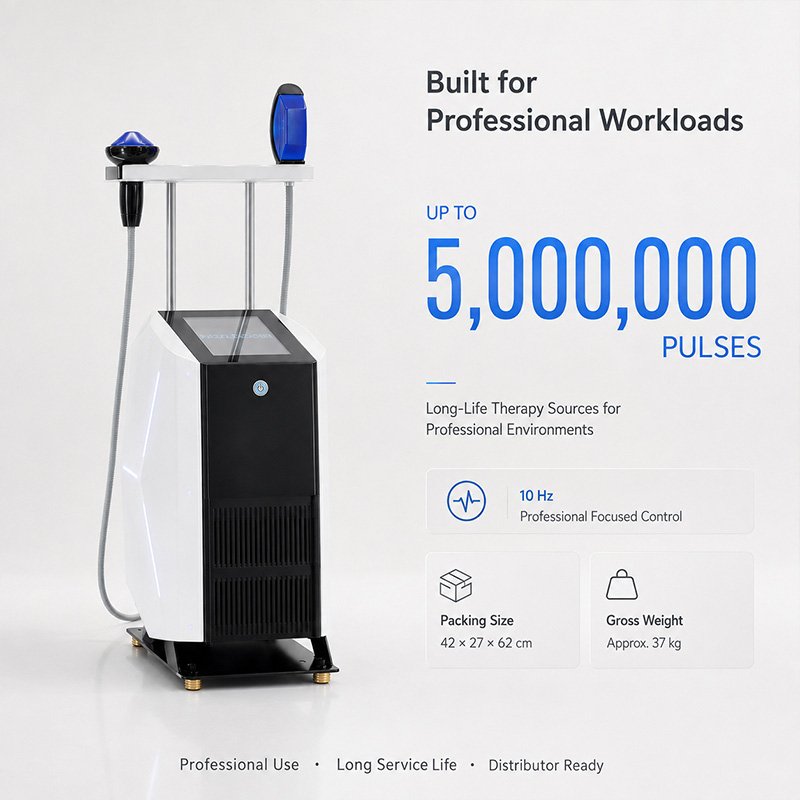
- Dual-source architecture: radial (1–5 Bar, 1–22 Hz) and focused electromagnetic (0–60mm focal depth, 0.03–0.65 mJ/mm²) in a single platform
- Complete applicator ecosystem: standard, angled, and focused heads with clinical-use documentation for each
- CE / FDA / MDR / ISO 13485 certified: verified regulatory compliance for EU and North American clinical deployment
- Session logging: built-in parameter documentation for clinical governance records
- 24/7 technical support: global after-sales coverage, remote diagnostics, spare parts logistics
- OEM/private label: custom branding for distributor partners and clinic groups
- Factory-direct pricing: eliminates intermediary margins — same certified specification at a fraction of branded Western system cost
Inquire Now
Fill out the form for more information, and an MNLT product manager will contact you shortly!
FAQ: Shockwave Therapy Machines for Sports Injury Clinics
What sports injuries can shockwave therapy machines address?
Clinical shockwave therapy machines are used in sports injury clinic protocols for a wide range of musculoskeletal conditions including plantar fasciitis, Achilles tendinopathy (both insertional and mid-portion), lateral and medial epicondylitis, rotator cuff tendinopathy, calcific shoulder tendinitis, patellar tendinopathy, greater trochanteric pain syndrome, proximal hamstring tendinopathy, tibial stress syndrome, and myofascial trigger point presentations. The appropriate delivery modality (radial or focused) and energy parameters depend on the tissue depth and chronicity of the condition — decisions that should be made by the treating practitioner based on clinical assessment.
Should a sports injury clinic buy radial or focused shockwave equipment?
The choice depends on your clinic's patient population. Radial shockwave is appropriate for superficial tendinopathies (0–30mm depth), myofascial trigger points, and broad soft tissue applications — it is easier to operate and lower in upfront cost. Focused shockwave is required for deep-lying pathology: insertional tendinopathies, calcific deposits, rotator cuff conditions, and greater trochanteric presentations at 30–60mm depth. Most sports injury clinics encounter both presentation types, making a dual-source system (radial + focused in one unit) the most clinically and commercially practical choice — it eliminates the need for two devices and covers the full patient population without compromise.
What certifications are required for a shockwave machine in a clinical setting?
For clinical deployment in regulated markets, the minimum certification baseline is CE marking (EU market access), FDA 510(k) clearance (US market access), MDR compliance (EU Medical Device Regulation — required for clinical-grade positioning), and ISO 13485 Quality Management System certification. For sports medicine and physiotherapy contexts specifically, practitioners and clinic owners should also verify that the device's indications documentation is consistent with their jurisdiction's scope-of-practice regulations. Always request traceable certificate numbers — not just certificate images — and verify them through the issuing body's public registry.
What frequency and pressure range does a sports injury shockwave machine need?
A clinical-grade shockwave machine for sports injury applications should offer a frequency range of 1–22 Hz and a radial pressure range of 1–5 Bar. The frequency range matters because different protocols require different settings: 1–4 Hz for sensitive or acutely symptomatic tissue, 5–12 Hz for standard chronic tendinopathy protocols, and 15–22 Hz for myofascial trigger point and large muscle group applications. A machine whose frequency ceiling is below 15 Hz cannot serve the full sports injury treatment menu. For focused shockwave, confirm the focal depth range (0–60mm recommended) and energy density range (0.03–0.65 mJ/mm² for full clinical coverage).
What applicator heads should a sports injury shockwave machine include?
A well-configured sports injury shockwave machine should include: a standard radial applicator (15–25mm diameter) for broad tendinopathy and myofascial applications, a smaller radial applicator (6–10mm) for precision work on small anatomical structures, a focused electromagnetic applicator with adjustable focal depth for deep tissue applications, and ideally a flat or angled applicator for periosteal and bony attachment treatments. Confirm the full applicator inventory included with the quoted price — some suppliers quote base unit pricing that excludes essential applicator heads, which must then be sourced separately at additional cost.
What is the MOQ for buying shockwave therapy machines for resale or distribution?
MOQ varies by supplier and configuration. For standard (non-OEM) stock units, many factory-direct manufacturers offer low-MOQ or single-unit purchasing suitable for clinic evaluation and first-time distributor orders. For OEM/branded configurations — custom logo, packaging, and documentation — MOQ is higher to cover customisation costs, with the exact threshold depending on branding scope. MNLT Laser offers flexible MOQ structures for both direct clinic procurement and regional distributor wholesale arrangements. Contact the MNLT commercial team with your target volume, market, and OEM requirements to receive a written pricing proposal.
How quickly does a shockwave therapy machine pay for itself in a sports clinic?
At factory-direct pricing for a dual-source shockwave system and session pricing of $100–$200 per treatment in EU and North American sports medicine markets, a clinic running 5 shockwave sessions per day breaks even within 1–3 weeks. There are no per-session consumable costs — the only ongoing expenses are standard applicator maintenance and coupling gel ($1–$2 per session). Standard protocols of 3–6 sessions per patient create predictable course revenue: at $120 per session and 4 sessions per course, each new shockwave patient generates $480 in gross revenue, with a gross margin of 95%+ once equipment cost is recovered.
Reviewed by David Ma
CTO & Chief Engineer, MNLT Laser (Shandong Moonlight Electronics Tech Co., Ltd.) — 19 years in aesthetic device manufacturing. David leads MNLT's R&D team across the full professional aesthetic device portfolio, ensuring all technical content meets the highest standards of accuracy and clinical safety.