
Physical therapy clinics, sports medicine centres, and rehabilitation facilities are increasingly adding shockwave therapy to their service menus — but the technology split between radial and focused delivery creates a critical equipment decision that directly shapes treatment capability, patient outcomes, and revenue potential. Choosing the wrong system for your clinical context is an expensive mistake that cannot be corrected by protocol adjustments alone. This guide provides a direct, evidence-grounded comparison to help clinic owners and procurement leads make the right decision in 2026.
5 Decisions This Guide Helps You Make
- Radial shockwave works by pneumatic pressure waves spreading from the applicator tip; focused shockwave concentrates energy at a precise focal point 0–60mm deep — the difference determines which musculoskeletal conditions each system can effectively address
- Focused shockwave therapy machines generate energy densities of 0.03–0.65 mJ/mm², enabling deep-tissue targeting that radial systems (typically 0.01–0.18 mJ/mm²) cannot match
- Clinics treating tendinopathies, calcifications, bone stress responses, and deep myofascial trigger points require focused or dual-source capability — radial alone is insufficient for these applications
- Dual-source systems (electromagnetic focused + radial in one device) provide the widest treatment coverage and the strongest ROI for multi-practitioner clinics
- Factory-direct focused shockwave therapy equipment starts at $4,000–$10,000 vs. $80,000–$150,000 for branded Western equivalents with equivalent clinical specifications
What Is Radial Shockwave Therapy?
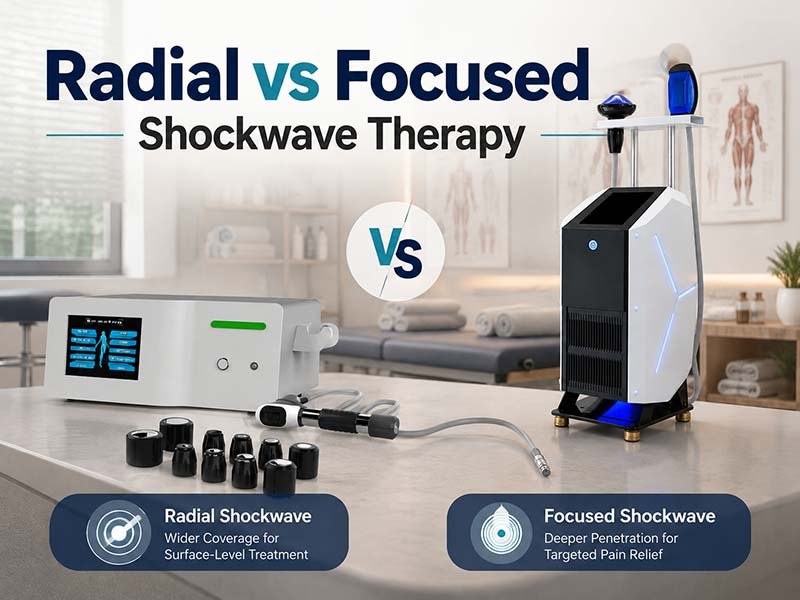
Radial shockwave therapy — also known as pneumatic shockwave or extracorporeal radial pressure wave therapy (EPRT) — generates acoustic pressure waves using a compressed air-driven projectile that strikes a metal applicator tip. The energy radiates outward from the contact point in a diverging, cone-shaped pattern, distributing pressure across a broad superficial area rather than concentrating it at a depth.
MNLT’s radial shockwave therapy machine (pneumatic ESWT, 6 Bar, 21 Hz) is available for clinics requiring high-throughput surface-level applications.
How It Works
The compressed projectile accelerates through a ballistic chamber and decelerates abruptly at the applicator tip. This rapid deceleration generates a radial pressure wave that propagates into the tissue, typically reaching effective treatment depths of 0–30mm depending on applicator geometry and frequency settings.
Clinical Applications
Radial shockwave is well-suited for:
- Superficial trigger point therapy and myofascial pain across broad muscle groups
- Plantar fasciitis (superficial attachment point)
- Lateral epicondylitis (“tennis elbow”) at the superficial attachment
- Cellulite reduction and general tissue stimulation protocols
- Post-treatment recovery and lymphatic support applications
Advantages of Radial Systems
- Lower equipment cost — entry-level radial systems start at $1,500–$3,000
- Easier operator technique (no precise depth targeting required)
- Wider contact area suited to large muscle groups
- Less patient discomfort at comparable energy settings
Limitations of Radial Systems
- Cannot concentrate energy below approximately 30mm depth
- Not suitable for periosteal (bone surface) or deep tendon applications
- Energy density drops off rapidly with depth, limiting effectiveness on buried pathology
- No depth visualisation or focal point adjustment capability
What Is Focused Shockwave Therapy?
Focused shockwave therapy machines generate acoustic energy that converges to a precise focal point beneath the tissue surface. Unlike radial systems, the shockwave is generated electromagnetically (or piezoelectrically) and geometrically focused — the energy travels through overlying tissue with minimal dispersion and deposits its maximum effect at the targeted depth.
How It Works
An electromagnetic coil generates a high-voltage pulse that creates a pressure wave in the water coupling medium. A parabolic or ellipsoidal reflector focuses this wave to a geometric focal point. The operator selects the target depth — typically 0–60mm on clinical systems — by adjusting the focal zone. Energy density at the focal point can reach 0.03–0.65 mJ/mm², far exceeding what radial systems deliver at equivalent tissue depths.
Clinical Applications
Focused shockwave therapy devices are indicated for:
- Calcific tendinopathy (calcium deposit fragmentation at depth)
- Insertional Achilles tendinopathy and patellar tendinopathy
- Bone stress response and delayed union support
- Deep myofascial trigger points (psoas, piriformis, deep rotator cuff)
- Plantar fasciitis with deep fascial involvement
- Chronic enthesopathies where surface-level energy is insufficient
Advantages of Focused Systems
- Precise depth targeting from 0 to 60mm in most clinical systems
- Significantly higher energy density at the focal zone
- Effective for hard and soft tissue applications that radial cannot reach
- Enables treatment of deeper anatomical structures without harming overlying tissue
Limitations of Focused Systems
- Requires trained operators who understand focal point anatomy
- Higher equipment cost than entry-level radial systems
- Smaller treatment footprint per pulse (requires systematic scanning technique)
- Some patient discomfort at higher energy settings on sensitive areas
The MNLT focused shockwave therapy machine integrates both electromagnetic focused and radial delivery in a single dual-source platform — enabling clinics to address the full spectrum of musculoskeletal applications without investing in two separate systems.
Radial vs Focused Shockwave Therapy — Key Differences
| Dimension | Radial Shockwave | Focused Shockwave |
|---|---|---|
| Energy generation | Pneumatic (compressed air projectile) | Electromagnetic or piezoelectric |
| Wave pattern | Diverging, radial spread | Converging to focal point |
| Effective depth | 0–30mm | 0–60mm (adjustable) |
| Energy density | 0.01–0.18 mJ/mm² | 0.03–0.65 mJ/mm² |
| Focal point control | None (surface application) | Precise depth adjustment |
| Best for | Superficial myofascial, large muscle groups | Deep tendon, calcification, bone, trigger points |
| Operator skill required | Lower | Higher |
| Equipment cost (factory-direct) | $1,500–$4,000 | $4,000–$10,000 |
| Session pricing range | $60–$120 | $100–$250 |


Which Shockwave Machine Is Right for Your Clinic?
Physical Therapy Clinics (General Practice)
Recommendation: Dual-source system (focused + radial)
General physical therapy clinics encounter the full breadth of musculoskeletal presentations — from superficial myofascial pain to deep insertional tendinopathies. A single-modality radial system will be adequate for some cases but will leave practitioners unable to address calcific tendinopathies or deep trigger points effectively. A dual-source focused shockwave therapy machine provides the coverage to handle all presentations from one device, maximising revenue per equipment investment.
Sports Medicine and Athletic Performance Centres
Recommendation: Focused shockwave, high energy output
Elite athletes present complex, deep-tissue pathologies — insertional tendinopathies, stress reaction sites, chronic enthesopathies — that require precise focal energy delivery. For sports medicine contexts where treatment outcomes must be measurable and protocols evidence-based, focused shockwave with adjustable focal depth and documented energy output is the clinical standard.
Rehabilitation Centres and Post-Surgical Recovery
Recommendation: Radial as primary, focused as optional upgrade
Post-surgical rehabilitation protocols frequently use shockwave for soft tissue mobilisation, scar tissue support, and lymphatic stimulation — applications where radial delivery is appropriate and the broader energy spread is an advantage. A radial system as a primary investment with a dual-source upgrade path is a rational entry strategy for this context.
Distributors and Multi-Clinic Operators
Recommendation: Dual-source focused shockwave for maximum market coverage
For equipment distributors placing devices into multiple clinic types, a dual-source system eliminates the need to stock two separate models. A single dual-source unit addresses sports medicine, physiotherapy, and rehabilitation applications — simplifying inventory, training, and after-sales support.
For clinics also evaluating adjacent body contouring technologies, our body contouring machine for clinics guide covers how shockwave complements EMS, Cryoskin, and HIFU in a multi-technology service menu.
What to Look for When Buying a Focused Shockwave Therapy Machine
1. Focal Depth Range and Adjustment Resolution
A clinical-grade focused shockwave therapy machine should offer a focal range of at least 0–60mm with stepwise depth adjustment. Systems that only offer fixed focal depths restrict the range of anatomical targets that can be addressed precisely. Confirm the adjustment increments — 5mm steps are typical; finer adjustment is preferable for periosteal targeting.
2. Energy Output Range and Fluence Documentation
Request the manufacturer’s documented energy density specifications at the focal point, not at the applicator surface. Clinical effectiveness for calcific tendinopathy and deep trigger point applications requires focal point fluence of 0.1 mJ/mm² and above. Systems that only document output power (watts) without focal point fluence are providing incomplete information.
3. Dual-Source vs. Single-Source Architecture
A dual-source system incorporating both focused electromagnetic and radial pneumatic delivery expands the clinical application range to cover both deep-focal and broad-superficial protocols. For clinics serving diverse patient populations, the additional flexibility of a dual-source platform justifies the marginal price difference over a single-modality focused-only system.
4. Certification and Regulatory Clearance
For EU market deployment: CE marking and MDR compliance. For the US: FDA clearance via 510(k). For regulated markets globally: ISO 13485 quality management certification. Request the certificate number for each credential and verify it independently — a label without a traceable certificate number does not constitute regulatory compliance.
5. After-Sales Training and Protocol Documentation
Focused shockwave therapy requires operator competence in anatomical targeting, energy titration, and patient screening. Confirm that the manufacturer provides: a documented clinical protocol library, operator training (video and live session), and ongoing technical support post-purchase. A device without operator training documentation cannot be deployed safely or effectively.
Contact the MNLT clinical team to request full technical specifications, protocol documentation, and factory-direct pricing for the dual-source focused shockwave system.
FAQ: Radial vs Focused Shockwave Therapy
Can a radial shockwave machine treat calcific tendinopathy?
Radial shockwave can address superficial calcific deposits but lacks the focal energy density required to effectively fragment calcifications located deeper than approximately 20–25mm. Calcific tendinopathy of the rotator cuff, Achilles insertion, or patellar tendon typically involves deposits at depths requiring focused shockwave with a focal point energy of 0.1 mJ/mm² or above. For clinics with a meaningful caseload of calcific tendinopathy, focused shockwave is the clinically appropriate technology.
What is the difference between piezo and electromagnetic focused shockwave?
Both generate focused acoustic waves, but through different mechanisms. Electromagnetic systems use a high-voltage coil to create a pressure wave that is reflected to a focal point by a parabolic mirror — producing high peak pressures over a broader focal zone. Piezoelectric systems use an array of piezo crystals that fire simultaneously, focusing energy directly without a reflector — typically producing a smaller, more precise focal zone. For general clinical use, electromagnetic focused shockwave offers a wider energy range and longer component lifespan. Piezo systems are more precise but at higher equipment cost and with more fragile crystal arrays.
How many shockwave therapy sessions do patients typically need?
Most clinical protocols for musculoskeletal applications specify 3–6 sessions spaced 5–7 days apart. Calcific tendinopathy applications may require fewer sessions (3–4) if the calcification fragments and resorbs efficiently. Chronic tendinopathies and myofascial pain syndromes typically benefit from 4–6 sessions with a reassessment at the midpoint. Session frequency and total number should always be determined by the treating practitioner based on the individual patient's response, not a fixed protocol.
Is a dual-source shockwave machine worth the extra cost over a focused-only system?
For clinics with mixed patient presentations — a combination of deep-focal pathologies and broad superficial applications — a dual-source system eliminates the need for a second device. The incremental cost of a dual-source focused shockwave therapy machine over a focused-only system is typically 20–35% at factory-direct pricing. If a clinic treats 20 or more shockwave sessions per month with varied indications, the dual-source investment recovers within 2–4 months through expanded treatment capability without added equipment overhead.
What certifications should I verify before purchasing a shockwave therapy machine?
The minimum certification baseline for clinical-grade shockwave equipment is: CE marking (EU market access), FDA 510(k) clearance (US market access), MDR compliance (EU Medical Device Regulation — required for clinical-grade positioning in European markets), and ISO 13485 (Quality Management System). Request the certificate number for each and verify it independently through the issuing body's public database. A certificate image without a traceable registration number does not constitute verified regulatory compliance.
Reviewed by David Ma
CTO & Chief Engineer, MNLT Laser (Shandong Moonlight Electronics Tech Co., Ltd.) — 19 years in aesthetic device manufacturing. David leads MNLT's R&D team across the full professional aesthetic device portfolio, ensuring all technical content meets the highest standards of accuracy and clinical safety.