
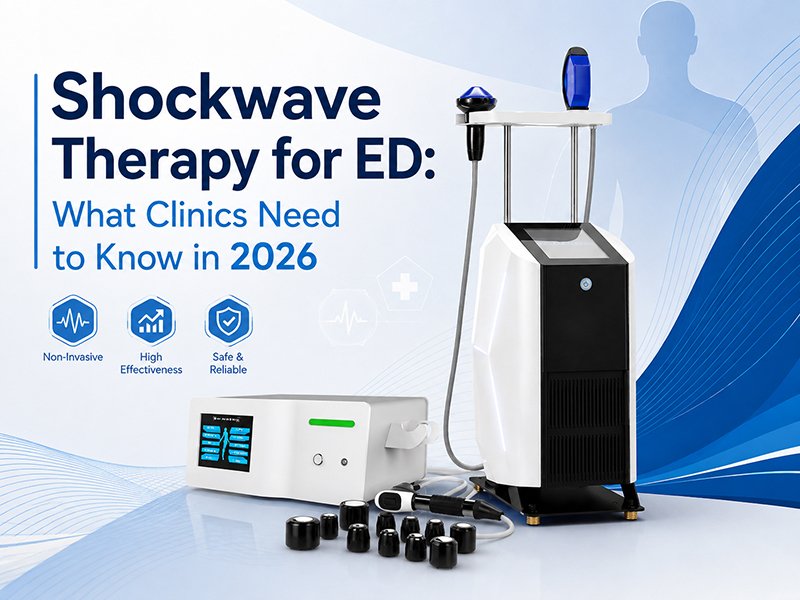
Low-intensity extracorporeal shockwave therapy (Li-ESWT) has become one of the most clinically discussed non-invasive modalities in men’s health in the past five years. For clinic owners evaluating whether to add a shockwave therapy machine to their men’s health or urology service line — and for equipment distributors supplying that market — this guide covers the clinical application landscape, the equipment specifications that matter, the compliance boundaries that cannot be crossed, and the sourcing decisions that separate profitable implementations from costly mistakes.
5 Things Clinic Owners Need to Know
- Li-ESWT for ED applications uses energy densities of 0.05–0.25 mJ/mm² — significantly lower than musculoskeletal-focused shockwave protocols; not all shockwave machines can reach the required low-intensity range with precision
- Focused shockwave is the technology of choice for ED-adjacent applications: it concentrates energy at a defined depth (20–40mm for penile tissue), enabling targeted delivery that radial/pneumatic systems cannot replicate
- The global men’s health device market is projected to exceed $4.2 billion by 2028 — ED-adjacent shockwave applications represent a growing share of private-pay clinic revenue in the EU and US
- Clinics in most EU and US jurisdictions position Li-ESWT as a wellness application or clinical protocol — not as a disease treatment — to operate within non-medical practitioner scope; always verify local regulatory requirements
- Factory-direct focused shockwave therapy equipment configured for Li-ESWT protocols is available from $4,000–$9,000, versus $50,000–$120,000 for branded Western systems with equivalent specification
What Is Low-Intensity Shockwave Therapy in ED Applications?
Low-intensity extracorporeal shockwave therapy (Li-ESWT) refers to the application of focused acoustic wave energy at low fluence levels to penile tissue. In clinical practice contexts, this protocol is positioned as a non-invasive vascular support application — delivered by trained practitioners using focused shockwave therapy devices capable of operating in the 0.05–0.25 mJ/mm² energy density range.
The physiological rationale is based on the mechanotransduction effect: low-intensity acoustic energy stimulates endothelial cells and local tissue responses that are studied in the context of neoangiogenesis (new blood vessel formation) and nitric oxide pathway activity. Clinical literature in this area has grown substantially since 2012, with multiple randomised controlled trials and systematic reviews published in peer-reviewed urology journals.
Compliance framing that matters: This guide does not present Li-ESWT as a medical treatment for erectile dysfunction as a disease. The content is directed at clinic owners and equipment procurement decision-makers evaluating a clinical application protocol — not at patients seeking medical advice. Any clinic adding Li-ESWT to its service menu must work with local legal and medical regulatory counsel to define how the application is described and marketed in their jurisdiction.
Why Focused Shockwave — Not Radial — for This Application
Not all shockwave therapy equipment is suitable for ED-adjacent protocols. The distinction between radial and focused delivery is clinically decisive for this application.
Radial shockwave generates diverging pressure waves from the applicator surface, with energy density decreasing rapidly with depth. Maximum effective depth is approximately 20–30mm, and energy at depth is substantially lower than at the surface. For penile tissue targeting at 20–40mm depth with precise, reproducible fluence, radial delivery is inadequate.
Focused shockwave concentrates acoustic energy at a defined focal point — adjustable from 0 to 60mm depth on clinical systems. The operator selects the target depth and energy level with precision, delivering reproducible fluence at the intended anatomical location. This is the technology class specified in published Li-ESWT research protocols and the standard referenced in practitioner training programmes for this application.
| Parameter | Radial Shockwave | Focused Shockwave |
|---|---|---|
| Effective tissue depth | 0–30mm | 0–60mm (adjustable) |
| Energy density at depth | Rapidly declining | Maintained at focal point |
| Low-intensity range (0.05–0.15 mJ/mm²) | Difficult to calibrate at depth | Precisely controllable |
| Focal point control | None | Yes — stepwise depth selection |
| Protocol reproducibility | Low at target depth | High |
| Suitability for ED applications | Not recommended | Clinical standard |
For a full technical comparison of radial vs focused shockwave technology, see the Radial vs Focused Shockwave Therapy clinic guide.


Key Equipment Specifications for Li-ESWT Applications
When evaluating shockwave therapy equipment for ED-adjacent protocol delivery, these are the specifications that determine clinical suitability — not brand name or price tag.
1. Low-Intensity Energy Range
The device must be capable of operating accurately and reproducibly in the 0.05–0.25 mJ/mm² range at the focal point. Many musculoskeletal-focused shockwave machines are calibrated primarily for 0.1–0.65 mJ/mm² applications and lack precision at the lower end of the range. Request the manufacturer’s documented output curves across the full energy range, not just rated maximum fluence.
2. Focal Point Depth Adjustment
Published Li-ESWT protocols target penile tissue at 20–40mm depth depending on anatomical location and applicator placement. A system with fixed focal depth cannot accommodate the range of treatment positions required. Confirm that the device offers stepwise focal depth adjustment with a minimum resolution of 5mm increments across the 10–50mm range.
3. Pulse Frequency Control
Protocol standards for Li-ESWT applications typically specify 3–5 Hz frequency settings. A device whose minimum frequency setting starts above this range is not suitable for the application. Verify the full frequency range and that low-frequency settings can be held stable across a treatment session.
4. Applicator Head Geometry
The small-field applicator geometry used for ED applications is distinct from the broad musculoskeletal heads used for shoulder or plantar protocols. Confirm that the system includes — or supports as an accessory — a small-diameter applicator head appropriate for precision anatomical placement.
5. Session Parameter Documentation
Every session delivered in a clinical context should generate a documented output record. Professional-grade shockwave therapy equipment includes session logging with energy level, pulse count, frequency, and focal depth — enabling practitioner records to document the protocol delivered. This is not a cosmetic feature; it is a clinical governance requirement.
The Clinical Protocol Structure
Li-ESWT for ED-adjacent applications follows a structured protocol that is well-documented in the published literature. While specific parameters vary between published studies, the commonly referenced protocol framework is:
| Protocol Element | Standard Range |
|---|---|
| Energy density (focal point) | 0.05–0.25 mJ/mm² |
| Pulses per session | 1,500–3,000 |
| Session frequency | 1–2 per week |
| Total sessions (initial course) | 6–12 |
| Anatomical sites per session | 5–6 positions |
| Applicator type | Small-diameter focused head |
| Break between courses | 4–6 weeks |
Clinics offering this protocol should provide practitioners with a documented protocol card, a patient screening checklist (contraindications include active infection, anticoagulant therapy, penile implants, and active malignancy in the treatment area), and a session record template.
Clinic Business Case: Men's Health as a Revenue Stream
Men’s health services represent one of the fastest-growing private-pay clinic segments in the EU and North American markets. The Li-ESWT application fits the profile of a high-value, recurring-revenue clinic service:
| Metric | Typical Range (EU/NA Private Pay) |
|---|---|
| Session pricing | $200–$500 per session |
| Standard initial course | 6–12 sessions |
| Average course revenue | $1,800–$4,500 per patient |
| Monthly maintenance (optional) | 2–4 sessions per month |
| Equipment cost (factory-direct focused) | $4,000–$9,000 |
| Break-even (at 5 courses/month) | 1–3 months |
Men’s health clients demonstrate high programme completion rates and strong referral behaviour when outcomes meet their expectations. The repeat engagement model — an initial course followed by optional maintenance sessions — supports both predictable revenue and long-term client relationships.
Sourcing a Focused Shockwave Machine for ED Applications
What to Ask Before You Buy
Q: Does the device reach the required low-intensity energy range (0.05–0.15 mJ/mm²) accurately? Many devices cannot calibrate accurately at the low end. Request energy output documentation, not just rated specifications.
Q: Is the focal depth adjustable to 20–40mm? Fixed-focal-depth devices cannot be repositioned for the range of anatomical sites in a standard Li-ESWT protocol.
Q: Does the system include a small-diameter applicator head? Confirm accessory compatibility before purchase, not after.
Q: What certifications does the device carry? Minimum: CE (EU), FDA 510(k) clearance (US), ISO 13485, MDR compliance. Verify certificate numbers independently.
Q: What is the after-sales support structure? For a men’s health application where practitioner training and protocol documentation are critical, confirm: operator training programme, clinical protocol library, 24/7 technical support, and spare parts lead time.
The MNLT focused shockwave therapy machine covers the full 0.03–0.65 mJ/mm² energy range with adjustable focal depth from 0–60mm, dual-source architecture (focused electromagnetic + radial in one unit), and CE/FDA/MDR/ISO certification. Contact the MNLT clinical team for Li-ESWT protocol documentation and configuration details.
FAQ: Shockwave Therapy for ED — Clinic Equipment Guide
What energy settings does a shockwave machine need for ED applications?
Low-intensity shockwave protocols for ED-adjacent applications use energy densities in the range of 0.05–0.25 mJ/mm² at the focal point. This is significantly lower than the 0.1–0.65 mJ/mm² range used in musculoskeletal shockwave protocols. Not all shockwave therapy machines can calibrate accurately at the low end of this range — many are optimised for higher-output musculoskeletal applications and lack precision below 0.1 mJ/mm². When sourcing equipment, request the manufacturer's documented energy output curve across the full range, including verification at 0.05–0.10 mJ/mm².
Can a radial shockwave machine be used for ED clinic protocols?
Radial shockwave is not the appropriate technology for ED-adjacent applications. Published Li-ESWT research protocols and practitioner training programmes specify focused shockwave delivery — which concentrates energy at a defined focal depth of 20–40mm with reproducible fluence. Radial systems generate diverging pressure waves whose energy density drops rapidly with depth, making precise, consistent delivery at 20–40mm anatomically impossible. Clinics adding Li-ESWT to their service menu should source a focused shockwave therapy device with adjustable focal depth, not a radial/pneumatic system.
How many shockwave sessions are in a standard Li-ESWT course?
The most frequently referenced Li-ESWT protocol structure in published clinical literature specifies 6–12 sessions total, delivered at a frequency of 1–2 sessions per week. Each session delivers 1,500–3,000 pulses across 5–6 anatomical positions. An initial course is typically followed by a reassessment period of 4–6 weeks, after which maintenance sessions (2–4 per month) may be offered. Specific parameters should be established by the clinic's medical director or supervising practitioner based on the individual patient's presentation and response.
What certifications must a shockwave therapy machine have for clinical use?
For clinical deployment in major regulated markets, the minimum certification baseline is: CE marking (EU market access), FDA 510(k) clearance (US market access), MDR compliance (EU Medical Device Regulation — required for clinical-grade positioning in European markets), and ISO 13485 (Quality Management System). For a men's health application specifically, also request the manufacturer's contraindication documentation and clinical protocol library — these are required for responsible clinical governance and practitioner training. Always verify certificate numbers through the issuing body's public registry, not just from the manufacturer's promotional materials.
What is the typical revenue potential of adding Li-ESWT to a men's health clinic?
In EU and North American private-pay markets, Li-ESWT sessions are typically priced at \$200–\$500 per session. A standard 6–12 session initial course generates \$1,800–\$4,500 in gross revenue per patient. Factory-direct focused shockwave equipment for this application costs \$4,000–\$9,000 — meaning break-even at 5 courses per month is achievable within 1–3 months. The repeat-engagement model (initial course + optional maintenance) supports predictable recurring revenue. Men's health clients in this segment also demonstrate strong referral behaviour when their expectations are met, providing additional organic acquisition value.
Reviewed by David Ma
CTO & Chief Engineer, MNLT Laser (Shandong Moonlight Electronics Tech Co., Ltd.) — 19 years in aesthetic device manufacturing. David leads MNLT's R&D team across the full professional aesthetic device portfolio, ensuring all technical content meets the highest standards of accuracy and clinical safety.