
At a Glance
- Both inner ball roller and Endospheres Therapy use compressive microvibration — oscillating spherical pressure — to address cellulite, lymphatic drainage, and body contouring; the core biological mechanism is identical between the two technologies.
- Endospheres Therapy is an Italian branded system sold through exclusive regional licensing; inner ball roller machines from certified manufacturers like MNLT deliver the same mechanism without licensing fees, territory restrictions, or per-session royalty obligations.
- Inner ball roller machines with 3 roller handle sizes (small/medium/large) + an EMS handle provide broader anatomical coverage and dual-modality capability in a single device — Endospheres systems do not include integrated EMS.
- Total first-year cost of entry for Endospheres licensing (equipment + licence fee + mandatory training + proprietary consumables) typically exceeds $25,000–$45,000; factory-direct inner ball roller clinical suites from MNLT cost $6,500–$9,500 with no ongoing licence obligations.
- Both technologies share the same clinical indication set: cellulite (Nürnberger-Müller Grade 1–3), lymphoedema management, localised fat reduction, post-surgical recovery, and sports rehabilitation.
- MNLT inner ball roller machines carry CE/FDA/MDR/ISO 13485 certification — the same regulatory tier as Endospheres — with traceable certificate numbers and 19 years of production experience across 20,000+ clinic installations.
- For clinics building a compressive microvibration treatment menu, factory-direct inner ball roller sourcing achieves the same clinical outcomes at 3–5× lower equipment and operating cost than the Endospheres licensing model.
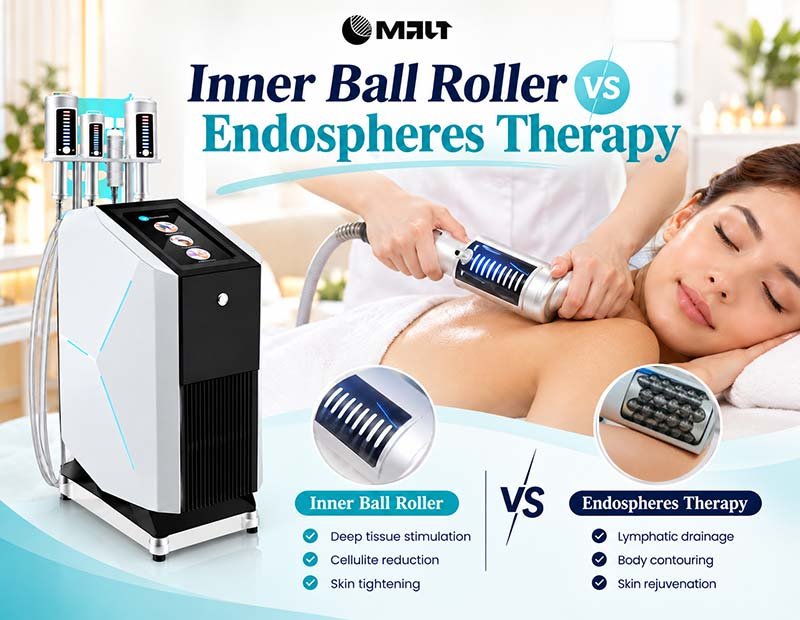
Endospheres Therapy is the most recognisable brand name in compressive microvibration — and for many clinic owners evaluating body contouring and cellulite treatment equipment, it is the first point of reference. But brand recognition is not the same as clinical superiority, and for procurement decision-makers the question is not “which brand is better known” but “which equipment delivers equivalent clinical outcomes at the most favourable total cost of ownership.” This guide compares inner ball roller machines and Endospheres Therapy head-to-head across every dimension that matters for clinic procurement: mechanism, clinical indications, equipment configuration, regulatory compliance, cost structure, and after-sales support.
The Technology: Same Core Mechanism, Different Commercial Models
Endospheres Therapy and inner ball roller technology share the same fundamental operating principle: compressive microvibration delivered through rotating spherical elements applied to the body surface. Both generate the same tissue-level effects:
- Mechanical disruption of fibrous septal adhesions that cause cellulite dimpling
- Stimulation of lymphatic vessel contraction to restore drainage and reduce interstitial fluid accumulation
- Improvement of local microcirculation through repeated capillary compression and release cycles
- Activation of fibroblast activity through mechanical stretch signalling, promoting collagen and elastin remodelling
The Endospheres device uses a roller head containing 60 silicon spheres arranged in a cylindrical pattern. Inner ball roller systems use rotating spherical heads in three diameters (60–80mm, 100–120mm, 140–180mm), enabling zone-specific optimisation across the full body treatment surface.
The biological mechanism is not proprietary to Endospheres — compressive microvibration is a physical principle that any device generating the correct oscillation frequency and pressure can deploy. What Endospheres has built is a brand identity and a licensing distribution model around a technology that factory-direct manufacturers produce to equivalent or superior specification.
For a detailed explanation of the compressive microvibration mechanism at the cellular and tissue level, see our inner ball roller compressive microvibration technical guide.
Head-to-Head Comparison: Inner Ball Roller vs Endospheres Therapy
| Dimension | MNLT Inner Ball Roller | Endospheres Therapy |
|---|---|---|
| Core mechanism | Compressive microvibration (oscillating spherical rollers) | Compressive microvibration (60-sphere cylindrical roller) |
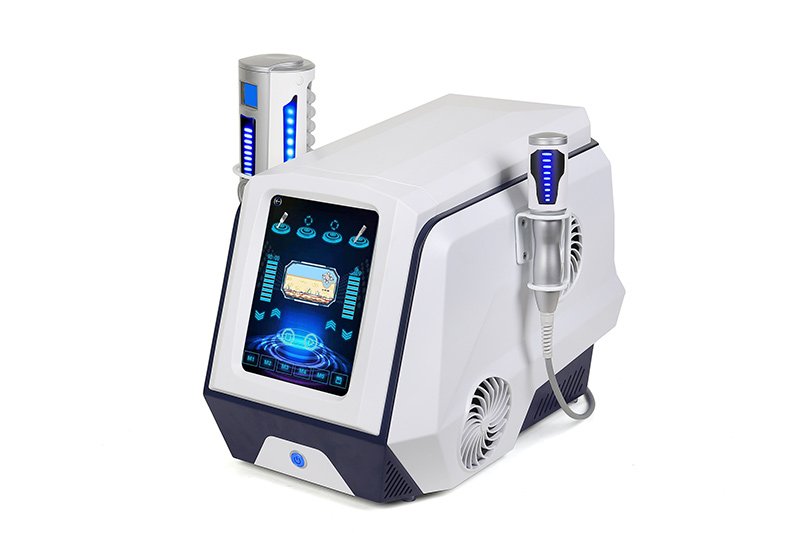
| Roller configurations | 3 sizes: small (60–80mm), medium (100–120mm), large (140–180mm) | Single fixed-configuration roller head |
| EMS capability | Yes — integrated EMS handle included | No |
| 360° rotation | Yes | Yes |
| Real-time pressure sensor | Yes | Varies by model |
| Certification | CE / FDA / MDR / ISO 13485 (all traceable) | CE / MDR (EU registration) |
| Equipment price | 6,500–6,500–9,500 (full clinical suite, factory-direct) | 12,000–12,000–20,000+ (hardware component only) |
| Licensing / territory fee | None | 5,000–5,000–20,000+ (varies by region and contract) |
| Mandatory training fee | Optional / included | 1,500–1,500–4,000 (required for certification) |
| Per-session consumable | Gel only (1–1–3) | Gel + proprietary consumables (variable) |
| Consumable lock-in | No — open market sourcing | Yes — proprietary products required |
| 3-year TCO estimate | 9,000–9,000–13,000 | 30,000–30,000–55,000+ |
| OEM / private label | Yes | No |
| After-sales support | 24/7 manufacturer direct | Through regional licensee |
| Manufacturer experience | 19 years, 20,000+ clinics | Established brand, regional distribution |
Clinical Indications: Where Both Technologies Agree
The clinical indication overlap between inner ball roller and Endospheres Therapy is near-complete — because the mechanism is the same. Both technologies are used in clinical practice for:
Body contouring and cellulite treatment: Nürnberger-Müller Grade 1–3 cellulite is the primary indication for both systems. Compressive microvibration addresses all three structural drivers of cellulite (fibrous septal tethering, lymphatic impairment, fat lobule expansion). For a complete clinical protocol guide covering grade assessment, parameter selection, and session design, see our inner ball roller cellulite treatment clinical guide.
Lymphatic drainage and oedema management: Both technologies are used in post-surgical lymphoedema management (post-liposuction, post-mastectomy), pregnancy-related oedema, and chronic lower limb oedema in appropriate clinical contexts.
Sports rehabilitation and muscle recovery: Both systems are used in high-performance sports medicine contexts for accelerated muscle recovery, DOMS (delayed onset muscle soreness) management, and fascial release. Endospheres has historically been positioned more strongly in elite sports contexts; inner ball roller’s EMS integration gives it an additional muscle stimulation capability that Endospheres lacks.
Localised fat reduction (inch loss): Compressive microvibration is not a lipolytic (fat-destroying) technology — it does not kill fat cells. Both technologies achieve measurable circumference reduction through improved lymphatic drainage, reduced interstitial fluid accumulation, and tissue toning rather than fat volume reduction. This distinction should be communicated clearly to clients regardless of which system is used.
Post-surgical recovery: Both technologies are used to manage post-liposuction fibrosis, reduce swelling, and accelerate tissue healing. This is a high-value clinical application because post-surgical clients represent a captive, motivated patient group with high treatment compliance.
Where Inner Ball Roller Outperforms Endospheres for Clinic Deployment
1. Zone-Specific Roller Configuration
Endospheres’ single roller head configuration is a clinical limitation for practitioners treating the full body. The optimal treatment approach for the gluteal region (large, high-density tissue) differs from the optimal approach for the medial thigh (smaller area, sensitive lymphatic pathways) or the calf (distal drainage endpoint). A single roller diameter cannot be optimised for all three simultaneously.
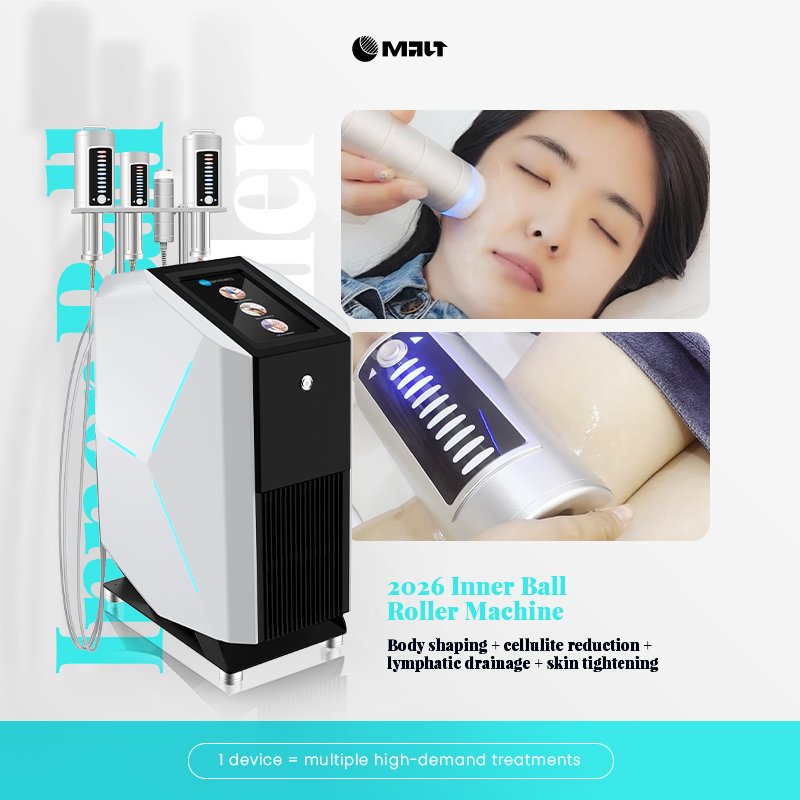
MNLT’s three-roller system — small (60–80mm), medium (100–120mm), and large (140–180mm) — enables the practitioner to select the clinically appropriate head for each zone within a single treatment session. This is not a marginal difference: roller head matching to treatment zone anatomy is a primary determinant of pressure delivery accuracy and treatment consistency.
2. Integrated EMS Capability
The EMS (electrical muscle stimulation) handle included in MNLT’s clinical configuration adds a modality that Endospheres does not offer: targeted neuromuscular stimulation of the muscles underlying the treatment zone. Combined with compressive microvibration in a single session, EMS:
- Improves local vascular return and metabolic activity in treated muscles
- Enhances lymphatic clearance through active muscle pump stimulation
- Produces measurably stronger results for Grade 2–3 cellulite than compressive microvibration alone
- Enables the clinic to offer a premium combination protocol at higher session pricing (150–150–250/session vs 80–80–130/session for single-modality)
An Endospheres clinic that wants to offer EMS combination treatments must invest in a separate EMS device — adding 2,000–2,000–8,000 to equipment cost and requiring separate staff training. MNLT’s integrated configuration eliminates both costs.
3. No Licensing or Territory Restrictions
Endospheres is sold through an exclusive regional licensing model. Depending on your market, this may mean: a mandatory territory licence fee payable to the brand holder, restrictions on your treatment menu (branded vs non-branded protocol naming), minimum session volume requirements, mandatory use of proprietary Endospheres-branded consumables, and potentially a geographic exclusivity arrangement that prevents other clinics in your area from using the same brand.
For independent clinic owners and regional distributors, the licensing model creates commercial dependencies that factory-direct purchasing eliminates entirely. An inner ball roller machine purchased factory-direct from MNLT is an asset you own outright, with no ongoing brand obligations.
4. Total Cost of Ownership
At an estimated 3-year TCO of 9,000–9,000–13,000 (factory-direct MNLT suite) versus 30,000–30,000–55,000+ (Endospheres including licensing, training, and proprietary consumables), the financial case for inner ball roller sourcing is straightforward. The 20,000–20,000–40,000 TCO saving over three years represents additional net revenue that the clinic retains — rather than returning to a brand licensing structure.
Browse the full MNLT inner ball roller range — including configuration options, accessory pricing, and OEM capabilities — on the inner ball roller machine product category page.
Where Endospheres Has Brand Advantages
Acknowledging Endospheres’ genuine commercial advantages is important for a credible comparison:
Brand recognition with consumers: In markets where Endospheres has established consumer awareness (Italy, France, Spain, parts of the UK and Middle East), clients may specifically request “Endospheres” by name. This brand pull can reduce marketing investment for new clinics entering the compressive microvibration category.
Sports medicine prestige positioning: Endospheres has successfully positioned itself in elite athletic and sports medicine contexts, which creates a premium pricing expectation in those market segments.
Training and protocol library: Endospheres’ mandatory training programme — while expensive — provides a standardised clinical protocol library and ongoing support structure that some practitioners find valuable, particularly those new to compressive microvibration techniques.
For clinics where consumer brand recognition is a significant commercial driver and the additional licensing cost is justified by that positioning, Endospheres may remain the right choice. For the majority of clinics prioritising clinical capability, equipment flexibility, regulatory compliance, and total cost of ownership, inner ball roller factory-direct sourcing delivers equivalent or superior outcomes at substantially lower cost.
The Sourcing Decision: MNLT Inner Ball Roller as the Clinical-Grade Alternative
MNLT Laser (Shandong Moonlight Electronics Tech Co., Ltd.) has been manufacturing professional aesthetic and body treatment devices for 19 years, with 20,000+ clinic installations across 120+ countries. The inner ball roller clinical suite is produced in an ISO 13485-certified facility with CE marking, FDA clearance, and MDR compliance — all verifiable through public registries.
Why MNLT is the optimal sourcing choice for clinics evaluating Endospheres alternatives:
- 3 roller handles + 1 EMS handle: the only configuration that matches Endospheres’ indication coverage while adding EMS capability
- CE / FDA / MDR / ISO 13485: full regulatory compliance for EU and North American clinical markets, with traceable certificate numbers
- No licensing, no territory restrictions, no royalties: outright equipment purchase with no ongoing brand obligations
- Factory-direct pricing: 6,500–6,500–9,500 for a complete clinical suite — a 3–5× cost advantage over Endospheres entry
- OEM/private label: custom branding for clinic groups and regional distributors
- 24/7 technical support: global after-sales, remote diagnostics, spare parts availability
- Transparent consumable pricing: gel only (1–1–3/session) — no proprietary consumable lock-in
Inquire Now
Fill out the form for more information, and an MNLT product manager will contact you shortly!
FAQ: Inner Ball Roller vs Endospheres Therapy
Is inner ball roller the same as Endospheres Therapy?
Inner ball roller and Endospheres Therapy use the same core technology — compressive microvibration through rotating spherical elements — and produce the same tissue-level effects: lymphatic stimulation, fibrous septal disruption, and microcirculatory improvement. The biological mechanism is identical. The difference is commercial: Endospheres is an Italian-branded system sold through exclusive regional licensing with mandatory training, territory fees, and proprietary consumable requirements. Inner ball roller machines from certified manufacturers like MNLT deliver the same mechanism without any licensing or royalty structure, with broader roller configuration options (3 sizes vs Endospheres' single roller) and integrated EMS capability.
How much cheaper is an inner ball roller machine compared to Endospheres?
Factory-direct inner ball roller clinical suites (3 roller handles + EMS) from MNLT cost $6,500–$9,500. Endospheres system entry — including hardware, regional licence fee, mandatory training, and year-one proprietary consumables — typically totals $25,000–$45,000 depending on market and contract terms. Over a 3-year ownership period, the total cost of ownership gap widens further: MNLT inner ball roller at $9,000–$13,000 vs Endospheres at $30,000–$55,000+. This $20,000–$40,000 difference represents pure additional clinic revenue — there is no clinical performance justification for the Endospheres premium in equivalent indication contexts.
Does inner ball roller have the same clinical indications as Endospheres?
Yes — the clinical indication sets are near-identical because both technologies use the same compressive microvibration mechanism. Both are used for cellulite treatment (Nürnberger-Müller Grade 1–3), lymphoedema management, localised body contouring, post-surgical recovery (post-liposuction fibrosis and swelling), sports rehabilitation, and muscle recovery. Inner ball roller with EMS capability extends the indication set to include active muscle stimulation protocols that Endospheres, which does not include EMS, cannot deliver as a single-device treatment.
Can I use "Endospheres" as a marketing term if I buy an inner ball roller machine?
No — Endospheres is a registered trademark. Clinics using inner ball roller equipment from other manufacturers cannot market their treatments as "Endospheres Therapy." The appropriate marketing language is "compressive microvibration therapy" or "inner ball roller treatment" — both of which accurately describe the technology and mechanism without infringing the Endospheres trademark. In markets where Endospheres has low consumer awareness, this distinction is commercially irrelevant. In markets where the Endospheres brand has strong consumer recognition, clinics should evaluate whether the licensing cost is justified by the brand pull in their specific geography before making the sourcing decision.
Does the inner ball roller machine have CE and FDA certification like Endospheres?
MNLT inner ball roller machines carry CE marking, FDA clearance, MDR compliance, and ISO 13485 Quality Management System certification — all verifiable through the issuing body's public registries using traceable certificate numbers. This is the same certification tier as Endospheres. Endospheres holds CE and MDR registration for the EU market; MNLT additionally holds FDA clearance for North American clinical deployment. When evaluating any compressive microvibration device, always request specific certificate numbers and verify them independently — a certificate logo on a product page is not verification of current certification status.
What is the advantage of the EMS handle in an inner ball roller machine?
The EMS (electrical muscle stimulation) handle included in MNLT's inner ball roller clinical suite adds neuromuscular stimulation capability that Endospheres does not offer. In a combined session, compressive microvibration addresses the fascial and lymphatic layers while EMS simultaneously activates the underlying musculature — improving venous return, enhancing metabolic clearance of treatment byproducts, and producing stronger results for Grade 2–3 cellulite than either modality alone. The combination protocol also justifies premium session pricing ($150–$250 vs $80–$130 for single-modality), increasing per-session revenue without meaningfully extending treatment time. An Endospheres clinic that wants EMS capability must invest in a separate device; MNLT's integrated configuration eliminates that cost.
What MOQ is available for inner ball roller machines for distributors?
MNLT Laser offers flexible MOQ structures for both direct clinic purchasing and regional distributor wholesale arrangements. For standard stock units (non-OEM), single-unit purchasing is available for clinic evaluation and first distributor orders. OEM/private label configurations — custom branding, packaging, and documentation — carry higher MOQ thresholds depending on customisation scope. For distributors considering inner ball roller as a factory-direct alternative to Endospheres licensing in their territory, MNLT can provide a written proposal covering unit pricing, MOQ, OEM options, lead times, and after-sales support structure. Contact the MNLT commercial team with your target market and volume to receive a detailed proposal.
Reviewed by David Ma
CTO & Chief Engineer, MNLT Laser (Shandong Moonlight Electronics Tech Co., Ltd.)
19 years in aesthetic device manufacturing. David leads MNLT's R&D team across the full professional aesthetic device portfolio, ensuring all technical content meets the highest standards of accuracy and clinical safety.