
- Factory-direct certified shockwave therapy machines typically cost $3,500–$9,000; at $100–$200 per session in EU/NA markets, equipment break-even is achievable in 20–60 clinical sessions — as few as 2–3 weeks at standard clinic volumes.
- Total cost of ownership (TCO) for a shockwave machine over 3 years typically runs $5,500–$14,000 including purchase price, consumables, maintenance, and training — versus $40,000–$80,000 for branded distributor-supplied equivalent systems.
- There are zero per-session consumable costs beyond coupling gel ($1–$3/session) for radial shockwave; focused electromagnetic systems require periodic coil servicing but no per-session disposables.
- A physiotherapy or sports rehabilitation clinic running 5 shockwave sessions per day generates $36,500–$73,000 in annual net revenue at conservative EU/NA session pricing — a 5–10× return on factory-direct equipment investment in year one.
- Hidden ROI factors — patient retention rates, treatment package upsell, and clinic differentiation — consistently add 20–40% to the measurable financial return of a shockwave machine investment when tracked systematically.
- MNLT Laser manufactures CE/FDA/MDR/ISO 13485-certified shockwave therapy machines with 19 years of production experience, dual-source (radial + focused) capability, and global supply to 20,000+ clinics across 120+ countries.
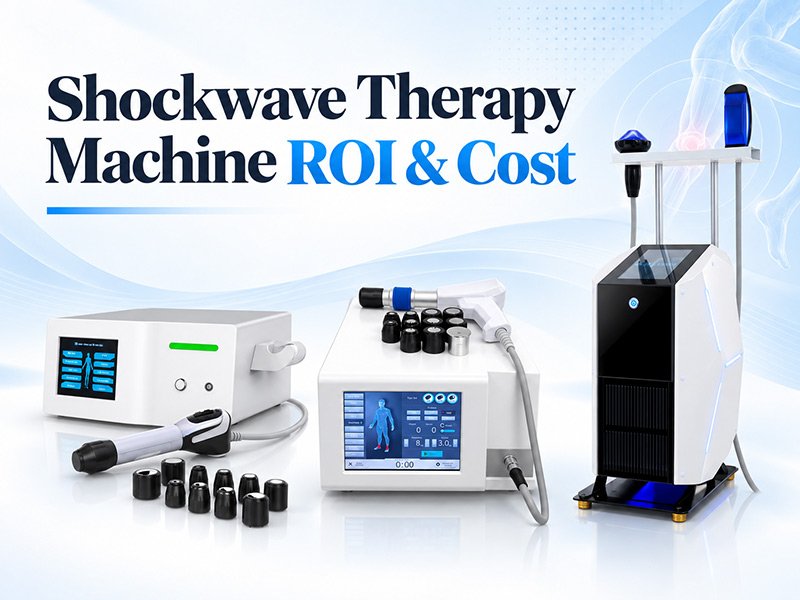
Buying a shockwave therapy machine on clinical evidence alone is not enough to get budget approval — from a practice owner, a clinic group CFO, or a distribution partner evaluating inventory investment. You need numbers: what it costs in total, when it pays back, and what the realistic upside looks like across different usage scenarios. This guide builds that financial case, using real clinic pricing data, verifiable equipment costs, and a break-even model that works for physiotherapy practices, sports rehabilitation centres, and aesthetics clinics alike.
Why You Should Calculate ROI Before You Buy Any Shockwave Machine
Equipment purchasing decisions in clinical settings are frequently made on the basis of technology enthusiasm or peer recommendation — without a structured financial model. This is how clinics end up with equipment that delivers outstanding clinical outcomes but disappoints commercially, because the session volume needed to justify the investment was never modelled against actual booking capacity.
The ROI calculation for a shockwave machine is simpler than most clinic owners expect — but it requires four inputs that must be gathered before any supplier conversation begins:
- Total cost of ownership (not just the purchase price)
- Realistic session volume (based on your current patient flow, not aspirational targets)
- Session pricing (what the market in your geography and clinic tier supports)
- Patient course value (average sessions per patient course × session price)
Get these four numbers right, and the shockwave machine decision becomes straightforward. Get them wrong — particularly by underestimating TCO or overestimating session volume — and even a well-priced machine becomes a financial disappointment.
For context on which clinical indications drive the highest session volumes and repeat-booking rates in sports and rehabilitation settings, see the shockwave therapy machine sports injury clinic guide.
Shockwave Machine Total Cost of Ownership: The Full Picture
The purchase price is the most visible cost but rarely the largest cost over a 3-year ownership period. Here is a complete TCO model for a dual-source (radial + focused) shockwave machine:
| Cost Category | Factory-Direct (Year 1) | Factory-Direct (Year 2–3/yr) | Branded Distributor (Year 1) | Branded Distributor (Year 2–3/yr) |
|---|---|---|---|---|
| Equipment purchase | 5,500–5,500–8,500 | — | 18,000–18,000–35,000 | — |
| Applicator set (radial + focused) | Included | — | 1,500–1,500–3,000 extra | — |
| Training and protocol documentation | Included / 0–0–500 | — | 1,000–1,000–3,500 | 500–500–1,500/yr |
| Coupling gel consumable | 200–200–600/yr | 200–200–600/yr | 300–300–800/yr | 300–300–800/yr |
| Applicator maintenance / replacement | 0–0–400/yr | 300–300–600/yr | 600–600–1,500/yr | 600–600–1,500/yr |
| Annual service / maintenance contract | Optional 0–0–800 | 0–0–800/yr | Mandatory 1,200–1,200–2,500 | 1,200–1,200–2,500/yr |
| 3-Year TCO (mid estimate) | $8,500 | $48,000 |
The 3-year TCO gap between factory-direct and branded distributor sourcing — approximately $39,500 at mid-range estimates — is not a quality difference. It is a distribution margin, brand licensing overhead, and mandatory service contract structure built into the branded model. The underlying hardware, certification, and clinical performance are equivalent.
Revenue Projection by Clinic Type: 3 Scenarios
Shockwave therapy revenue potential varies by clinic type, treatment mix, and market positioning. The following three scenarios use conservative EU/NA session pricing:
Scenario A — Physiotherapy Practice (NHS/insurance billing environment)
- Session price: 80–80–120 (insurance reimbursement or co-pay structure)
- Average sessions per patient course: 4
- Patient course value: 320–320–480
- Target session volume: 4 sessions/day
| Metric | Conservative | Mid-Range |
|---|---|---|
| Daily net revenue (after $2/session gel) | $312 | $472 |
| Annual net revenue (250 days) | $78,000 | $118,000 |
| Year-1 ROI on $7,000 machine | 11× | 17× |
Scenario B — Sports Rehabilitation Clinic (private pay)
- Session price: 120–120–180
- Average sessions per patient course: 5
- Patient course value: 600–600–900
- Target session volume: 5 sessions/day
| Metric | Conservative | Mid-Range |
|---|---|---|
| Daily net revenue | $590 | $890 |
| Annual net revenue (250 days) | $147,500 | $222,500 |
| Year-1 ROI on $8,000 machine | 18× | 28× |
Scenario C — Aesthetics & Wellness Clinic (body contouring + cellulite)
- Session price: 150–150–250
- Average sessions per patient course: 6
- Patient course value: 900–900–1,500
- Target session volume: 3 sessions/day
| Metric | Conservative | Mid-Range |
|---|---|---|
| Daily net revenue | $444 | $744 |
| Annual net revenue (250 days) | $111,000 | $186,000 |
| Year-1 ROI on $7,500 machine | 15× | 25× |
All three scenarios assume the machine is used exclusively for shockwave sessions. In practice, most clinics see utilisation ramp from 40–60% in months 1–3 to 80–90% by month 6 as patient awareness builds and referral networks activate. The figures above represent steady-state utilisation, not month-one performance.
Break-Even Calculator: 3 Usage Scenarios
The break-even point — the number of sessions required to recover the full equipment cost — is the most important single metric for budget approval conversations. The following table models break-even across three usage intensity scenarios for a factory-direct dual-source shockwave machine at $7,500 purchase price:
| Usage Scenario | Sessions/Day | Net Revenue/Session | Sessions to Break-Even | Working Days to Break-Even |
|---|---|---|---|---|
| Low utilisation | 2 | $100 | 75 | ~38 days |
| Standard clinic | 5 | $140 | 54 | ~11 days |
| High volume / multi-practitioner | 10 | $160 | 47 | ~5 days |
Key insight: even at low utilisation (2 sessions per day at 100net),a100net),a7,500 factory-direct shockwave machine achieves break-even in under 40 working days. At standard clinic volume, break-even occurs in approximately 11 working days. No comparable physical therapy or body treatment modality offers this payback speed at this equipment price point.
For comparison, a branded distributor-supplied equivalent at $28,000 requires 280 sessions to break even at the same net revenue per session — approximately 56 working days at standard volume, with the additional burden of mandatory service contracts that begin in year two.
Browse the full range of certified shockwave and physical therapy machines in the MNLT physical therapy machine category to compare radial-only, focused-only, and dual-source configurations before building your financial model.
Hidden ROI Factors: The Numbers Most Clinics Don't Track
The financial models above cover direct session revenue. Three additional ROI dimensions are consistently under-measured by clinic owners — and consistently significant when tracked:
1. Patient Retention and Course Completion Rates
Shockwave therapy patients who experience measurable improvement in sessions 2–3 complete their full course at significantly higher rates than patients receiving manual therapy or exercise-only protocols. Higher course completion rates directly increase revenue per patient acquired — a patient who completes 5 of 5 sessions generates 67% more revenue than a patient who completes 3 of 5.
Clinics that track this metric typically report course completion rates of 78–88% for shockwave patients versus 55–70% for comparable manual therapy courses. At 5 sessions per course and 140netpersession,therevenuedifferencebetween65140netpersession,therevenuedifferencebetween65140 per patient — which compounds significantly at scale.
2. Treatment Package and Combination Protocol Upsell
Shockwave therapy pairs naturally with soft tissue massage, dry needling, exercise rehabilitation, and ultrasound therapy. Clinics that build combination protocols — shockwave + manual therapy, or shockwave + targeted exercise — report 25–40% higher average invoice values per patient visit compared to single-modality sessions. The shockwave component acts as an anchor for a higher-value treatment package without proportionally increasing practitioner time.
3. Clinic Differentiation and New Patient Acquisition
In physiotherapy and sports rehabilitation markets where clinical outcomes are largely equivalent across providers, equipment investment signals quality and capability to referral sources — GPs, orthopaedic consultants, sports coaches, and athletic trainers. Clinics that actively communicate their shockwave capability to referral networks report 15–30% increases in new patient referrals from professional sources within 6–12 months of deployment, compared to pre-deployment baselines.
This referral effect cannot be directly attributed to a session revenue number, but it compounds the financial return of the equipment investment in ways that make the headline ROI figures conservative rather than aspirational.
Why MNLT Factory-Direct Is the Right Source for Your Shockwave Investment
MNLT Laser (Shandong Moonlight Electronics Tech Co., Ltd.) has been manufacturing professional physiotherapy and aesthetic devices for 19 years, supplying 20,000+ clinics across 120+ countries. The shockwave therapy machine range is produced in an ISO 13485-certified facility with CE marking, FDA clearance, and MDR compliance.
The MNLT commercial advantage for the shockwave ROI calculation:
- Factory-direct pricing: 3,500–3,500–9,000 for certified dual-source configurations — 3–4× less than branded distributor equivalents, directly improving your break-even timeline
- Zero mandatory service contract: maintenance is available but not a contractual obligation, keeping year-2 TCO lean
- Full applicator ecosystem included: radial and focused heads in one purchase — no applicator upsell eroding your budget
- Transparent consumable pricing: coupling gel is the only per-session cost; applicator maintenance pricing disclosed pre-purchase
- CE / FDA / MDR / ISO 13485 certified: all traceable through public registries — clinical governance protection at every market tier
- OEM/private label: custom branding for distributor and clinic group partners
- 24/7 technical support: global after-sales, remote diagnostics, spare parts logistics


Inquire Now
Fill out the form for more information, and an MNLT product manager will contact you shortly!
FAQ: Shockwave Therapy Machine ROI & Cost for Clinics
How much does a shockwave therapy machine cost for a clinic in 2026?
Factory-direct certified shockwave therapy machines range from $3,500 for radial-only configurations to $9,000 for full dual-source (radial + focused) clinical systems. Branded distributor-supplied equivalents in the same specification class typically cost $18,000–$35,000 — a 3–4× premium that reflects distribution margins and licensing overhead rather than clinical performance differences. For most clinic procurement contexts, factory-direct purchasing from a CE/FDA/ISO 13485-certified manufacturer delivers the same regulatory compliance and clinical capability at a substantially lower capital cost, directly improving the break-even timeline and year-one ROI.
How quickly does a shockwave therapy machine pay for itself?
At factory-direct pricing of $7,500 for a dual-source shockwave machine and a net session revenue of $140 (after $2 coupling gel cost), a clinic running 5 sessions per day achieves break-even in approximately 11 working days — roughly 2 calendar weeks. At lower utilisation (2 sessions/day at $100 net), break-even is achieved in approximately 38 working days. No shockwave machine — regardless of supplier — changes these fundamentals: the key variables are purchase price, session volume, and net session revenue. Factory-direct sourcing directly reduces the purchase price variable, accelerating break-even at every utilisation level.
What are the ongoing consumable costs for a shockwave therapy machine?
Shockwave therapy has one of the lowest consumable cost profiles of any clinical physical therapy modality. For radial shockwave, the only per-session consumable is coupling gel at $1–$3 per session. Focused electromagnetic shockwave systems require periodic coil inspection and replacement (typically every 12–24 months at clinical volume) but have no per-session disposable. There are no cartridges, patches, or treatment pads. At 5 sessions per day, annual coupling gel cost is approximately $250–$750 — less than 10% of the equipment purchase price. This near-zero consumable structure is the primary driver of the exceptional gross margin profile shockwave therapy delivers compared to RF, laser, or ultrasound platforms.
What certifications should a shockwave therapy machine have for clinical use?
The minimum certification baseline for a shockwave therapy machine deployed in regulated clinical markets is CE marking (EU), FDA clearance (US), MDR compliance (EU Medical Device Regulation — required for clinical-grade positioning in European physiotherapy and medical aesthetics practices), and ISO 13485 Quality Management System certification. Request traceable certificate numbers — not certificate images — and verify each through the issuing body's public registry. From an ROI perspective, certification traceability also protects your clinic's professional liability position and insurance coverage for the device's use in patient treatment.
What is the 3-year total cost of ownership for a shockwave therapy machine?
For a factory-direct certified dual-source shockwave machine, 3-year total cost of ownership (TCO) is approximately $8,500–$12,000, comprising: $5,500–$8,500 equipment purchase price, $600–$1,800 in coupling gel over 3 years (at standard clinical volume), $0–$1,800 in applicator maintenance, and $0–$2,400 in optional service contract costs. For branded distributor-supplied equivalents, 3-year TCO typically runs $40,000–$55,000, including higher purchase price, mandatory training fees, mandatory annual service contracts, and proprietary consumable mark-ups. The TCO gap — approximately $35,000 over 3 years — represents pure additional return on the factory-direct purchase decision.
What is the MOQ for buying shockwave therapy machines for distribution?
MOQ varies by supplier and configuration. For standard stock units (non-OEM), many factory-direct manufacturers including MNLT Laser offer single-unit or low-MOQ purchasing for clinic evaluation and first-order distributor purchases. OEM/branded configurations carry higher MOQ thresholds to cover customisation costs. For regional distributors building a shockwave product line, MNLT supports volume pricing structures with committed delivery timelines. Contact the MNLT commercial team with your target volume, market geography, and OEM requirements to receive a written pricing proposal with MOQ detail.
What session pricing should I model when calculating shockwave therapy ROI?
Session pricing for shockwave therapy varies by clinic type and geography. In EU and North American markets: physiotherapy practices with insurance billing typically price sessions at $80–$120; private-pay sports rehabilitation clinics charge $120–$180 per session; aesthetics and wellness clinics offering body contouring or cellulite protocols price at $150–$250 per session. For ROI modelling purposes, use the conservative end of your market's range for break-even calculation and the mid-range figure for year-one projection. Avoid using aspirational pricing that does not reflect your current or near-term patient mix — conservative modelling produces a financial case that withstands management scrutiny.
Reviewed by David Ma
CTO & Chief Engineer, MNLT Laser (Shandong Moonlight Electronics Tech Co., Ltd.)
19 years in aesthetic device manufacturing. David leads MNLT's R&D team across the full professional aesthetic device portfolio, ensuring all technical content meets the highest standards of accuracy and clinical safety.