




At a Glance
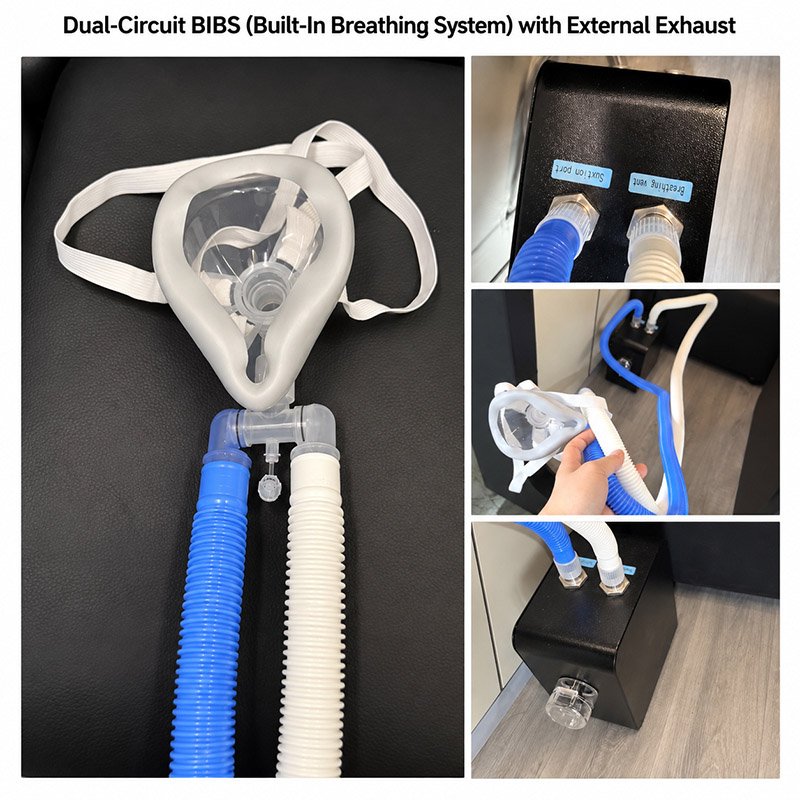
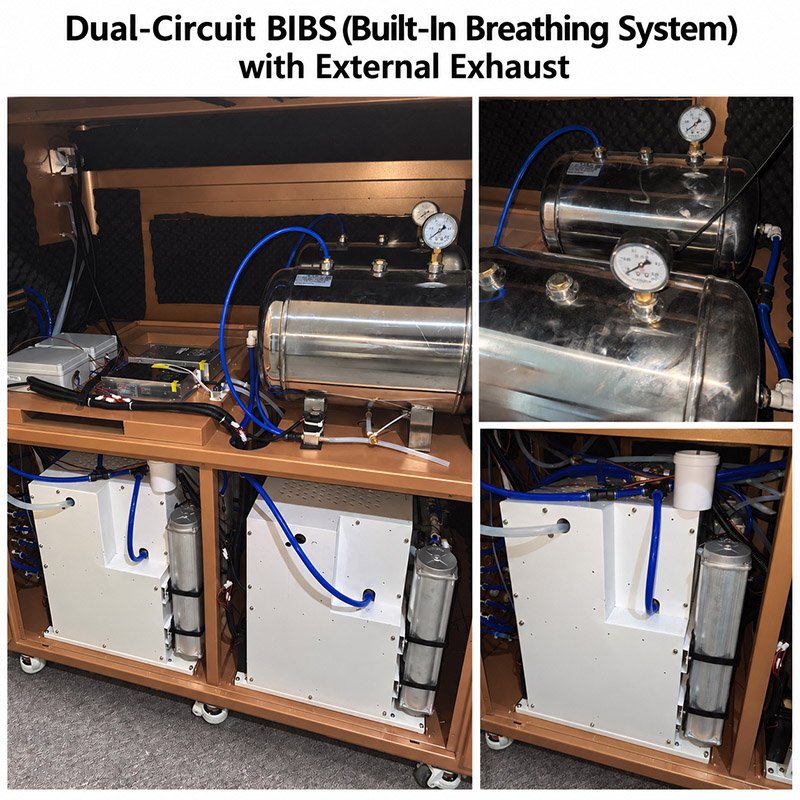
- A Built-In Breathing System (BIBS) is a dual-circuit mechanical assembly that delivers 95%–100% medical-grade oxygen directly to patient airways via a sealed oronasal mask while routing 100% of exhaled gas outside the chamber hull.
- Unregulated chambers that flood the ambient vessel with oxygen quickly surpass the critical 23.5% environmental oxygen threshold, exponentially elevating combustion velocities and violating fundamental NFPA 99 and ASME PVHO life-safety codes.
- By pressurizing the chamber interior with clean compressed air while isolating pure oxygen delivery to the closed BIBS loop, ambient oxygen concentrations remain safely between 20.9% and 23.0%, eliminating explosive flash-fire hazards.
- BIBS dual-stage demand and exhaust regulators prevent hypercapnia (carbon dioxide rebreathing) by maintaining unidirectional flow with negative exhaust bias, protecting patients against respiratory acidosis.
- The system enables seamless, instant "air breaks" during extended hyperbaric protocols without altering vessel pressure, mitigating Central Nervous System (CNS) oxygen toxicity and retinal oxidative stress.
- MNLT Laser engineers clinical hard-shell and semi-rigid hyperbaric oxygen chambers featuring medical-grade dual-line BIBS manifolds, supported by CE, FDA, and ISO 13485 manufacturing certifications backed by 19 years of engineering excellence.
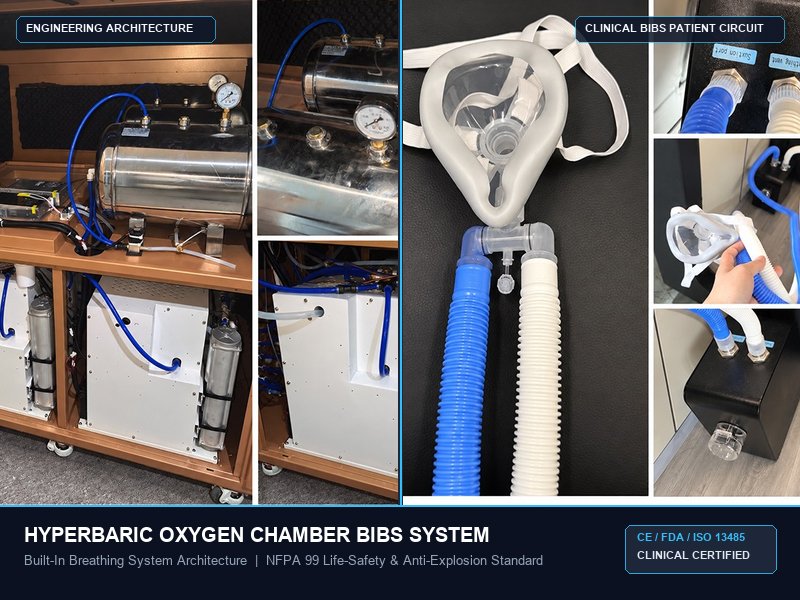
Hyperbaric Oxygen Therapy (HBOT) has transitioned from specialized naval decompression medicine and hospital wound-care centers into the mainstream vanguard of longevity medicine, functional neurology, sports performance, and elite post-surgical recovery. As commercial wellness clinics, biohacking suites, and regenerative physical therapy practices invest heavily in hyperbaric infrastructure, the technical specifications separating clinical-grade equipment from dangerous consumer approximations have become paramount. Among all engineering sub-assemblies, none is more critical to life safety, regulatory compliance, and therapeutic efficacy than the Built-In Breathing System (BIBS). While low-cost chamber suppliers cut manufacturing corners by flooding open chamber vessels with ambient oxygen, world-class medical manufacturers adhere to international safety codes (NFPA 99, ASME PVHO-1) by decoupling vessel pressurization from patient oxygen delivery. This engineering and clinical safety guide breaks down the fluid mechanics of BIBS technology, analyzes fire risk thresholds, examines hypercapnia mitigation, and details why professional clinics must mandate dedicated BIBS architecture when acquiring hyperbaric systems in 2026.
The Physics of Hyperbaric Combustion: The 23.5% Oxygen Threshold
To understand why BIBS is non-negotiable in commercial and clinical operations, facility directors must first grasp the physical chemistry of pressurized oxygen environments.
The Fire Triangle in Hyperbaric Spaces
Combustion requires three elements: fuel, heat (ignition source), and an oxidizer. In standard atmospheric conditions (1.0 ATA, 20.9% O2), common materials like cotton scrubs, hair oils, synthetic mattress covers, and silicone seals require substantial ignition energy to sustain a flame.
However, in an enriched hyperbaric environment, the physical properties of fire change drastically:
- Accelerated Flame Propagation Velocity: When ambient oxygen concentrations exceed 23.5% by volume, the ignition energy required to initiate combustion drops exponentially. Materials considered flame-retardant at atmospheric pressure ignite instantly and burn with explosive, blowtorch-like velocity.
- Elevated Partial Pressure of Oxygen (PO2PO2): According to Dalton’s Law, total pressure is the sum of the partial pressures of individual gases. In a chamber pressurized to 1.5 ATA or 2.0 ATA, even a modest rise in oxygen percentage dramatically increases the absolute number of oxygen molecules per cubic centimeter, supercharging chemical oxidation rates.
The Fatal Flaw of Ambient Oxygen Flooding
In rudimentary or low-cost chambers lacking a BIBS circuit, an oxygen concentrator or liquid oxygen cylinder pumps O2 directly into the open chamber cavity. As the occupant breathes and exhales within this enclosed volume, the ambient environment rapidly becomes an oxygen-enriched trap, often reaching 30% to 50% O2 concentration within 20 minutes of operation.
In this state, a static electricity discharge from synthetic clothing, a dropped electronic accessory, or friction from a zipper can initiate a catastrophic, non-survivable flash fire. For this reason, the National Fire Protection Association (NFPA 99, Chapter 14 – Hyperbaric Facilities) strictly mandates that ambient chamber oxygen concentrations must never exceed 23.5% in human-occupied vessels without specialized deluge safety suppression.
[Ambient Flooding Model (Dangerous)]
Oxygen Source ──▶ Open Chamber Cavity (Ambient O2 > 23.5% ──▶ Extreme Fire Hazard)
▲
│ Exhaled O2 + CO2 accumulates inside hull
[Closed BIBS Manifold Model (Safe)]
Compressed Air ──▶ Pressurizes Chamber Hull (Ambient O2 remains 20.9%–22.5%)
│
Medical O2 ────▶ BIBS Inhalation Line ──▶ Sealed Patient Mask
│
Exhaled O2 + CO2
│
Overboard Dump ◀── BIBS Exhaust Line ◀─────────┘ (100% Routed Outside Hull)
By utilizing a dedicated BIBS assembly, the chamber hull is pressurized exclusively with clean, filtered compressed ambient air, while pure oxygen is delivered through an isolated internal pipeline directly into an oronasal mask. Exhaled gases are routed via a secondary exhaust line straight out of the chamber hull, ensuring the interior cabin oxygen concentration remains virtually identical to fresh outdoor air (21.0% to 22.5%).
Eliminating Hypercapnia: The Mechanics of Exhaled Gas Scavenging
The secondary physiological danger in enclosed hyperbaric chambers is the accumulation of carbon dioxide (CO2CO2), medically known as hypercapnia.
The Mechanics of C O 2 CO 2 Poisoning in Confined Chambers
A resting adult human exhales approximately 200 to 250 mL of pure carbon dioxide per minute, a figure that increases under anxiety or physiological stress. In a sealed 1,500-liter chamber volume without active scavenging:
- Ambient CO2CO2 levels rise steadily, surpassing 0.5% (5,000 ppm) within 30 to 45 minutes.
- As inspired CO2CO2 levels climb, the patient’s arterial carbon dioxide tension (PaCO2PaCO2) increases, triggering respiratory acidosis.
- Clinical Symptoms: Patients experience throbbing frontal headaches, lightheadedness, tachypnea, nausea, and acute claustrophobia—symptoms frequently misattributed by inexperienced operators to “detoxification reactions” or barotrauma, when in reality they stem from acute carbon dioxide toxicity.
How BIBS Prevents Rebreathing
A medical-grade BIBS oronasal mask incorporates a precision dual-stage demand and exhaust regulator assembly:
- Inhalation Demand Valve: Responding to minimal negative inspiratory effort (less than 2 cm H2OH2O of water column pressure), the demand valve opens to provide high-flow, 100% oxygen on demand.
- Exhaust Dump Valve with Negative Bias: Upon exhalation, positive pressure instantly seals the inhalation port and opens the exhaust diaphragm. The exhaled breath—saturated with moisture, carbon dioxide, and residual oxygen—is forced into an isolated overboard dump line.
- Differential Pressure Balancing: Advanced BIBS systems utilize an external vacuum regulator or balanced exhaust block to ensure that the pressure inside the exhaust line matches the ambient chamber pressure minus a slight negative bias (approximately 1 psi lower than chamber atmosphere). This differential ensures effortless exhalation for the patient without risking mask implosion or ambient leakage.
Clinical Optimization: Seamless Air Breaks & Toxicity Mitigation
Beyond foundational life safety, the Built-In Breathing System is an essential tool for achieving peak therapeutic outcomes while protecting neurological structures.
Preventing Central Nervous System (CNS) Oxygen Toxicity
While hyperbaric oxygen therapy stimulates angiogenesis, upregulates sirtuins, and mobilizes stem cells, prolonged exposure to high partial pressures of oxygen (PO2>1.4 ATAPO2>1.4 ATA) generates reactive oxygen species (ROS) in cerebral tissue. Left unchecked, this can provoke CNS Oxygen Toxicity (the Paul Bert Effect), which manifests through early warning signs known by the clinical mnemonic VENTIDC:
- V: Visual disturbances (tunnel vision, blurring)
- E: Ear symptoms (tinnitus, sound distortion)
- N: Nausea and spasmodic vomiting
- T: Twitching (facial muscles, lips, eyelids)
- I: Irritability, confusion, or sudden personality shifts
- D: Dizziness and vertigo
- C: Convulsions (generalized grand mal seizures)
The Role of "Air Breaks"
To arrest the biochemical accumulation of neurotoxic free radicals, clinical hyperbaric protocols mandate scheduled “air breaks.” For example, in a standard 90-minute treatment at 2.0 ATA, a patient breathes 100% oxygen for 20 minutes, followed by a 5-minute break breathing ambient chamber air, repeated for three full cycles.
In a chamber equipped with a BIBS manifold, executing an air break is instantaneous: the practitioner toggles a gas selector valve or the patient simply removes the sealed mask to breathe the compressed ambient air filling the chamber. In an ambient-flooded chamber, an air break is physically impossible without performing a complete emergency decompression cycle, venting all gas, and re-pressurizing—wasting time, electricity, and vast quantities of oxygen while causing severe patient ear discomfort.
For clinics integrating hyperbaric medicine alongside physical therapy, contrast thermal therapy, and non-invasive body contouring, explore our complete physical therapy and wellness equipment portfolio.
Architectural Comparison: BIBS Closed-Circuit vs. Ambient Open Flooding
Medical directors evaluating capital purchases must weigh the structural and operational differences between these two hyperbaric methodologies:
| Engineering & Safety Dimension | Dedicated Dual-Line BIBS Architecture | Open Ambient Chamber Flooding |
|---|---|---|
| Ambient Vessel Oxygen Level | Maintained safely between 20.9% and 22.5% | Uncontrolled escalation to 30%–50%+ |
| Fire & Flash Deflagration Risk | Negligible (ambient atmosphere remains non-enriched) | Catastrophic (violates NFPA 99 Chapter 14 safety limits) |
| Inspired Oxygen Concentration ($FiO_2$) | 95% – 100% medical oxygen delivered at mouth/nose | Diluted (variable 24%–40% depending on chamber volume) |
| $CO_2$ Retention & Hypercapnia Risk | Zero (100% of exhaled gas routed through overboard dump) | High (exhaled $CO_2$ recirculates within the enclosed hull) |
| Seamless Clinical Air Breaks | Instantaneous via selector valve or mask removal | Impossible without total chamber decompression |
| Oxygen Consumption Efficiency | High (oxygen consumed only on tidal inhalation demand) | Extremely wasteful (must fill thousands of liters of hull) |
| Permitted Patient Clothing & Materials | Standard comfortable apparel (cotton preferred) | Strict 100% anti-static hospital gowns; zero personal items |
| ASME PVHO & NFPA 99 Regulatory Auditing | Fully compliant for commercial & clinical licensing | Fails commercial inspection in regulated health markets |
MNLT Hyperbaric Oxygen Chamber BIBS System Demonstration Video
Regulatory Compliance: NFPA 99, ASME PVHO-1, and Global Standards
Operating a hyperbaric facility without documented compliance to international life-safety standards exposes clinic owners to catastrophic liability, loss of operational licenses, and insurance nullification in the event of an incident.
| Standard / Code Body | Key Technical Requirement | BIBS Engineering Compliance Mandate |
|---|---|---|
| NFPA 99 (Chapter 14) | Limits human-occupied chamber atmosphere to <23.5% oxygen by volume unless equipped with rapid water deluge fire suppression. | Mandates overboard dump circuit to exhaust oxygen directly outside the room or facility envelope. |
| ASME PVHO-1 | Pressure Vessels for Human Occupancy: structural integrity, acrylic viewport impact resistance, and penetrator port safety. | Penetrator bulkheads for oxygen supply and exhaust lines must be certified to withstand 1.5× working pressure without leakage. |
| ISO 13485 | Medical Device Quality Management System governing component cleanliness, assembly cleanrooms, and traceability. | BIBS tubing, valves, and masks must be cleaned and packaged in certified oxygen-clean environments free of hydrocarbons. |
| CGA G-4.1 | Compressed Gas Association standard for cleaning equipment for oxygen service (eliminating combustible hydrocarbons/grease). | All internal brass, stainless steel, and medical silicone components in the BIBS manifold must undergo ultrasonic degreasing. |
| EU MDR / CE Class IIb | European Medical Device Regulation for pressurized therapeutic systems delivering high-fraction medicinal oxygen. | Requires documented clinical safety files and third-party notified body audit of pressure regulation and exhaust failsafes. |
To evaluate the operational space requirements, pressure capabilities, and clinical sizing considerations between soft-sided recovery chambers and clinical hard-shell platforms, study our comprehensive hyperbaric oxygen chamber wellness center guide.
Operating Economics: The Cost Savings of Dedicated BIBS
While clinical safety is the primary motivation for BIBS engineering, the operational financial metrics provide an overwhelming business case for commercial facility operators:
- Reduced Oxygen Generation Infrastructure: Filling a 1,800-liter hard chamber to 90% oxygen concentration requires massive oxygen supply networks (either industrial cryogenic liquid oxygen Dewars or power-hungry 40 L/min PSA oxygen plants). With a BIBS system, the chamber hull is pressurized by an energy-efficient ambient air compressor, while oxygen is supplied strictly at the patient’s minute-ventilation rate (typically 8 to 12 L/min during quiet respiration).
- Extended Chamber Component Lifespan: Continually saturating chamber electronics, communication microphones, viewing acrylics, and structural seals in high-concentration oxygen causes rapid polymer degradation, embrittlement, and optical yellowing. Air-pressurized chambers with BIBS run cleanly for decades with minimal maintenance.
- Reduced Insurance Premiums: Commercial property and medical malpractice underwriters heavily scrutinize hyperbaric facilities. Demonstrating compliance with NFPA 99 via an air-pressurized BIBS system drastically lowers facility insurance premiums compared to high-risk ambient oxygen installations.
MNLT Hyperbaric Engineering: Dual-Line BIBS Clinical Chambers
For over 19 years, MNLT Laser (Shandong Moonlight Electronic Technology Co., Ltd.) has engineered and manufactured precision medical-grade aesthetic and physical rehabilitation systems for more than 20,000 clinics across 120 countries.
- Aircraft-Grade Structural Engineering: MNLT hard-shell hyperbaric oxygen chambers are fabricated from heavy-gauge marine-grade aluminum and aerospace alloys, hydrostatically pressure-tested to exceed ASME PVHO standards.
- Dual-Line Medical BIBS Manifold: Precision brass and medical-grade silicone delivery assemblies with pneumatic overboard dump valves, ensuring effortless exhalation mechanics and guaranteed isolation of exhaled gases.
- Automated Ambient Air Pressurization: Quadruple-filtered, oil-free silent scroll compressors manage cabin pressurization up to 1.5–2.0 ATA, equipped with dual mechanical pressure relief valves and pneumatic manual decompressors.
- Semi-Rigid Portable Configurations: For decentralized sports recovery suites and concierge medical practices, MNLT engineers the portable hyperbaric oxygen chamber with reinforced composite polymer hulls and modular BIBS integration.
- Complete Regulatory Dossier: Comprehensive manufacturing compliance backed by CE, FDA, and ISO 13485 certifications with verified, traceable test certificates.
Review full technical schematics and vessel configurations on our physical therapy and hyperbaric portfolio page, or contact MNLT’s medical engineering team today for detailed chamber blueprints, technical specifications, and factory-direct procurement support.
Inquire Now
Fill out the form for more information, and an MNLT product manager will contact you shortly!
Frequently Asked Questions: BIBS Architecture & Hyperbaric Safety
What is a Built-In Breathing System (BIBS) in a hyperbaric oxygen chamber?
A Built-In Breathing System (BIBS) is a specialized dual-pipeline mechanical assembly that supplies high-concentration medical oxygen (95%–100%) directly to a patient's breathing mask while channeling 100% of exhaled gas through a separate overboard dump line outside the chamber hull. This ensures the main chamber volume is pressurized safely with ambient air, preventing dangerous oxygen enrichment and carbon dioxide accumulation within the cabin.
Why is ambient oxygen flooding considered a severe fire hazard in hyperbaric chambers?
When pure oxygen is pumped directly into an open chamber volume, the interior oxygen concentration rapidly surpasses the critical 23.5% threshold defined by the National Fire Protection Association (NFPA 99). In an oxygen-enriched, pressurized environment, the ignition energy required to spark a fire drops exponentially, and common materials such as cotton bedding, hair oils, or electronic plastics burn with explosive, non-survivable speed. BIBS prevents this hazard by keeping the ambient chamber air below 23% O2 at all times.
How does a BIBS assembly prevent carbon dioxide poisoning (hypercapnia)?
In an enclosed chamber without an overboard exhaust system, a patient's continuous exhalation accumulates carbon dioxide inside the hull, leading to hypercapnia, severe headaches, and respiratory acidosis. BIBS features a specialized differential-pressure exhaust valve that automatically opens during exhalation, carrying all carbon dioxide and moisture directly out of the chamber hull, guaranteeing that every breath inspired by the patient is fresh, pure medical oxygen.
What are "air breaks" and why are they impossible without a BIBS circuit?
Air breaks are scheduled 5-minute intervals during clinical HBOT where a patient temporarily switches from breathing 100% oxygen to breathing ambient air, resetting oxidative stress and preventing Central Nervous System (CNS) oxygen toxicity. In a BIBS-equipped chamber, an air break is achieved instantly by switching a selector valve or removing the mask while the chamber remains pressurized with air. In a chamber flooded with pure oxygen, an air break is physically impossible without completely venting and decompressing the entire vessel.
What international safety codes require the use of BIBS or overboard dump systems?
The primary regulatory codes governing hyperbaric facilities are NFPA 99 (Health Care Facilities Code, Chapter 14), ASME PVHO-1 (Safety Standard for Pressure Vessels for Human Occupancy), and European Norm EN 14931. These standards strictly limit ambient chamber oxygen concentration to under 23.5% unless elaborate automated water deluge systems are installed, effectively making dual-line BIBS manifolds mandatory for commercial and clinical installations.
Does a BIBS system reduce oxygen operating costs for a wellness clinic?
Yes, significantly. In an ambient-flooded chamber, thousands of liters of medical oxygen must be wasted simply to pressurize and fill the entire interior cabin volume. With a BIBS system, an inexpensive ambient air compressor pressurizes the chamber hull, and medical oxygen is consumed strictly on demand at the patient's metabolic breathing rate (8 to 12 L/min), reducing overall oxygen consumption by over 60%.
Can patients wear normal clothing inside a BIBS-equipped hyperbaric chamber?
Because a BIBS-equipped chamber maintains an ambient oxygen concentration of 20.9% to 22.5% (identical to outdoor atmospheric air), standard comfortable clothing such as 100% cotton apparel can be worn safely. In contrast, chambers that flood the cabin with oxygen require rigorous anti-static procedures, grounding straps, and complete prohibition of personal synthetic garments to prevent catastrophic static ignition.
Reviewed by David Ma
CTO & Chief Engineer, MNLT Laser (Shandong Moonlight Electronics Tech Co., Ltd.)
19 years in aesthetic device manufacturing. David leads MNLT's R&D team across the full professional aesthetic device portfolio, ensuring all technical content meets the highest standards of accuracy and clinical safety.