
5 Numbers That Define 7D HIFU for Clinics in 2026
5 cartridge depths (1.5mm / 3.0mm / 4.5mm / 6.0mm / 9.0mm) in a single MNLT 7D system cover face, neck, and body in one machine investment
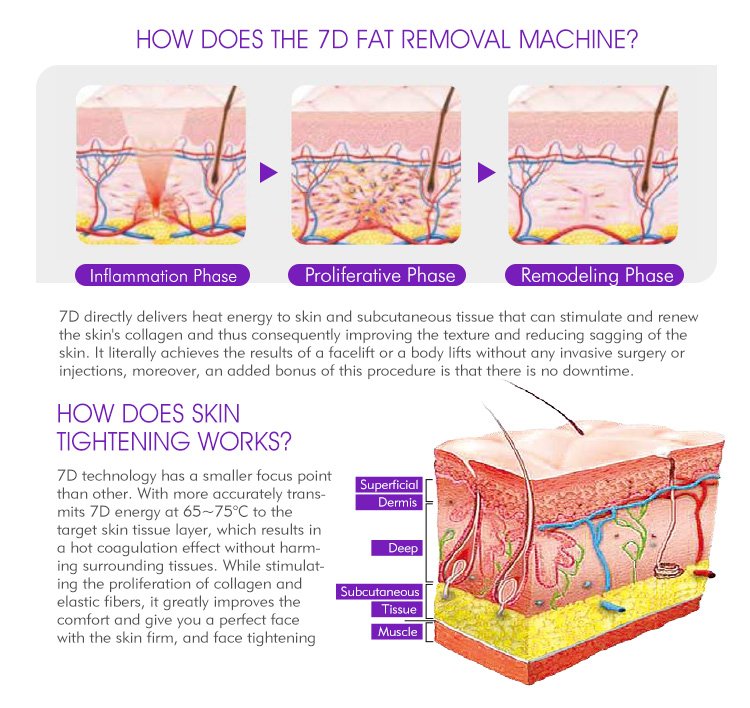
Ultrasound energy creates focal-point temperatures of 65–75°C — the precise range for collagen denaturation and new collagen synthesis without epidermal damage
Clients observe initial tightening immediately; progressive lifting emerges over 2–3 months as neocollagenesis completes
Factory-direct HIFU machine price: $3,000–$8,000; comparable systems from Western aesthetic brands list at $30,000–$60,000+
Single-session pricing in EU and North American markets: $300–$800 for a full-face protocol — most clinics break even within 10–20 sessions
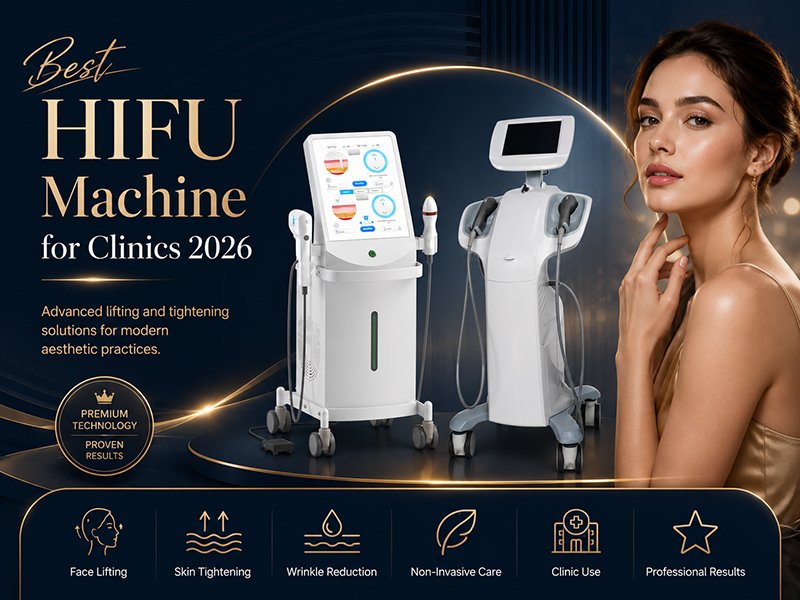
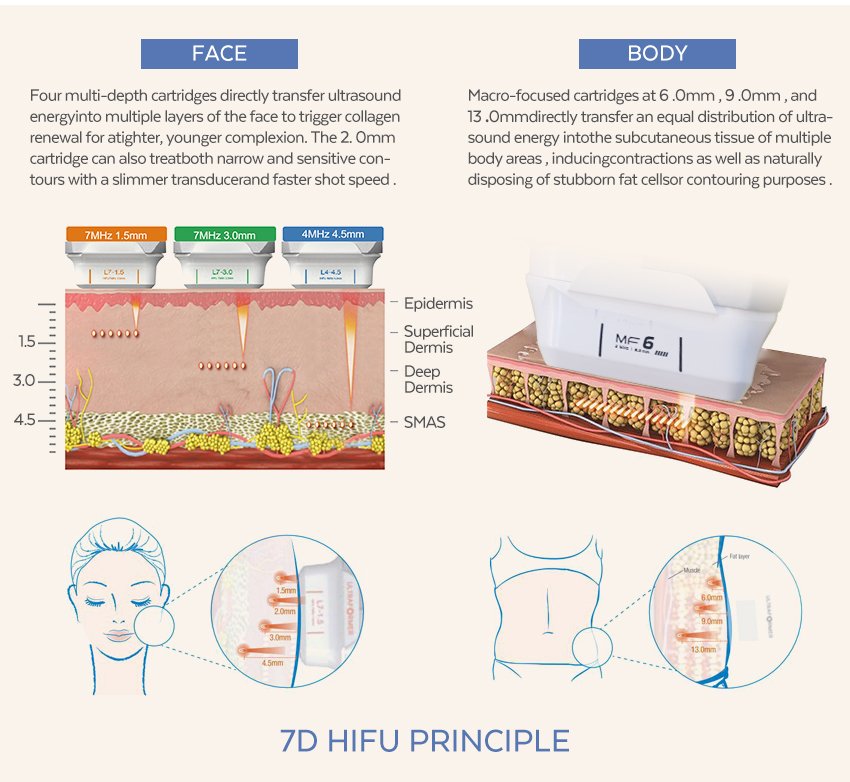
A HIFU machine (High-Intensity Focused Ultrasound) is a non-invasive aesthetic device that delivers concentrated ultrasound energy to precise tissue depths beneath the skin surface, generating controlled thermal coagulation zones that stimulate collagen and elastin synthesis. Unlike surface-level energy devices, a clinical-grade HIFU face lift machine targets multiple structural layers simultaneously — from the epidermis (1.5mm) through the dermis (3.0mm) down to the SMAS layer (4.5mm) — without incisions, needles, or downtime. In 2026, 7D MMFU (Macro & Micro Focused Ultrasound) systems represent the current clinical standard for non-invasive face lifting and body contouring in aesthetic clinics worldwide.
1: How HIFU Technology Works — The Physics Behind Non-Invasive Lifting
Selective Photothermolysis for Structural Tissue
HIFU achieves its results through a mechanism called thermal coagulation: ultrasound waves are focused to a precise point beneath the skin surface, where their energy converges and generates heat at the focal zone. Because the energy passes through overlying tissue layers without heating them, only the targeted depth is affected. This selectivity is what makes HIFU fundamentally different from radiofrequency (RF) devices, which heat tissue conductively from the surface downward.
At the focal point, temperatures reach approximately 65–75°C for a duration of milliseconds. This thermal exposure achieves two simultaneous effects:
Collagen denaturation and immediate contraction: Existing collagen fibres denature at this temperature range, causing immediate mechanical contraction — the sensation of “tightening” clients describe immediately after treatment.
Neocollagenesis (new collagen formation): The thermal injury triggers the body’s wound-healing cascade. Fibroblasts migrate to the site of coagulation and begin synthesising new Type I and Type III collagen over the following 8–12 weeks. This is the mechanism behind the progressive lifting and firmness improvement that clients observe over 2–3 months post-treatment.
Why the SMAS Layer Is Clinically Significant
The SMAS (Superficial Muscular Aponeurotic System) is the fibromuscular layer that connects facial muscles to the overlying skin. Gravitational descent of the SMAS is the primary driver of mid-face volume loss and jowling in the aging face. Surgical facelift procedures address the SMAS mechanically through direct manipulation.
HIFU face lift machines that include a 4.5mm cartridge reach the SMAS layer non-surgically — the defining capability that distinguishes clinical-grade HIFU systems from entry-level devices with only superficial cartridge depths.
2: The 7D MMFU System — What "7D" Means Clinically
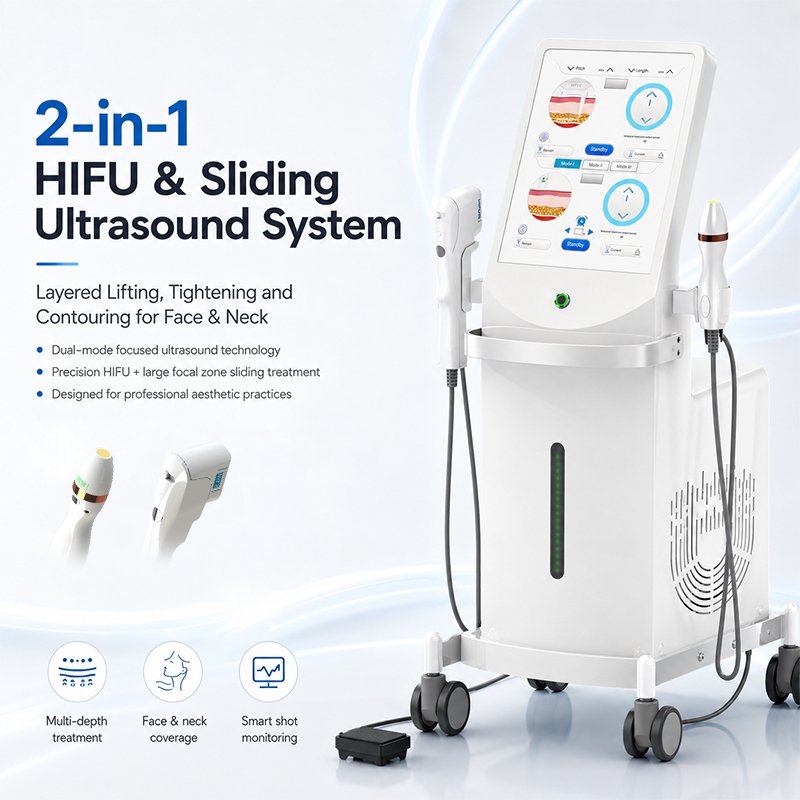
The MNLT 7D HIFU machine uses MMFU (Macro & Micro Focused Ultrasound) — a dual-mode architecture that combines two distinct energy delivery patterns in a single platform:
- Micro-Focused Ultrasound: Precise, small focal zones optimised for facial skin tightening and SMAS targeting. Delivers high energy density to a defined depth with minimal scatter.
- Macro-Focused Ultrasound: Broader focal zones designed for body contouring applications — targeting subcutaneous fat layers at 6–9mm depth for circumferential reduction and skin firmness on larger surface areas.
This dual-mode capability means a single MNLT 7D system supports both facial lifting protocols and body contouring services — eliminating the need for a separate body HIFU machine.
3: Complete Cartridge Guide — Depths, Frequencies, and Clinical Applications
The MNLT 7D HIFU system ships with a comprehensive cartridge range. Understanding which cartridge to use for each treatment scenario is critical for both clinical outcomes and client safety.
| Cartridge | Frequency | Depth | Target Layer | Primary Clinical Use |
|---|---|---|---|---|
| L7 — 1.5mm | 7 MHz | 1.5 mm | Epidermis | Skin texture refinement, fine line improvement, pore appearance |
| L7 — 3.0mm | 7 MHz | 3.0 mm | Dermis | Collagen stimulation, skin tightening, elasticity improvement |
| L4 — 4.5mm | 4 MHz | 4.5 mm | SMAS layer | Facial lifting, jawline definition, jowl reduction |
| MF6 — 6.0mm | 4 MHz | 6.0 mm | Subcutaneous fat (body) | Body contouring, fat layer targeting on abdomen / thighs |
| MF9 — 9.0mm | 4 MHz | 9.0 mm | Deep subcutaneous (body) | Deeper body fat contouring, waist and thigh circumference reduction |
| Sugar / Total Dermis | — | Full dermis | Full dermis layer | Glycation improvement, overall dermis rejuvenation |
| Smart Slim Cartridge | — | Variable | Wider field | Faster full-face coverage, lower per-session consumable cost |
Clinical Cartridge Selection Protocol
For a standard full-face lifting protocol, the recommended sequence is:
1.Begin with the 4.5mm cartridge for SMAS layer stimulation across the lower face and neck
2.Follow with 3.0mm for dermis-level collagen stimulation across cheeks, forehead, and periorbital area
3.Complete with 1.5mm for superficial skin texture refinement, particularly around fine lines
For body contouring sessions, deploy 6.0mm on the abdomen and inner thighs; 9.0mm for the outer thighs and gluteal area where subcutaneous fat is deeper.
4: Clinical Evidence Supporting HIFU for Skin Lifting
Clinic procurement decisions should be grounded in peer-reviewed evidence, not marketing claims.
A 2023 systematic review published in JAMA Dermatology and indexed on PMC (PMC9861614) evaluated the efficacy of Micro-Focused Ultrasound (MFU) for facial skin laxity across multiple controlled studies. The review found that HIFU/MFU treatment improved skin tightness and produced measurable lifting in the lower face, neck, and brow in the majority of study participants, with a favourable safety profile characterised by temporary erythema and mild discomfort as the most commonly reported adverse events.
For regulatory compliance verification, HIFU devices sold for professional clinical use require regulatory clearance in their target markets. You can verify any device’s clearance status through the FDA 510(k) premarket notification database — a critical step before finalising any equipment purchase, regardless of supplier.
5: HIFU Machine vs. RF Skin Tightening — How Clinics Choose
Clinic owners frequently ask whether to invest in HIFU or radiofrequency (RF) for their skin tightening services. The two technologies are not mutually exclusive — but they serve different client needs.
| Dimension | HIFU Machine | RF Skin Tightening |
|---|---|---|
| Energy type | Focused ultrasound (internal focal point) | Radiofrequency (conductive heating from surface) |
| Depth of action | 1.5mm – 9mm (layered, precise) | Surface to ~4mm (gradient) |
| SMAS targeting | Yes (4.5mm cartridge) | No |
| Session frequency | 1 session / 6–12 months | Multiple sessions / 4–6 weeks |
| Suitable skin types | All Fitzpatrick types | All Fitzpatrick types |
| Body applications | Yes (6mm, 9mm cartridges) | Limited |
| Session duration | 60–90 min (full face) | 30–45 min |
| Client suitability | Moderate to significant laxity | Mild laxity, maintenance |
Strategic recommendation for clinics: Position HIFU as the primary annual treatment and RF as a quarterly or monthly maintenance modality. This creates a two-tier service model with different price points and visit frequencies — increasing both client lifetime value and equipment utilisation.
6: Facial vs. Body HIFU — Protocol Differences
Face and Neck Protocol
Indication: Jaw line definition, brow lifting, cheek contouring, neck tightening, periorbital area
Cartridge sequence: 4.5mm → 3.0mm → 1.5mm Energy settings: Adjusted per area — lower settings around the eye contour; higher settings on the neck and lower jaw Session time: 60–90 minutes for full face and neck Treatment frequency: 1 session; repeat assessment at 3–6 months Post-care: No specific downtime; mild redness typically resolves within 2–4 hours
Body Contouring Protocol
Indication: Abdomen, inner/outer thighs, upper arms, buttock lifting, double chin
Cartridge sequence: 9.0mm → 6.0mm (sequence from deepest to superficial) Energy settings: Higher fluence appropriate for the larger tissue volumes in body areas Session time: 40–60 minutes per body zone Treatment frequency: 2–3 sessions spaced 4–6 weeks apart for body areas (more sessions required for circumferential reduction vs. face) Post-care: Mild tenderness in the treated area is normal; no restriction on activity
7: HIFU Machine Pricing and Clinic ROI — 2026 Market Data
Equipment Investment
| System Type | Factory-Direct Price Range | Western-Brand Equivalent |
|---|---|---|
| Entry-level HIFU (3–4 cartridges) | $2,500–$4,000 | $15,000–$25,000 |
| 7D MMFU (full cartridge set) | $4,000–$8,000 | $30,000–$60,000 |
| Portable HIFU | $1,500–$3,000 | $10,000–$20,000 |
Revenue Model
| Scenario | Sessions/Month | Revenue/Session | Monthly Gross | Break-Even (at $6,000 equipment) |
|---|---|---|---|---|
| Conservative | 8 | $350 | $2,800 | ~2.1 months |
| Standard | 15 | $450 | $6,750 | ~27 days |
| Premium Package | 20 | $600 | $12,000 | ~15 days |
Revenue acceleration strategies:
- Sell 3-session packages at $1,200–$1,800 (valued at full single-session pricing) — improves cash flow and reduces booking volatility
- Bundle HIFU face with inner ball roller body contouring as a combination protocol at $500–$700 — leverages existing equipment investment. Read how compressive microvibration therapy complements HIFU in multi-modality clinic workflows
- Annual maintenance session reminders drive predictable repeat business from existing clients
8: Buying Guide — 6 Things to Verify Before Purchasing Any HIFU Machine for Clinics
1. Cartridge Depth Range
A clinical-grade HIFU machine for clinics must include the 4.5mm SMAS cartridge. Systems sold without it cannot target the facial structural layer that drives visible lifting results. Confirm the complete cartridge set included in the purchase price — body cartridges (6mm, 9mm) are often sold separately.
2. Frequency Specifications per Cartridge
Depth and frequency are related but not identical. A 4.5mm cartridge should operate at 4MHz; facial cartridges at 1.5mm and 3.0mm should operate at 7MHz. Mismatched frequency-to-depth ratios indicate either substandard engineering or misleading specifications.
3. Thermal Coagulation Point Temperature
The clinical efficacy of HIFU depends on achieving 65–75°C at the focal point. This is the temperature range that causes collagen denaturation without tissue necrosis. Request the manufacturer’s focal-point temperature specification. Systems that cannot provide this data should be disqualified from clinical procurement.
4. Shot Count per Cartridge and Replacement Cost
HIFU cartridges have a finite shot count before replacement is required. Confirm: (a) rated shots per cartridge, (b) replacement cost, and (c) lead time for cartridge shipment. This is a direct input to your per-session consumable cost calculation.
5. Certification Verification
For EU clinical deployment: CE and MDR compliance. For the US: FDA clearance or 510(k) status. For international distribution: ISO 13485. Request certificate numbers and verify independently through the issuing body’s public database.
6. After-Sales Training and Technical Support
HIFU machines require operator competence in cartridge selection, energy calibration, and contraindication screening. Confirm that the supplier provides: (a) operator training documentation, (b) treatment protocols, and (c) access to technical support post-purchase. A poorly trained operator can both underdeliver results and, in edge cases, cause client discomfort through incorrect cartridge depth selection.
Explore the MNLT HIFU machine range for available configurations and cartridge specifications, or contact the MNLT technical team directly for factory-direct pricing and compliance documentation.
FAQ: What Clinic Buyers Ask Before Purchasing a HIFU Machine
1. What is the difference between a 3D and 7D HIFU machine?
2. How often can clients receive HIFU face lift machine treatments?
3. Is HIFU safe for all skin types and tones?
4. What is the realistic HIFU machine price for a clinic-grade system from a factory-direct supplier?
5. Can a HIFU machine be combined with other aesthetic devices in a single session?
With 15+ years of expertise in optoelectronic and medical aesthetic engineering, David leads MNLT’s R&D team across the full professional aesthetic device portfolio, ensuring all technical content meets the highest standards of accuracy and clinical safety.