
At a Glance
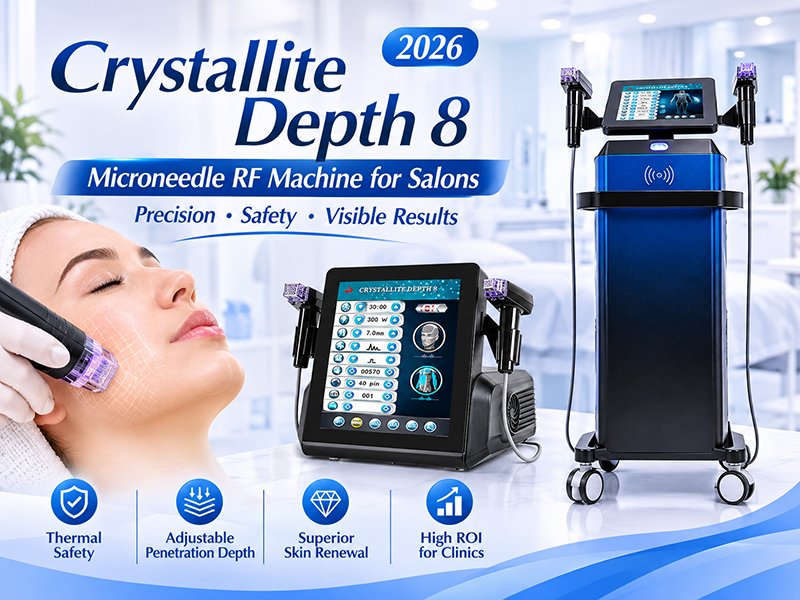
- Crystallite Depth 8 combines programmable 0.5–7 mm mechanical needle penetration with an additional 1 mm radiofrequency thermal diffusion zone, allowing aesthetic practitioners to customize energy delivery across various anatomical layers.
- Insulated needle arrays focus RF coagulation strictly at the exposed needle tip to protect the epidermis, whereas non-insulated needles deliver fractional heating throughout the entire conductive shaft.
- Clinical safety and efficacy depend on a multi-factorial balance: penetration depth, pulse duration, energy density, tissue impedance, and operator pass intervals—not solely on maximum power settings.
- Integrated real-time impedance monitoring dynamically analyzes tissue resistance, helping prevent accidental epidermal burns and uneven dermal heating across curved facial planes.
- Single-use sterile needle cartridges provide clinic operators with a predictable consumable cost structure, enabling transparent per-treatment margin calculation and high hygiene compliance.
- A realistic clinic ROI model demonstrates that operating just 15 to 20 monthly treatment packages allows full capital equipment breakeven within 30 to 60 clinical working days.
- Manufactured by Shandong Moonlight Electronic Technology Co., Ltd. (MNLT Laser) with 19 years of professional aesthetic device manufacturing experience, supporting OEM/ODM housing customization, cleanroom assembly, and global technical training.
A Crystallite Depth 8 system is purchased for one central reason: to deliver controlled radiofrequency energy at a planned tissue depth rather than heating only from the surface. That capability can expand a salon or aesthetic clinic’s menu across texture, enlarged pores, acne-scar appearance, laxity and selected body applications. It also creates a more demanding procurement decision. Maximum depth, needle construction, impedance response, cartridge quality and operator protocols all affect whether the system performs consistently in daily practice.
For buyers, the correct question is not simply, “How deep does it go?” The better question is: Can the machine deliver repeatable energy at the selected depth while giving the operator enough control to manage anatomy, tissue response and thermal accumulation?
This guide explains the engineering behind 0.5–7 mm penetration plus the 1 mm thermal effect, compares insulated and non-insulated cartridges, outlines practical safety controls, models consumable economics and provides a procurement checklist for salons, clinics and distributors evaluating the Crystallite Depth 8 Machine.
How Crystallite Depth 8 Delivers RF Energy Below the Surface
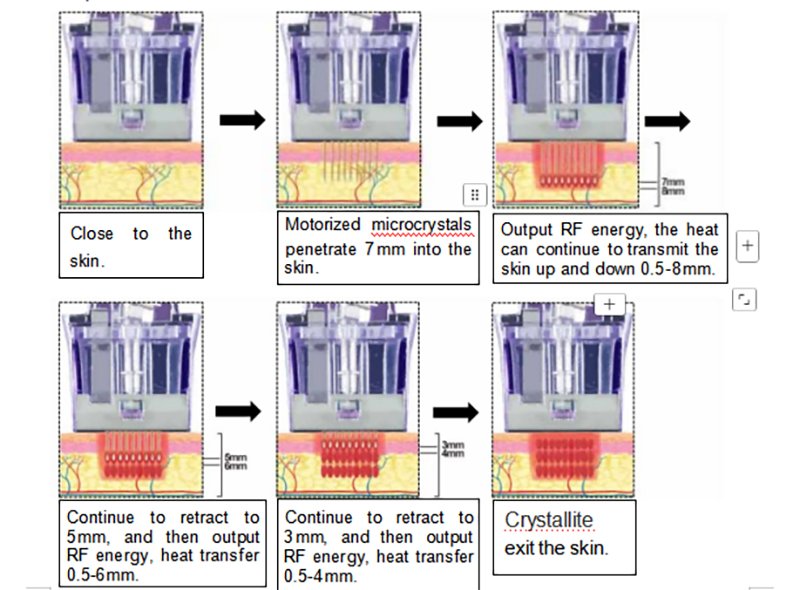
The platform combines two actions in one treatment cycle:
- A motorized handpiece inserts a sterile array of fine electrodes to a selected mechanical depth.
- RF energy passes between or around those electrodes, creating controlled resistance heating in the surrounding tissue.
The needles bypass part of the epidermal barrier, placing energy closer to the intended treatment layer. Tissue resistance converts electrical energy into heat. The resulting thermal zone can initiate a wound-healing response associated with collagen remodeling while the microchannels created by insertion add a separate mechanical stimulus.
This is not a “deeper is better” technology. Different facial and body zones have different epidermal, dermal and subcutaneous thicknesses. The forehead, periorbital area, cheek, jawline, abdomen and scar tissue should not be treated as if they have identical anatomy. Operators must follow local scope-of-practice requirements, manufacturer training, patient assessment and approved protocols.
The machine’s value therefore comes from controlled adjustability: depth selection, energy, pulse timing and cartridge choice should be matched to the indication and tissue zone rather than set to the maximum.
Understanding 0.5–7 mm Penetration Plus the 1 mm Thermal Effect
The stated 0.5–7 mm range describes the programmed mechanical insertion depth. The additional 1 mm refers to the surrounding thermal influence that RF energy may create beyond the needle endpoint. It should not be interpreted as another millimeter of physical needle travel.
For example, a 3 mm insertion setting does not automatically mean a perfectly uniform 4 mm treatment depth. The actual thermal field depends on conductivity, hydration, electrode geometry, delivered power, pulse duration and tissue contact. The “+1 mm” specification is best used as a treatment-planning concept, not as a substitute for clinical endpoint observation.
| Depth Band | Typical Planning Context | Key Safety Consideration | Buyer Evaluation Point |
|---|---|---|---|
| 0.5–1.0 mm | Superficial facial zones and fine texture protocols | Thin anatomy requires conservative energy and careful overlap | Confirm shallow-depth repeatability and stable insertion |
| 1.1–2.5 mm | General facial texture, pores and selected scar protocols | Adjust by facial zone rather than using one full-face setting | Review step increments and parameter memory |
| 2.6–4.0 mm | Thicker cheek, jawline or selected deeper tissue objectives | Thermal stacking rises with passes, density and pulse duration | Test energy stability and contact sensing |
| 4.1–7.0 mm | Qualified professional use on appropriate thicker tissue or body zones | Requires advanced anatomical knowledge and strict protocol control | Verify that maximum depth is usable, stable and supported by training |
| Additional thermal zone | RF diffusion around and beyond the electrode endpoint | Not equivalent to physical penetration; varies with tissue and settings | Ask how the manufacturer validates thermal distribution |
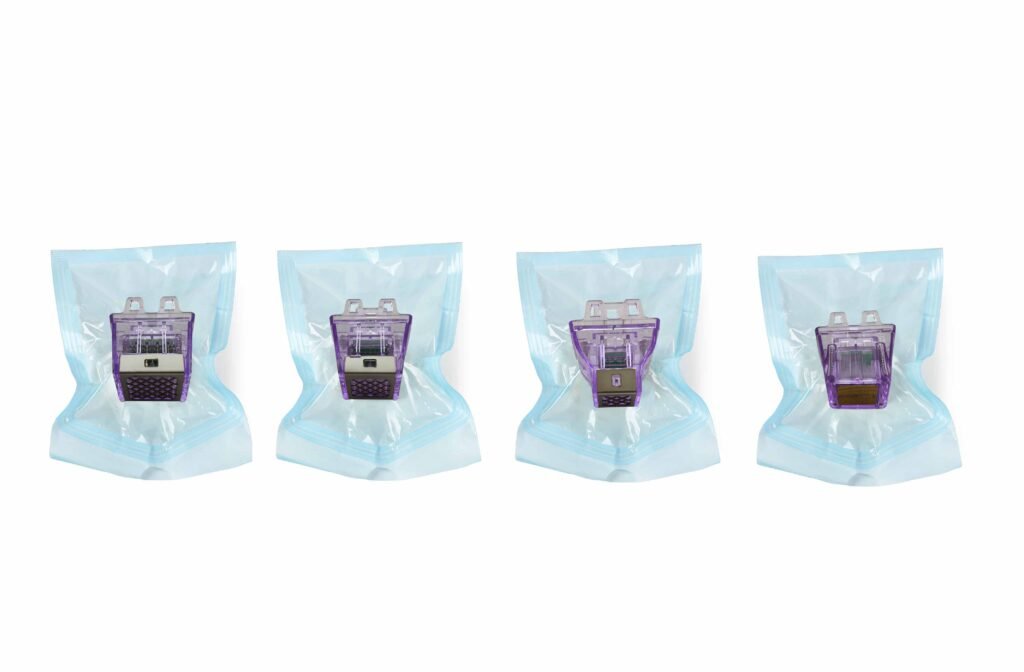
A buyer should confirm whether depth changes occur in precise increments, whether the handpiece inserts consistently across a full cartridge and whether the interface prevents incompatible parameter combinations. Ask the supplier to demonstrate repeated insertions into a suitable test medium at shallow, middle and maximum settings.
Insulated vs. Non-Insulated Needles
Cartridge selection changes where RF energy is released.
Insulated Needles
Most of the shaft is electrically insulated, leaving a conductive section near the tip. Energy is concentrated around that exposed area. This can help limit heating along the upper insertion path and focus the thermal zone deeper in the planned layer.
Insulated cartridges may be selected when the treatment goal calls for more localized endpoint heating or when the operator wants to reduce unnecessary energy deposition closer to the surface. Their performance depends on coating integrity. Damaged or inconsistent insulation can alter the energy pattern, so cartridge manufacturing quality and lot traceability matter.
Non-Insulated Needles
The conductive surface extends along more of the shaft. RF energy can therefore distribute through a broader vertical column. This may suit protocols requiring more diffuse coagulation across the treatment depth, but it also increases the importance of conservative parameter selection and overlap control.
Neither cartridge type should be presented as the answer for every indication. A clinic benefits from having both options only if its operators understand when and why to use them.
| Comparison | Insulated Needle Cartridge | Non-Insulated Needle Cartridge |
|---|---|---|
| Energy release | Concentrated near the exposed electrode tip | Distributed along a larger conductive shaft area |
| Thermal pattern | More localized at the selected endpoint | Broader vertical treatment column |
| Procurement check | Inspect insulation consistency and coating integrity | Verify uniform conductivity and electrode finish |
| Protocol focus | Precise depth-specific energy planning | More distributed treatment across the inserted path |
| Primary caution | Damaged insulation changes the intended energy field | Surface-proximal heating and overlap require close control |
Thermal Safety and Real-Time Impedance Monitoring
RF delivery changes as tissue resistance changes. Hydration, pressure, insertion quality and anatomical location can all influence impedance. A real-time impedance monitoring system gives the operator feedback about electrical contact and resistance during delivery.
Impedance feedback is a safety and consistency aid, not an autonomous clinical decision-maker. It should work alongside:
- Appropriate patient selection and medical history review
- Screening for active infection, impaired healing and other contraindications
- Correct cartridge installation and full tissue contact
- Conservative test settings when indicated
- Zone-specific depth and power selection
- Controlled pass count and overlap
- Observation of immediate tissue endpoints
- Post-treatment instructions and follow-up
Buyers should ask how the machine reacts when impedance falls outside its working range. Does it pause energy, display a warning, log the event or merely show a number? A useful system should communicate clearly enough for the operator to respond without disrupting treatment flow.
Thermal accumulation is also time-dependent. Repeating passes over the same area before heat dissipates can create a different tissue response from a single pass, even when the displayed energy is unchanged. Pin density, pulse duration and treatment speed belong in every protocol discussion.
Clinics comparing this approach with non-invasive tightening should also review the HIFU vs RF Guide 2026, which explains how focal ultrasound and radiofrequency differ in energy delivery and treatment planning.
Patient Assessment and Practical Clinical Workflow
A professional consultation begins before the cartridge is opened. The operator should document the patient’s concern, treatment history, skin condition, healing history, medications and relevant contraindications. Baseline photography should use consistent lighting, angle and distance.
A practical workflow includes:
- Define the treatment objective. Texture, scar appearance and laxity may require different depth and cartridge logic.
- Map anatomical zones. Divide the area by tissue thickness and sensitivity rather than applying one universal setting.
- Select the cartridge. Match insulated or non-insulated construction and pin configuration to the intended energy distribution.
- Set conservative starting parameters. Follow the manufacturer’s training, local clinical rules and patient-specific assessment.
- Monitor contact, impedance and tissue response. Adjust only within the approved protocol framework.
- Record the session. Save depth, energy, pulse duration, cartridge lot and treatment map for reproducibility.
- Schedule follow-up. Evaluate recovery and standardized images before escalating future settings.
Outcomes vary with indication, patient biology, operator technique and course design. Clinics should communicate realistic expectations and avoid promising a fixed result after a fixed number of sessions.

Consumable Economics and Clinic ROI
Single-use sterile cartridges are a necessary direct cost. The relevant commercial question is not whether a cartridge costs money, but whether the system creates a controllable contribution margin without tying the clinic to unpredictable supply.
Before purchase, obtain written answers to these questions:
- What is the clinic price per cartridge by type and pin count?
- Is there a minimum cartridge order?
- What is the production lead time and expiry period?
- Are lots traceable and individually sealed?
- Can the supplier maintain inventory for the installed machine base?
- Does the device recognize authentic cartridges, and are future prices contractually transparent?
Use this formula:
Contribution per treatment = Collected treatment fee − cartridge − topical supplies − practitioner labor − payment fees − allocated marketing cost
| Illustrative Variable | Conservative Case | Base Case | Higher-Utilization Case |
|---|---|---|---|
| Paid treatments per month | 12 | 24 | 40 |
| Collected fee per treatment | $300 | $400 | $500 |
| Illustrative direct cost per treatment | $110 | $120 | $135 |
| Monthly treatment revenue | $3,600 | $9,600 | $20,000 |
| Monthly contribution before fixed overhead | $2,280 | $6,720 | $14,600 |
| Equipment payback formula | Quoted system cost ÷ monthly contribution before fixed overhead | ||
These figures are planning assumptions, not promised outcomes. Replace every input with local prices, actual labor cost, quoted cartridge cost and realistic bookings. Include training time, taxes, financing, maintenance and downtime in the final investment model.
For clinics and distributors comparing configurations, the Crystallite Depth 8 Series provides the appropriate starting point for matching handpiece and cartridge options to the intended service menu.

💬 Speak Directly with an RF Equipment Specialist
Need instant wholesale pricing, sterile cartridge quotation, or custom OEM branding options for the Crystallite Depth 8? Our engineering team is online to assist you directly via WhatsApp.
Buyer Checklist: What to Verify Before Ordering
A professional quotation should specify more than maximum depth and screen size. Verify the following in writing:
Energy and Control
- Available depth range and adjustment increments
- RF power or energy control and pulse-duration options
- Real-time impedance display, warning and cutoff behavior
- Parameter memory and user-access controls
- Emergency stop and fault reporting
Handpiece and Cartridges
- Supported insulated and non-insulated cartridges
- Pin counts and intended applications
- Sterility method, package integrity and lot traceability
- Cartridge pricing, minimum order and supply lead time
- Handpiece insertion-cycle testing and replacement policy
Quality and Service
- Factory functional testing before shipment
- Electrical safety and market-relevant compliance documentation
- Operator training and protocol materials
- Written warranty coverage and exclusions
- Remote diagnostics and spare-part response process
- OEM/ODM labeling, housing and interface options for distributors
Ask for a live demonstration that includes cartridge recognition, repeated insertion, impedance response and stable RF delivery. A factory should be willing to explain how each specification is tested rather than asking the buyer to rely on interface screenshots.
Why Source from MNLT Laser?
Shandong Moonlight Electronic Technology Co., Ltd. has 19 years of professional aesthetic device manufacturing experience. MNLT supports clinics, salons and distributors with configuration consultation, OEM/ODM development, production quality control, operator materials and after-sales engineering support.
The purchasing process should begin with the buyer’s intended indications, local scope of practice, expected monthly utilization and cartridge plan. That information allows the factory team to recommend an appropriate configuration instead of selling an unnecessary maximum specification.
For a model-specific configuration, cartridge quotation and written service scope, Contact MNLT before placing an order.
Frequently Asked Questions: Crystallite Depth 8
What is the clinical significance of 0.5–7 mm penetration depth?
The 0.5–7 mm mechanical travel allows practitioners to address every layer of tissue with a single platform: shallow depths (0.5–1.5 mm) target delicate periorbital rhytids and enlarged pores, medium depths (1.5–3.5 mm) treat atrophic acne scars and deep dermal wrinkles, and maximum depths (4.0–7.0 mm) reach subdermal adipose and fibrous septae for significant jawline and body skin tightening.
How does the additional 1 mm thermal diffusion zone work?
The "+1 mm" thermal effect refers to radiofrequency electro-thermal dispersion extending radially beyond the physical needle endpoints. When needles discharge RF at a 7 mm mechanical depth, the surrounding thermal coagulation field effectively engages tissue up to an 8 mm depth, promoting structural tightening of thick subdermal collagen bands without requiring painful mechanical over-penetration.
Why should clinics choose insulated cartridges for darker skin types?
Insulated cartridges feature a biocompatible protective sheath covering the upper needle shaft, ensuring that RF energy discharges exclusively through the distal needle tip. This design shields the melanin-dense dermo-epidermal junction from thermal injury, virtually eliminating the risk of post-inflammatory hyperpigmentation (PIH) in Fitzpatrick Skin Types IV through VI.
Does the Crystallite Depth 8 require proprietary locked RFID consumable cards?
No. Unlike legacy western brands that enforce proprietary RFID chip locks costing $120 to $180 per tip, MNLT's open-platform architecture enables clinics to source sterile, high-precision cartridges at direct factory pricing ($15 to $22 per tip). This structure protects clinic operating margins and accelerates capital payback.
What warranty and international technical support are provided?
Every Crystallite Depth 8 platform includes a 2-year full hardware warranty, lifetime software updates, and 24/7 direct video technical support from our senior engineering team. In the rare event of a component failure, express replacement modules are dispatched with international tracking to minimize clinical downtime.
Reviewed by David Ma
CTO & Chief Engineer, MNLT Laser (Shandong Moonlight Electronic Technology Co., Ltd.)
19 years of professional aesthetic device manufacturing experience. David oversees MNLT's advanced RF architecture research labs and electro-mechanical engineering division, specializing in fractional radiofrequency pulse calibration, closed-loop impedance sensing algorithms, and multi-depth clinical applicator design for international aesthetic clinics.