
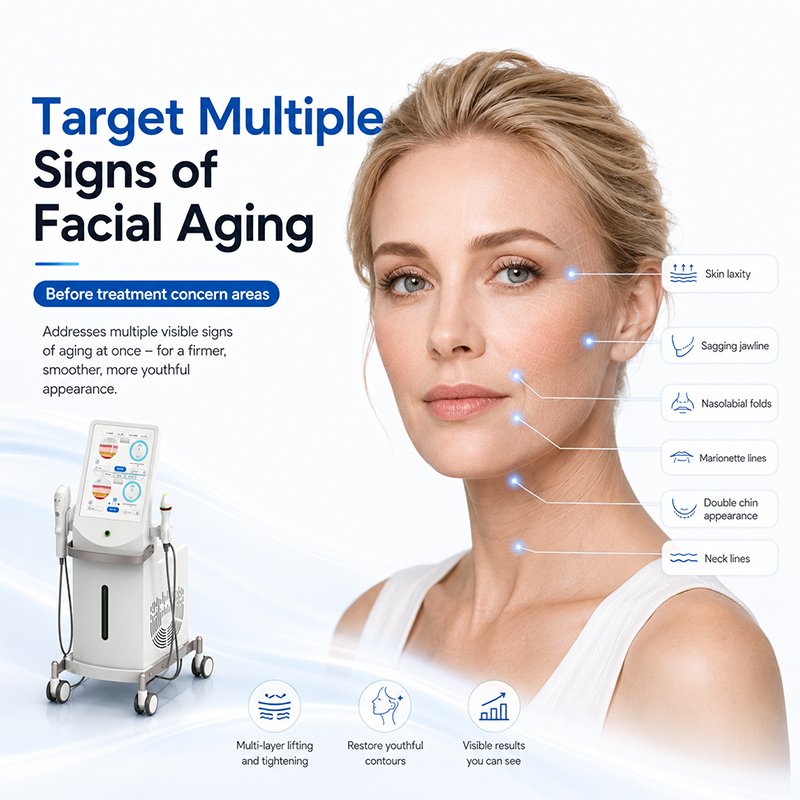
HIFU reaches structural depths up to 4.5mm (SMAS layer), while RF’s thermal effect is generally confined to the 1.5–4mm superficial-to-mid-dermis range, depending on monopolar vs bipolar configuration.
A single HIFU session typically produces visible tightening for 9–12 months, whereas RF results from a maintenance protocol usually last 1–3 months per session, requiring repeat visits.
Entry-level RF equipment starts around USD 1,500–3,000, roughly 30–50% cheaper than entry-level HIFU systems in the USD 2,500–4,000 range.
Clinics offering both technologies as a combined protocol report client retention increases tied to recurring RF maintenance bookings — often 4–8 additional visits per client per year compared to HIFU-only service lines.
RF sessions generally run 20–40 minutes with minimal-to-no discomfort, versus 45–90 minutes for full-face HIFU with moderate discomfort during treatment — a factor that affects scheduling density and staffing.

HIFU (High-Intensity Focused Ultrasound) and radiofrequency (RF) skin tightening are both non-invasive technologies that stimulate collagen production through thermal energy, but they differ fundamentally in how that energy reaches the target tissue. HIFU focuses ultrasound waves to a precise depth — including the SMAS layer at 4.5mm — without heating the skin surface, enabling structural lifting that RF cannot achieve. RF heats tissue conductively from the surface inward, making it effective for superficial tightening and maintenance protocols but unable to reach the facial structural layer. In 2026, many aesthetic clinics deploy both technologies as complementary services: HIFU for annual structural lifting, RF for monthly maintenance — a two-tier service model that maximises both client results and equipment ROI.
How HIFU and RF Actually Differ at the Tissue Level
The core distinction between these two technologies comes down to how energy is delivered and where it does its work.
HIFU: focused energy at a fixed depth
HIFU devices use transducers that converge ultrasound waves at a precise focal point beneath the skin surface — commonly targeting the SMAS layer (4.5mm), deep dermis (3.0mm), and superficial dermis (1.5mm) in sequence. Because the energy converges at depth rather than dispersing across the surface, the skin surface itself experiences minimal heating. This is what allows HIFU to create a controlled thermal coagulation point at the SMAS layer — the same connective tissue layer addressed in surgical facelifts — without an incision. The result is a structural lifting effect that RF, working purely at the surface and mid-dermis, cannot replicate.
RF: conductive surface-inward heating
Radiofrequency devices pass an electrical current through tissue, and resistance to that current generates heat, starting at the skin surface and working inward. Monopolar RF can achieve slightly deeper penetration than bipolar RF, but even at its deepest, RF energy dissipates across a broader tissue volume rather than converging at a single focal point. This makes RF well-suited to stimulating collagen remodeling in the dermis and improving skin texture and mild laxity, but it does not reach — or meaningfully affect — the SMAS layer.
Why this matters for treatment planning
A client with early-stage skin laxity and textural concerns is often a strong RF candidate, since RF’s gentler, more frequent protocol suits a “maintenance” mindset. A client with moderate-to-advanced laxity, jowling, or brow descent typically needs the structural lift that only HIFU’s SMAS-layer targeting provides. Clinics that understand this distinction — and communicate it clearly to clients — tend to see better outcome satisfaction and fewer mismatched-expectation complaints than clinics marketing either technology as a one-size-fits-all solution.
HIFU vs RF: Side-by-Side Comparison
| Dimension | HIFU | Radiofrequency (RF) |
|---|---|---|
| Energy delivery mechanism | Focused ultrasound converging at a fixed depth | Conductive electrical current heating tissue surface-inward |
| Maximum effective depth | Up to 4.5mm (SMAS layer) | Approx. 1.5–4mm (dermis, mono- vs bipolar dependent) |
| Structural (SMAS) lifting capability | Yes | No |
| Typical session duration | 45–90 minutes (full face) | 20–40 minutes |
| Client discomfort during treatment | Moderate (brief, focal) | Minimal to none |
| Results duration per session | 9–12 months | 1–3 months (maintenance protocol) |
| Typical entry equipment price | USD 2,500–4,000+ | USD 1,500–3,000+ |
| Recommended treatment frequency | 1–2x per year | Monthly to quarterly |
| Best-suited client profile | Moderate-to-advanced laxity, structural concerns | Early laxity, texture, maintenance clients |
Comparison spans nine dimensions: mechanism, penetration depth, structural capability, session length, discomfort, results duration, entry price, treatment frequency, and target client profile.
Neither technology is categorically “better” — they solve different problems at different tissue depths. The clinics generating the most consistent per-client revenue in 2026 tend to be the ones offering both as a structured, complementary protocol rather than positioning them as competing options.
Clinic ROI Model: Adding RF as a Complementary Service to Existing HIFU
The table below models the financial impact of adding an RF maintenance program to a clinic that already offers HIFU, using a mid-range RF unit (approx. USD 2,500 factory-direct). Assumptions: existing HIFU client base opts into monthly RF maintenance at USD 150/session, with a per-session consumable/electrode cost of USD 15.
| Scenario | Clients Opting Into RF Maintenance | Monthly RF Sessions | Monthly RF Revenue | Est. Monthly Consumable Cost | Est. Net Monthly Contribution | Approx. Breakeven Timeline |
|---|---|---|---|---|---|---|
| Conservative | 10 clients, 1x/month | 10 | USD 1,500 | USD 150 | USD 1,350 | ~2 months |
| Standard | 25 clients, 1x/month | 25 | USD 3,750 | USD 375 | USD 3,375 | <1 month |
| Full Capacity | 40 clients, mixed monthly/biweekly | 60 | USD 9,000 | USD 900 | USD 8,100 | <1 month |
These figures are illustrative projections, not financial guarantees. Actual RF adoption rates depend on how the maintenance program is presented to existing HIFU clients, local pricing tolerance, staff capacity to deliver additional sessions, and the overall size of the clinic’s active client base. Model your own numbers using your current HIFU client count and realistic opt-in assumptions before purchasing.
Who Should Read This Comparison
This guide is written for:
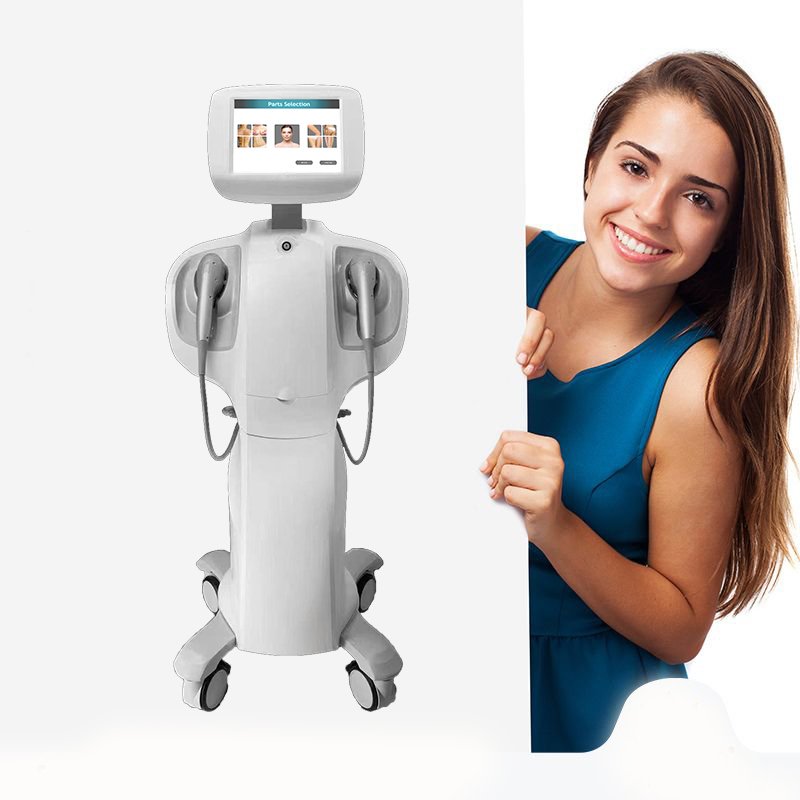
- Clinics currently offering only 7D HIFU who are evaluating whether adding RF as a maintenance/upsell service makes financial sense, versus clinics offering only RF considering whether client demand justifies a HIFU investment for structural cases.
- Distributors advising clinic clients on which technology — or which combination — fits a given market’s client demographics and price sensitivity.
- New clinic operators deciding which technology to launch with first, given limited initial equipment budget.
- Multi-service medical spas building out a tiered service menu (RF for maintenance-focused monthly memberships, HIFU for annual “signature” procedures) to improve client retention and average revenue per client.
This comparison is not intended to argue that one technology universally replaces the other — in most 2026 clinic models, they serve distinct client segments and revenue functions.
Buying Checklist: Choosing Between HIFU, RF, or Both
- Assess your existing client base’s needs. If most inquiries involve visible jowling, brow descent, or moderate-to-advanced laxity, HIFU should be the priority. If most inquiries are early-prevention or maintenance-focused, start with RF.
- Model the combined service revenue, not just standalone ROI. As shown above, RF’s real financial value in an established clinic often comes from recurring maintenance revenue on an existing HIFU client base — not from RF as a standalone acquisition tool.
- Check depth specifications, not just brand claims. Request the exact focal depths (for HIFU) or monopolar/bipolar penetration data (for RF) in writing, since marketing materials sometimes overstate effective depth.
- Confirm CE/FDA/MDR certification for both device types, since HIFU and RF are regulated differently in some jurisdictions and require separate documentation.
- Evaluate session throughput against your appointment book. RF’s shorter session time (20–40 minutes) supports higher client volume per day than HIFU’s 45–90 minute sessions — relevant if you’re capacity-constrained.
- Ask about combo/dual-modality units. Some manufacturers offer devices that integrate both HIFU and RF handpieces in a single console, which can reduce total footprint and upfront cost compared to two standalone machines — worth comparing against separate-unit pricing.
- Verify consumable and electrode/cartridge costs for both technologies before committing, since RF electrode tips and HIFU cartridges have very different replacement economics.
Not sure which configuration fits your client base and budget? Contact the MNLT Laser team for a side-by-side quotation covering standalone HIFU, standalone RF, or combined dual-modality equipment options.
Frequently Asked Questions
What is the main difference between HIFU and RF skin tightening?
Can RF achieve the same lifting results as HIFU?
Should a clinic invest in HIFU or RF first?
How often do clients need HIFU versus RF treatments?
Can a clinic offer both HIFU and RF using one machine?
With 15+ years of expertise in optoelectronic and medical aesthetic engineering, David leads MNLT's R&D team across the full professional aesthetic device portfolio, ensuring all technical content meets the highest standards of accuracy and clinical safety.
Get a Factory-Direct Quotation for HIFU, RF, or Both
Whether your clinic needs structural lifting, maintenance-focused RF protocols, or a combined two-tier service model, equipment selection should be driven by your client base’s actual needs and your appointment book’s capacity — not by chasing a single trending technology. MNLT Laser manufactures both HIFU and RF systems with 19 years of production experience and CE/FDA/MDR certification, supplying clinics and distributors across 120+ countries. Reach out to the MNLT Laser team for configuration guidance and current pricing on standalone or combined equipment.