

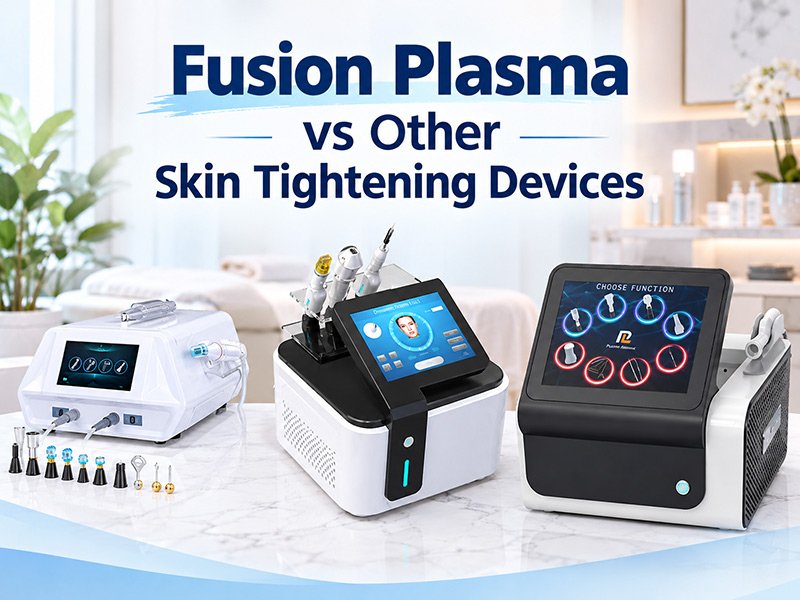
- Fusion plasma combines atmospheric plasma sublimation with simultaneous electroporation to deliver collagen remodelling and active ingredient infusion in a single treatment — a dual-action mechanism no other single skin tightening modality replicates.
- Compared to RF and HIFU, fusion plasma works at the epidermal-dermal junction rather than deep dermis or SMAS layer — making it uniquely suited for superficial skin tightening, texture correction, and periorbital applications where RF and HIFU carry higher risk profiles.
- Fibroblast/plasma pen devices and fusion plasma both use atmospheric plasma, but fusion plasma adds electroporation capability, broader tip configurations, and a lower per-session downtime profile than high-energy fibroblast treatments.
- Fractional laser and fusion plasma address overlapping indications (scar revision, texture, pigmentation), but fusion plasma has no ablative depth limitation, no mandatory cooling protocol, and significantly lower consumable cost per session ($5–$15 vs $30–$80 for laser consumables).
- For clinics building a multi-modality skin tightening menu, fusion plasma fills the precision epidermal gap that RF (dermal), HIFU (SMAS), and laser (ablative) all leave unaddressed.
- Factory-direct certified fusion plasma machines cost $2,500–$7,000 — versus $8,000–$30,000 for RF platforms and $15,000–$50,000 for HIFU systems of comparable clinical capability class.
Clinic owners evaluating skin tightening equipment in 2026 face a market saturated with competing technology claims. RF, HIFU, plasma pen, fractional laser, and fusion plasma all promise collagen induction and skin tightening — but they work at different tissue depths, carry different risk profiles, require different operator skill levels, and deliver meaningfully different clinical outcomes for specific indications. This guide compares fusion plasma against the four most commonly evaluated competing technologies in the clinic procurement context, giving you a factual basis for the investment decision rather than a vendor claim.
How Fusion Plasma Works: The Mechanism That Changes the Comparison
Before comparing technologies, it is essential to understand what fusion plasma actually does — because the combination of mechanisms is what distinguishes it from every other modality in this comparison.
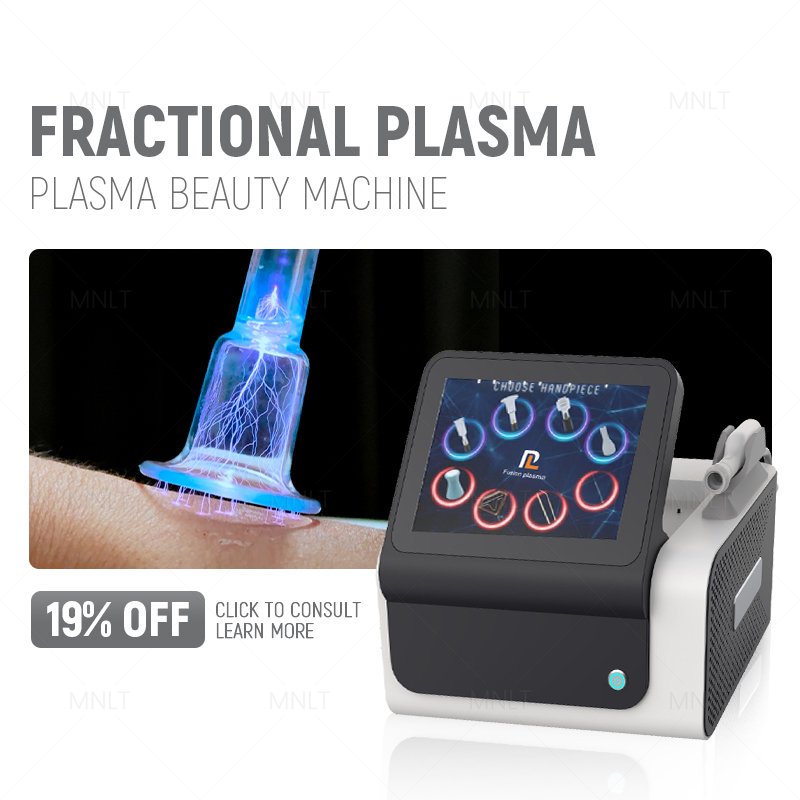
Fusion plasma generates atmospheric plasma — ionised gas created between the device tip and the skin surface — that produces a controlled sublimation effect at the epidermal surface. This creates a precise micro-trauma at the epidermal-dermal junction: the stratum corneum is vaporised in a controlled dot or area pattern, triggering an immediate tissue contraction response (the “plasma lift” effect) and initiating a sustained wound-healing cascade that drives collagen and elastin synthesis over 4–8 weeks.
The fusion component adds simultaneous electroporation: pulsed electrical fields temporarily permeabilise cell membranes, enabling active ingredients (hyaluronic acid, growth factors, peptide complexes) to penetrate to depths that topical application cannot achieve. This turns a structural treatment into a simultaneous infusion treatment — extending outcomes and enabling add-on revenue.
This combined mechanism — sublimation + electroporation — is what no other single device in this comparison delivers. Understanding it is the starting point for understanding where fusion plasma wins, where it does not, and how it fits alongside other modalities.
For the clinical indications and treatment outcomes that fusion plasma addresses, see our detailed plasma fusion facial treatment and skin rejuvenation guide.
Technology Comparison: Fusion Plasma vs the Field
The following table compares fusion plasma against the four most commonly evaluated skin tightening technologies across five clinically and commercially critical dimensions:
| Dimension | Fusion Plasma | Fibroblast / Plasma Pen | RF Skin Tightening | HIFU | Fractional Laser |
|---|---|---|---|---|---|
| Tissue depth target | Epidermal-dermal junction | Epidermal surface | Mid-dermis (2–4mm) | SMAS / deep dermis (4.5–13mm) | Epidermal-dermal junction |
| Primary mechanism | Sublimation + electroporation | Sublimation only | Resistive heating | Focused ultrasound | Ablative/fractional vaporisation |
| Downtime | 3–7 days (mild scabbing) | 5–14 days (significant scabbing) | None to 24 hours | None to 48 hours | 3–10 days (depth-dependent) |
| Per-session consumable cost | 5–5–15 (gel + tips) | 3–3–10 (tips) | 20–20–80 (RF cartridges) | 30–30–120 (HIFU cartridges) | 30–30–80 (laser tips / gas) |
| Equipment price range | 2,500–2,500–7,000 | 500–500–3,000 | 8,000–8,000–30,000 | 15,000–15,000–50,000 | 20,000–20,000–80,000 |
| Periorbital safety | High (fine-point control) | Moderate (operator-dependent) | Low (thermal risk) | Very low (contraindicated near eyes) | Moderate (depth-dependent) |
| Active ingredient delivery | Yes (electroporation) | No | Limited (iontophoresis only) | No | No |
| Scar revision capability | Strong | Moderate | Weak | None | Strong |
| Body treatment suitability | Moderate | Low | High | High | Moderate |
| Certification baseline | CE / FDA / MDR | CE only (most) | CE / FDA | CE / FDA | CE / FDA / MDR |
Fusion Plasma vs Fibroblast / Plasma Pen
Fibroblast and plasma pen devices represent the closest technological relative to fusion plasma — both use atmospheric plasma generation, both target the epidermal layer, and both are used for skin tightening, periorbital rejuvenation, and scar work.
The differences are practically significant for clinical deployment:
Downtime: Traditional fibroblast treatments create a grid of plasma dots at higher energy density, producing visible scabbing that typically requires 5–14 days before clients return to normal activity. Fusion plasma’s adjustable intensity and electroporation integration allows the same clinical endpoints to be approached with a lower-energy protocol, reducing visible recovery to 3–7 days. For clinics serving working-age clients who cannot afford extended downtime, this is a material clinical differentiator.
Electroporation capability: Standard fibroblast and plasma pen devices are sublimation-only — there is no simultaneous ingredient delivery mechanism. Fusion plasma’s electroporation mode transforms what would otherwise be a structural treatment into a complete skin renewal session with active ingredient infusion. This creates a revenue opportunity (serum add-ons) that plasma pen devices cannot support.
Tip configuration range: Most fibroblast and plasma pen devices offer one or two tip configurations. Fusion plasma systems with full clinical tip ecosystems (fine-point, broad-area, infusion) enable the practitioner to transition between precision periorbital work and broad-area resurfacing within a single session — reducing chair time without reducing treatment scope.
Bottom line: For clinics already using plasma pen or fibroblast, fusion plasma is a direct capability upgrade. For clinics evaluating their first plasma technology purchase, fusion plasma is the better long-term investment.
Fusion Plasma vs RF Skin Tightening
Radiofrequency skin tightening heats the mid-dermis (2–4mm depth) using resistive electrical energy, stimulating collagen contraction and neocollagenesis through thermal injury response. It is one of the most widely deployed skin tightening modalities in aesthetics clinics globally.
Where RF wins:
Large-area body treatments (abdomen, thighs, arms), deep dermal remodelling, and no-downtime protocols for clients who cannot tolerate visible recovery. RF is also well-established in combination with microneedling (RF microneedling) for enhanced dermal penetration.
Where fusion plasma wins over RF:
- Periorbital applications: RF carries meaningful thermal risk around the periorbital area — the thin eyelid skin and proximity to the eye make RF a high-caution application in this zone. Fusion plasma’s surface-level sublimation mechanism is significantly safer for periorbital tightening and non-surgical blepharoplasty work.
- Epidermal texture and pigmentation: RF works at depth; it does not address epidermal surface texture, enlarged pores, or superficial pigmentation. Fusion plasma’s epidermal mechanism directly addresses these concerns.
- Active ingredient delivery: RF has no electroporation capability. Fusion plasma enables simultaneous serum infusion that RF cannot replicate.
- Equipment and consumable cost: RF platforms of comparable capability class cost 8,000–8,000–30,000 with per-session cartridge costs of 20–20–80. Fusion plasma equipment is 2,500–2,500–7,000 with per-session consumable costs of 5–5–15.
Combination strategy:
RF and fusion plasma are genuinely complementary rather than competitive for multi-modality clinics. RF addresses deep dermal laxity; fusion plasma addresses epidermal surface quality. A clinic offering both can build a complete skin renewal protocol that neither modality alone can cover.
Fusion Plasma vs HIFU
High-Intensity Focused Ultrasound (HIFU) targets the deepest tissue planes of any modality in this comparison — the SMAS layer at 4.5mm and deep dermis at 3.0mm — making it the gold standard for non-surgical face lifting and significant structural laxity. HIFU is not in the same clinical indication space as fusion plasma for most applications.
Where HIFU is appropriate and fusion plasma is not
Significant jawline laxity, neck sagging, and jowl lifting requiring SMAS-level stimulation — applications where the required tissue change is at 4.5–13mm depth, entirely beyond fusion plasma’s mechanism.
Where fusion plasma is appropriate and HIFU is not
Periorbital applications (HIFU is contraindicated in the periorbital zone), surface skin texture, scar revision, fine line correction at 0.5–1.5mm depth, and any indication requiring epidermal surface change rather than deep structural lifting.
Equipment cost
HIFU systems capable of multi-depth treatment (1.5mm, 3.0mm, 4.5mm cartridges) cost 15,000–15,000–50,000, with per-cartridge session costs of 30–30–120. For clinics where deep SMAS lifting is not the primary indication mix, this investment profile is difficult to justify against fusion plasma’s 2,500–2,500–7,000 equipment cost.
Fusion Plasma vs Fractional Laser
Fractional laser (ablative or non-ablative fractional CO₂ or Er:YAG) and fusion plasma share the closest indication overlap of any comparison in this guide — both address scar revision, skin texture, resurfacing, and pigmentation through a controlled micro-injury mechanism. This makes the fusion plasma vs laser decision the most nuanced for clinic procurement.
Where fractional laser wins
Deep scar revision (3.0mm+ depth ablative fractional), photodamage and lentigines requiring higher energy density, and established protocols with strong long-form clinical evidence for severe acne scarring.
Where fusion plasma wins over fractional laser
- Equipment and operational cost: Fractional CO₂ laser platforms cost 20,000–20,000–80,000; fusion plasma is 2,500–2,500–7,000. Per-session consumable cost for laser (tips, cooling, gas) runs 30–30–80 versus 5–5–15 for fusion plasma.
- Regulatory and operational overhead: CO₂ laser requires medical-grade room ventilation (smoke evacuator), eye protection protocols, and in many jurisdictions, medical practitioner supervision. Fusion plasma has a significantly lower regulatory burden for aesthetic (non-medical) clinic deployment.
- Electroporation integration: Fractional laser has no active ingredient delivery mechanism. Fusion plasma’s electroporation enables post-sublimation serum infusion into open micro-channels — a clinically additive step that laser cannot offer.
- Downtime management: Fractional CO₂ at therapeutic depth typically produces 5–10 days of visible recovery. Fusion plasma at equivalent surface indications produces 3–7 days — meaningful for client acceptance and booking throughput.
For clinics with an existing laser investment, fusion plasma is a complement that fills the lower-cost, lower-downtime, electroporation-capable slot in the treatment menu. For clinics without a laser and evaluating their first resurfacing investment, fusion plasma delivers the majority of applicable indications at a fraction of the equipment and operational cost.
For a full procurement and ROI analysis for fusion plasma, including break-even modelling and supplier evaluation criteria, see the fusion plasma machine clinic buying and ROI guide.
Which Technology Is Right for Your Clinic?
The honest answer is that technology choice depends on your patient mix — and for most clinics building a skin tightening and rejuvenation menu, the question is not “which technology to choose” but “which technology to start with.”
| Clinic Profile | Best Starting Point | Consider Adding |
|---|---|---|
| New aesthetics clinic, budget-conscious | Fusion plasma (2,500–2,500–7,000) | RF or HIFU as volume grows |
| Physiotherapy / medical aesthetics hybrid | RF microneedling | Fusion plasma for epidermal precision |
| Established aesthetics clinic with RF | Fusion plasma (fills epidermal gap RF misses) | HIFU for structural laxity cases |
| High-volume skin clinic with laser | Fusion plasma (lower cost, electroporation add-on) | Maintain laser for deep scar work |
| Distributor building a complete portfolio | Fusion plasma + RF + HIFU | Provides full depth coverage as a bundle |
Fusion plasma is the strongest single first investment for clinics that do not yet have a skin tightening device — it covers the widest indication range at the lowest entry cost, with the lowest consumable overhead and the only electroporation-enabled ingredient infusion capability in its class.
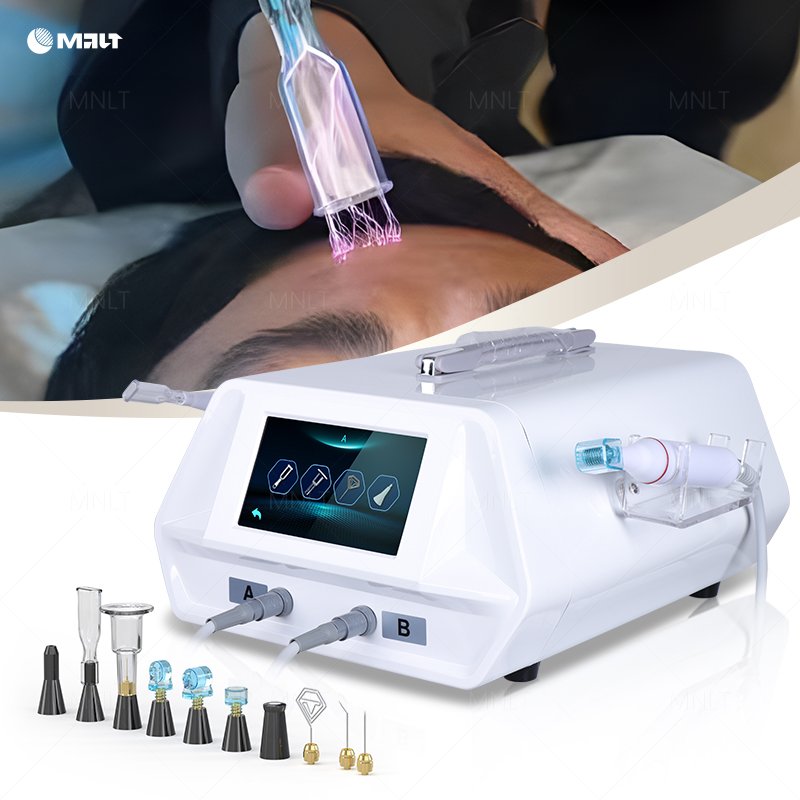
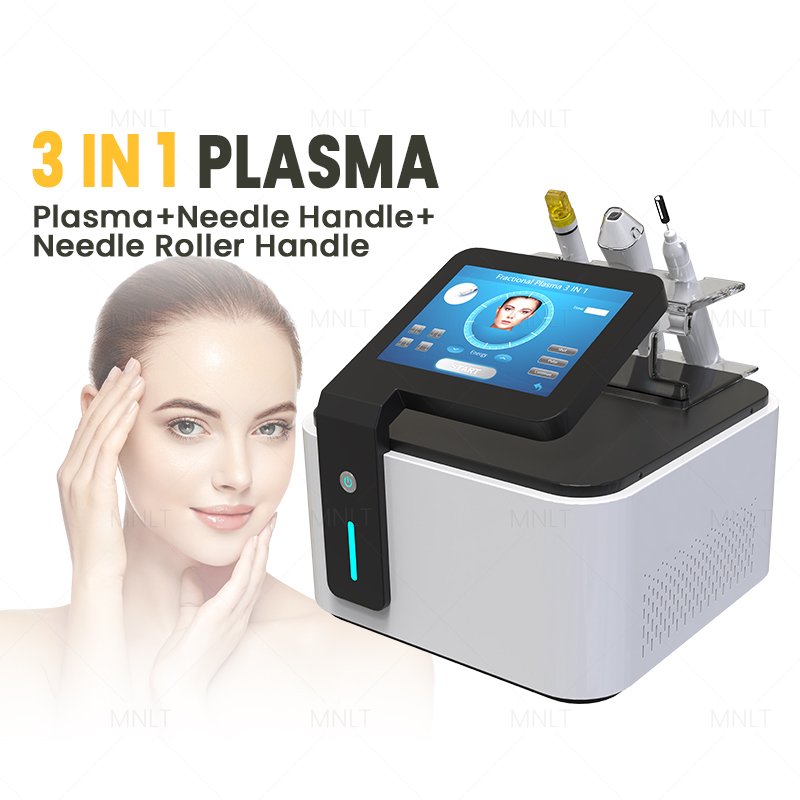
Browse the full range of certified fusion plasma devices on the MNLT fusion plasma machine category page to compare configurations and request a specification sheet.
Inquire Now
Fill out the form for more information, and an MNLT product manager will contact you shortly!
FAQ: Fusion Plasma vs Other Skin Tightening Devices
What is the difference between fusion plasma and a fibroblast or plasma pen device?
Both fusion plasma and fibroblast/plasma pen devices use atmospheric plasma to create a sublimation effect at the epidermal surface. The key differences are: fusion plasma adds simultaneous electroporation capability (enabling active ingredient infusion that plasma pen cannot deliver), offers broader tip configurations for zone-specific treatment, and typically produces shorter visible recovery (3–7 days vs 5–14 days for high-energy fibroblast treatment). For clinics evaluating their first plasma technology purchase, fusion plasma provides a broader clinical scope and additional revenue opportunity from ingredient infusion add-ons that standard plasma pen devices do not support.
Is fusion plasma better than RF for skin tightening?
Fusion plasma and RF work at different tissue depths and are better understood as complementary than competitive. RF targets the mid-dermis (2–4mm), making it effective for deep dermal laxity and body applications; fusion plasma targets the epidermal-dermal junction, making it more effective for superficial texture, periorbital tightening, scar revision, and ingredient infusion. Fusion plasma has a significant advantage over RF for periorbital applications (where RF carries thermal risk) and in equipment and consumable cost ($2,500–$7,000 device vs $8,000–$30,000 for RF; $5–$15 per session vs $20–$80). For clinics choosing their first skin tightening device, fusion plasma covers more indication types at lower cost; for clinics with RF already, fusion plasma fills the epidermal precision gap.
Can fusion plasma replace HIFU for skin lifting?
No — fusion plasma and HIFU are not direct substitutes. HIFU targets the SMAS layer at 4.5mm depth and deep dermis at 3.0mm, making it the appropriate choice for significant structural face lifting and jawline/neck laxity. Fusion plasma works at the epidermal-dermal junction and cannot replicate SMAS-level stimulation. However, fusion plasma is appropriate for many periorbital and surface skin applications where HIFU is contraindicated or cannot reach the required depth. For clinics evaluating skin tightening investment, the question is which patient presentations dominate: epidermal precision and surface quality (fusion plasma) or structural laxity and deep lifting (HIFU).
How does fusion plasma compare to fractional laser for scar treatment?
For mild to moderate acne scars, surgical scars, and stretch marks at epidermal-dermal depth, fusion plasma and fractional laser deliver comparable clinical outcomes. Fusion plasma has practical advantages over fractional CO₂ laser for many clinic deployments: equipment cost is $2,500–$7,000 vs $20,000–$80,000 for laser platforms; per-session consumable cost is $5–$15 vs $30–$80; regulatory and ventilation requirements are significantly lower; and fusion plasma adds electroporation-mediated serum infusion into open micro-channels post-treatment — a step fractional laser cannot offer. For deep ablative scar revision requiring 3mm+ penetration depth, fractional CO₂ laser has a clinical advantage that fusion plasma does not match.
What certifications does a fusion plasma machine need for clinic use?
Clinical-grade fusion plasma machines require CE marking (EU market access), FDA clearance (US market access), MDR compliance (EU Medical Device Regulation — required for clinical positioning in European aesthetics practices), and ISO 13485 Quality Management System certification. In contrast, many fibroblast and plasma pen devices carry only CE marking without FDA clearance or ISO 13485 manufacturing certification. The full four-credential baseline is the standard that distinguishes clinical-grade from consumer or semi-professional plasma devices. Always request traceable certificate numbers and verify through public registries — not certificate images on product pages.
Which skin tightening device is best for periorbital (eyelid) treatments?
For periorbital tightening and non-surgical blepharoplasty, fusion plasma is the safest and most clinically precise option among the technologies compared in this guide. RF carries thermal risk in the thin periorbital skin zone; HIFU is generally contraindicated near the eyes; fractional laser requires careful parameter management for periorbital application. Fusion plasma's fine-point tip delivers a surface-level sublimation effect with operator-controlled intensity, making it the modality of choice for upper and lower eyelid tightening in aesthetic practice. The fine-point tip configuration and adjustable intensity levels (minimum 3 required for clinical safety in this zone) are the key specification requirements for periorbital fusion plasma work.
How much does a fusion plasma machine cost compared to RF and HIFU?
Factory-direct certified fusion plasma machines cost $2,500–$7,000 for a complete clinical configuration. Comparable RF skin tightening platforms cost $8,000–$30,000; HIFU systems with multi-depth cartridges cost $15,000–$50,000; fractional CO₂ laser platforms cost $20,000–$80,000. Per-session consumable costs follow a similar hierarchy: fusion plasma $5–$15 (gel + tips), RF $20–$80 (cartridges), HIFU $30–$120 (cartridges), laser $30–$80 (tips/gas). For clinics building a first skin tightening investment or adding a precision epidermal modality to an existing multi-technology menu, fusion plasma delivers the highest indication-to-cost ratio of any technology in this comparison.
Reviewed by David Ma
CTO & Chief Engineer, MNLT Laser (Shandong Moonlight Electronics Tech Co., Ltd.)
19 years in aesthetic device manufacturing. David leads MNLT's R&D team across the full professional aesthetic device portfolio, ensuring all technical content meets the highest standards of accuracy and clinical safety.