




At a Glance
- A 550ps pulse duration can deliver a stronger photoacoustic effect than nanosecond systems at comparable fluence, but pulse width must be verified across the operating energy range rather than accepted from a brochure.
- For professional tattoo and pigment work, a claimed 1200mJ output should refer to measured single-pulse energy at the treatment endpoint—not stored electrical energy or a short-lived peak value.
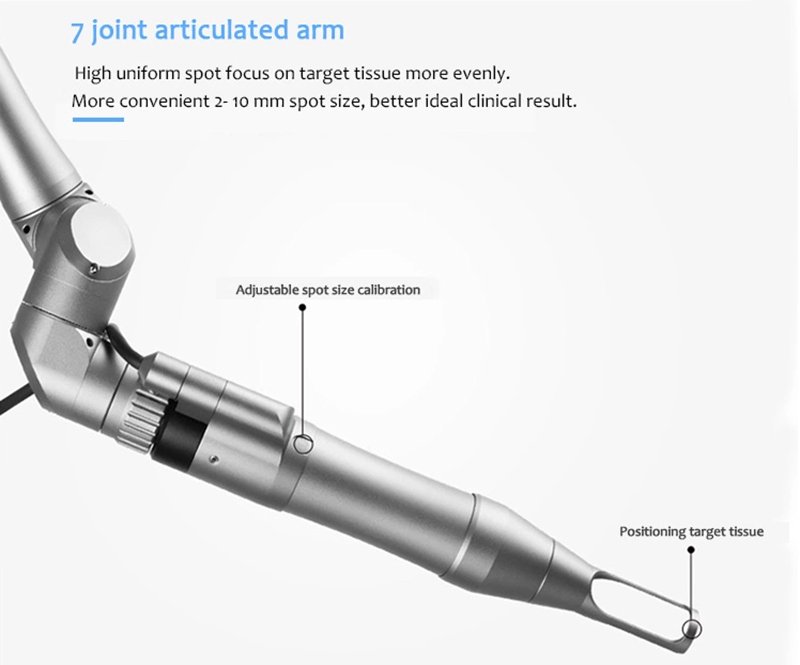
- A properly aligned 7-joint articulated optical arm offers low-loss beam delivery, flexible positioning and stable spot geometry; poor joints or coatings can reduce usable energy and create an uneven beam.
- A practical wavelength matrix combines 1064nm for deeper dark pigment, 532nm for superficial warm-color pigment and an optional 755nm channel for selected blue-green pigment applications.
- A fractional focus array, often called a honeycomb lens, divides the beam into microbeams to create controlled optical breakdown points for selected skin-rejuvenation protocols.
- A double-lamp, double-rod resonator may improve energy reserve and thermal stability, but buyers should evaluate measured endpoint output, cooling capacity and repeatability—not component count alone.
- Clinic payback depends on equipment cost, local pricing and utilization; a factory-direct system can typically target capital recovery within 2–4 months when the clinic books 2–4 paid treatments per day.
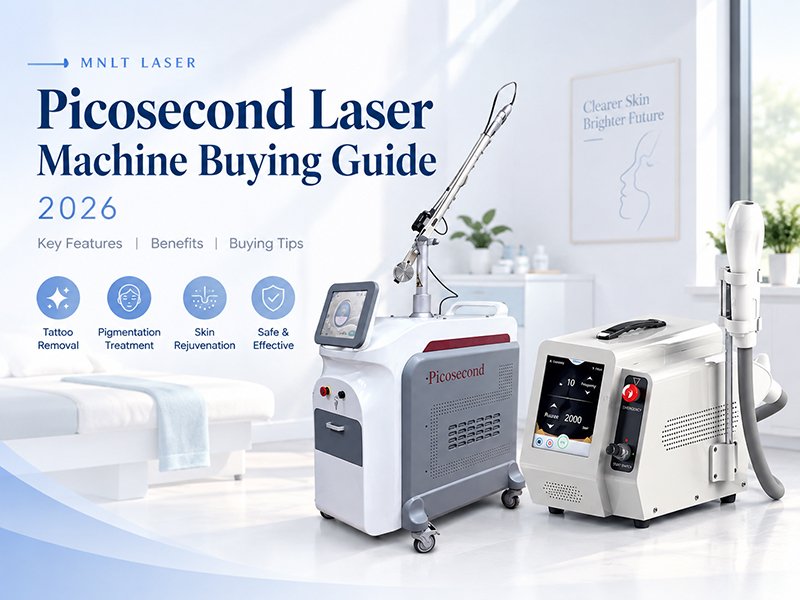
A picosecond laser machine is not defined by one large number on a sales page. For clinics, salons and distributors, the real buying decision depends on how the laser is generated, transmitted, focused, cooled and measured at the treatment endpoint. Two systems may both advertise “550ps” and “1200mJ,” yet deliver very different beam quality, pulse stability and service life.
This 2026 buying guide focuses on the engineering questions that matter before procurement: 7-joint articulated optical arms versus direct-coupled handpieces, verified single-pulse energy versus inflated peak claims, wavelength selection, fractional focus arrays, double-lamp and double-rod resonators, cooling architecture, quality-control evidence and clinic payback. It complements our clinical comparison of Nd:YAG vs. picosecond laser technology by concentrating on hardware selection rather than repeating pulse-mechanism basics.
Why Hardware Architecture Matters More Than a Headline Specification
A picosecond platform converts stored electrical energy into a short optical pulse and then transports that pulse to a precise skin target. Every stage introduces possible loss or instability:
- The power supply charges the capacitor bank.
- The flashlamp excites the laser rod inside the resonant cavity.
- The Q-switch releases the stored optical energy as a short pulse.
- Mirrors and beam-shaping optics control the profile.
- The delivery system transports the beam through an articulated arm or handpiece.
- The treatment tip sets spot size and focal geometry.
- Cooling stabilizes the cavity during repeated operation.
This chain explains why a buyer should never compare machines using pulse width alone. A short pulse with poor beam uniformity can create localized hot spots. A high stored-energy specification with inefficient transmission may produce weak endpoint output. A strong first pulse followed by rapid thermal decline may look impressive during a demonstration but perform inconsistently during a full clinic schedule.
The procurement objective is therefore not “the biggest number.” It is repeatable optical energy at the skin, with a stable beam profile and documented quality control.
7-Joint Articulated Optical Arm vs. Direct-Coupled Handpiece
The delivery path is one of the most important—and most misunderstood—differences between professional picosecond systems.
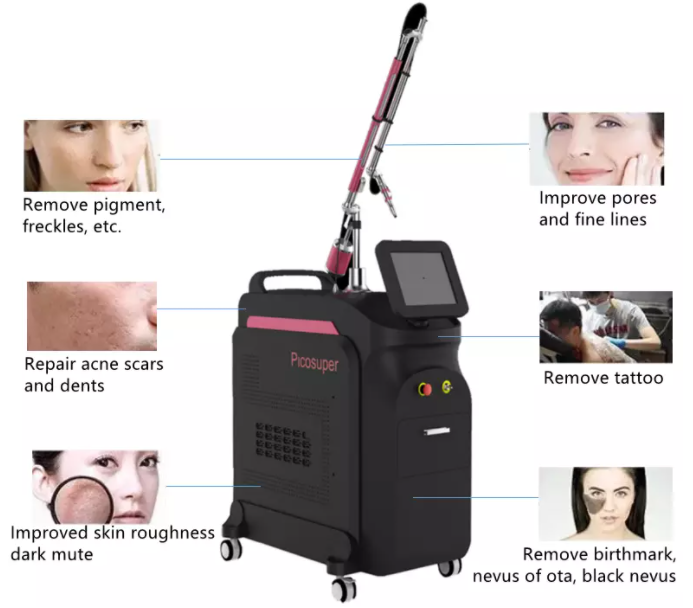
How a 7-Joint Articulated Arm Works
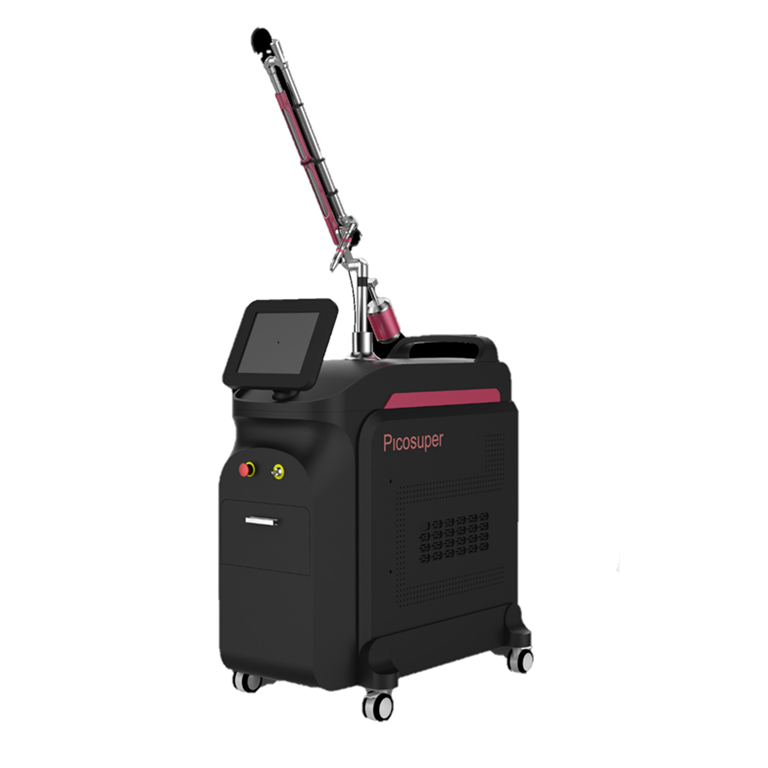
A 7-joint articulated arm uses a sequence of precision mirrors inside rotating joints to redirect the laser beam from the resonator to the treatment handpiece. Each mirror changes the beam direction while allowing the operator to position the arm freely around the patient.
A well-engineered articulated arm provides four practical advantages:
- Flexible positioning: The operator can approach large tattoos, curved body areas and facial zones without twisting a heavy cable.
- High peak-power compatibility: Free-space optical transmission can handle high peak power without concentrating energy inside a fiber core.
- Interchangeable optical tips: Clinics can switch between standard spot tips and fractional focus arrays for different protocols.
- Stable handpiece weight: The treatment handpiece can remain relatively light because the main optical generation system stays inside the machine.
However, “7 joints” is not automatically a quality guarantee. Every mirror and rotating interface must maintain alignment. Low-grade reflective coatings, loose bearings or imprecise mechanical assembly can create transmission loss and beam drift. During evaluation, move the arm through its full working range and confirm that the aiming point, spot shape and output remain stable at different positions.
How a Direct-Coupled Handpiece Works
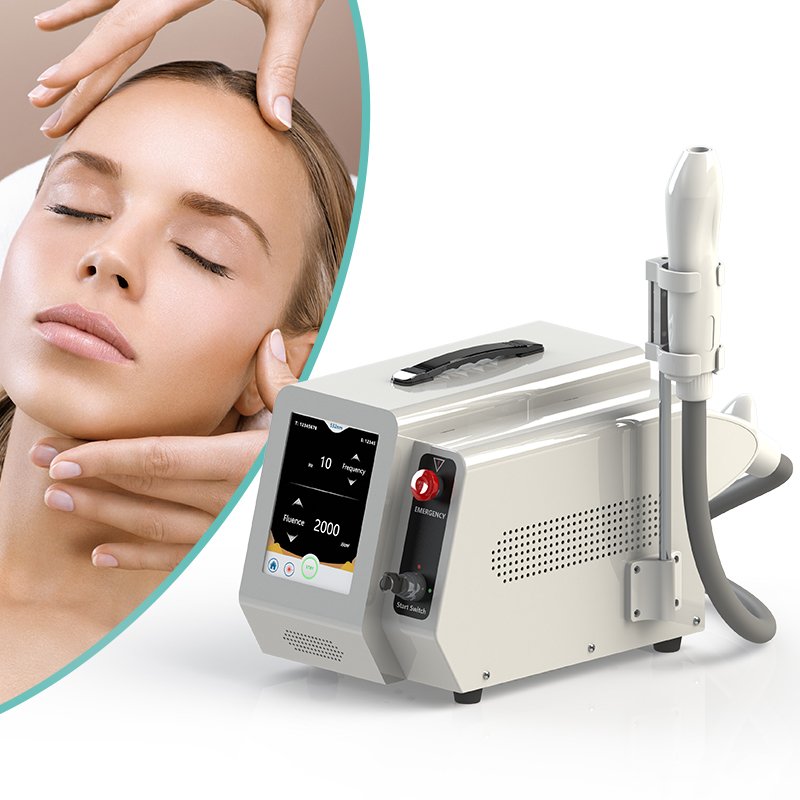
A direct-coupled or light-guide handpiece transports the beam through a more compact delivery path. Depending on the design, the optical channel may use a rigid guide, short free-space path or proprietary coupling structure. These systems can be compact, easier to package and less expensive to manufacture.
Their limitations depend on implementation. A lower-cost coupled design may place more optical or thermal load near the operator’s hand, restrict movement or lose energy through the coupling interface. Some compact systems also advertise cavity energy rather than actual handpiece output, making direct comparisons difficult.
For low-volume salons or mobile service providers, a compact handpiece design can be practical if endpoint output and thermal stability are verified. For high-volume tattoo-removal clinics and distributors seeking a premium professional configuration, a precision 7-joint articulated arm usually offers better ergonomics, tip flexibility and peak-power handling.
| Selection Factor | 7-Joint Articulated Optical Arm | Direct-Coupled Handpiece | Buyer Verification |
|---|---|---|---|
| Beam transmission | Free-space mirror path designed for high peak power | Compact coupling path; performance depends on interface quality | Request measured energy at the treatment tip |
| Movement | Wide positioning range across face and body | Compact, but cable or housing may limit angle | Test all working positions during live demonstration |
| Optical maintenance | Requires precise mirror alignment and clean joints | Fewer joints, but coupled modules may be proprietary | Confirm alignment procedure and spare-part availability |
| Tip options | Supports multiple spot tips and fractional arrays | May have fewer compatible optical attachments | Ask for a complete included-tip list |
| Best-fit buyer | High-volume clinics, dermatology centers and distributors | Entry-level clinics, salons or mobile operators | Match architecture to utilization and treatment menu |
1200mJ Single-Pulse Energy: How to Detect Inflated Claims
Energy is commonly displayed in millijoules (mJ), but buyers must determine what the number actually represents. A brochure may quote capacitor energy, resonator energy, theoretical maximum, combined multi-pulse energy or the strongest pulse measured under ideal laboratory conditions. None of these necessarily equals the energy reaching the skin.
For procurement, ask one precise question:
Is the advertised 1200mJ measured as a single pulse at the treatment handpiece after the full delivery path, and is it repeatable during continuous operation?
A credible supplier should be able to explain the measurement position, instrument, spot size, wavelength and repetition rate. Request a test using a calibrated energy meter placed at the endpoint. Observe a sequence of pulses rather than one isolated shot. The first pulse, tenth pulse and fiftieth pulse should remain within the manufacturer’s stated tolerance.
Energy Must Be Evaluated with Spot Size
Energy alone does not define treatment intensity. Fluence is calculated as:
Fluence (J/cm²) = Pulse Energy (J) ÷ Spot Area (cm²)
The same 1200mJ pulse produces different fluence at a 2mm spot and an 8mm spot. Buyers should therefore request a fluence chart that maps energy to every available spot size. The interface should display clinically usable values rather than a marketing-only maximum that is available at just one small spot and low frequency.
Pulse Width Must Remain Stable
A claimed 550ps pulse width should be verified at representative energy settings. Some systems produce their shortest pulse only at a narrow low-energy setting and lengthen significantly as output rises. This matters because peak power is a function of energy divided by pulse duration. For example, a genuine short pulse can generate a stronger photoacoustic pressure wave without relying solely on thermal accumulation.
Clinics do not need to own a laboratory-grade photodiode system, but distributors and serious multi-site buyers should request factory pulse-width records, endpoint energy calibration reports and batch QC documentation before ordering.
Wavelength Matrix: 1064nm, 532nm and Optional 755nm
A clinic’s wavelength configuration should follow its actual patient and pigment mix.
1064nm: The Core Channel for Dark Pigment
The 1064nm wavelength penetrates more deeply and has lower epidermal melanin absorption than shorter visible wavelengths. It is the principal channel for black, dark blue and deep tattoo pigment, and it is generally preferred when treating higher Fitzpatrick skin types under appropriate clinical protocols.
532nm: Superficial Warm-Color Pigment
A frequency-doubled 532nm channel targets more superficial red, orange and selected brown pigment. Because epidermal melanin absorption is higher at 532nm, conservative parameters, careful endpoint observation and appropriate operator training are essential.
755nm: Selected Blue-Green Pigment Applications
An optional 755nm channel expands the platform’s ability to address selected blue and green tattoo pigments. Buyers should confirm whether 755nm is generated by a genuine optical module or merely represented by a cosmetic filter with limited usable output. Request measured energy data for each wavelength separately; never assume that the 1064nm energy specification applies to 532nm or 755nm.
For a broader overview of machine formats and treatment categories, visit the professional tattoo removal machine category and the dedicated picosecond laser machine collection.
1320nm: Laser Carbon Peeling & Pore Refinement
The specialized 1320nm treatment probe is engineered for non-invasive laser carbon peeling (often commercially known as the “Hollywood Carbon Peel” or porcelain skin facial). By applying a topical medical-grade carbon suspension that penetrates deep into sebaceous pores, the 1320nm laser pulse selectively shatters the carbon particles along with trapped sebum, dead keratinocytes, and surface impurities. This photoacoustic exfoliation stimulates deep dermal collagen regeneration, tightens enlarged pores, balances oil secretion, and brightens overall skin tone with immediate clinical radiance and zero downtime.


Fractional Focus Array: What the Honeycomb Lens Actually Does
A fractional focus array—commonly described as a honeycomb lens—divides the main beam into an array of high-intensity microbeams. At the focal plane, each microbeam can create a localized optical breakdown point, producing a controlled photoacoustic effect within selected skin layers.
This architecture is different from simply reducing the spot size. The array creates multiple microscopic focal zones while leaving intervening tissue untreated. In appropriate professional protocols, the pattern may support skin texture, enlarged-pore and selected acne-scar applications with less surface disruption than a fully ablative approach.
Before purchasing, inspect three details:
- Uniformity: The microspot grid should be evenly distributed without missing or unusually bright points.
- Focal distance: The supplier should specify the correct working distance and provide a positioning guide.
- Optical material and coating: Low-quality arrays can absorb energy, overheat or degrade, reducing consistency over time.
A fractional array does not turn every low-power laser into a professional rejuvenation platform. Its performance still depends on beam quality, endpoint energy, pulse stability and trained parameter selection.
Double-Lamp, Double-Rod Cavity: Useful Architecture or Marketing Feature?
The resonant cavity is the energy-generation core. A double-lamp, double-rod architecture uses two excitation lamps and two laser rods to increase energy reserve and distribute the thermal load. In a properly engineered system, this can support stronger output, improved pulse consistency and lower stress on each component during high-volume operation.
However, component count alone cannot prove performance. Poor cavity alignment, undersized cooling or an unstable power supply can erase the theoretical advantage. A clinic should evaluate the complete system:
- Endpoint energy stability across repeated pulses
- Water temperature during a sustained firing test
- Capacitor and power-supply specification
- Flashlamp service interval and replacement procedure
- Rod material, coating and cavity alignment records
- Cooling flow, filtration and over-temperature protection
A single-lamp system with excellent engineering can outperform a poorly assembled double-lamp system. The correct buying question is not “Does it have two lamps?” but “What measured improvement does the cavity deliver under continuous clinic use?”
Factory-Direct Configuration Checklist for Clinics and Distributors
Use the following matrix when comparing supplier quotations. Require each vendor to complete the same fields so that specifications are comparable.
| Procurement Item | Professional Target Configuration | Evidence to Request | Red Flag |
|---|---|---|---|
| Pulse width | 550ps-class output across usable settings | Pulse-width QC record by energy level | One value with no test condition |
| Single-pulse energy | Up to 1200mJ measured at endpoint | Calibrated energy-meter video and report | Stored electrical energy presented as optical output |
| Delivery system | Precision 7-joint articulated arm | Full-range movement and spot-stability test | Beam shifts when arm position changes |
| Wavelengths | 1064nm + 532nm; optional verified 755nm | Separate energy data for each wavelength | Same output claim copied across all channels |
| Fractional option | Uniform fractional focus array | Microspot pattern and working-distance demonstration | Uneven grid or overheating lens |
| Resonator | Double-lamp, double-rod option for high duty cycle | Continuous firing and temperature-stability test | No thermal or repeatability data |
| Compliance | CE, ISO13485, FDA/MDR documentation as applicable, RoHS | Certificates matching manufacturer and model | Unverifiable logo images or mismatched model names |
| After-sales support | Training, warranty, spare parts and remote diagnostics | Written service scope and response process | Verbal promise without service documentation |
Clinic ROI: Model Payback Before You Buy
A procurement decision should connect engineering quality to revenue capacity. Use a conservative model rather than a supplier’s best-case projection.
Assume a factory-direct picosecond system investment of $12,000, an average collected treatment fee of $280, variable cost of $20 per session and 2 paid sessions per operating day. At 22 operating days per month, the system produces $12,320 in monthly revenue and approximately $11,440 in contribution before rent, labor, marketing and tax. Under these assumptions, equipment-level capital recovery is slightly longer than one month, but a prudent clinic model should budget 2–4 months after allowing for ramp-up, promotions, practitioner compensation and schedule gaps.
The model is sensitive to three factors:
• Lead flow: New clinics should budget marketing before assuming daily utilization.
• Package pricing: Multi-session packages improve cash flow but require transparent refund and treatment policies.
• Downtime: A cheaper machine that loses appointments because of unstable output or slow parts support can cost more than a properly supported system.
Distributors should also model demonstration inventory, local registration, training, spare parts and warranty reserves. Factory price is only one line in the commercial plan; dependable engineering and service documentation protect the margin after the sale.
Why Source a Picosecond Laser Machine from MNLT?
Shandong Moonlight Electronics (MNLT) has 19 years of professional aesthetic device manufacturing experience. Its factory-direct model is designed for clinics, salons and distributors that need transparent configuration, OEM flexibility and engineering support rather than a generic reseller quotation.
MNLT procurement support includes:
- Hardware configuration matching the clinic’s treatment menu and patient mix
- 7-joint articulated arm and multi-wavelength configuration options
- Endpoint energy, cooling and functional inspection before shipment
- OEM/ODM support for housing color, logo and software startup interface
- Operator training materials and remote technical guidance
- Quality-management and compliance documentation, including CE, ISO13485, FDA/MDR documentation as applicable to the model and market, and RoHS
- Global logistics coordination and after-sales spare-part support
Before placing an order, send MNLT your target market, expected daily treatment volume, preferred wavelengths and local electrical standard. The engineering team can then recommend a configuration rather than overselling an unnecessary maximum specification.

Final Buying Decision: Seven Questions to Ask Every Supplier
- Is the 1200mJ figure measured at the treatment tip as a single pulse?
- Can you provide pulse-width and energy-repeatability records across normal settings?
- Does the 7-joint arm maintain the same beam position and spot shape through its full movement range?
- What is the measured output of each wavelength—1064nm, 532nm and optional 755nm?
- Is the fractional focus array included, and can you demonstrate its microspot uniformity?
- What continuous firing and water-temperature test is completed before shipment?
- Which warranty parts, training materials and remote diagnostic services are documented in the quotation?
A supplier that answers these questions with measurement evidence is more valuable than one that responds with a longer list of marketing specifications. To compare a factory-direct configuration for your clinic or distribution market, contact MNLT Laser for a technical checklist, quotation and OEM consultation.
Inquire Now
Fill out the form for more information, and an MNLT product manager will contact you shortly!
FAQ: Buying a Picosecond Laser Machine in 2026
How much energy is lost through a 7-joint articulated optical arm?
Loss depends on mirror coating quality, alignment and cleanliness rather than the joint count alone. A professional supplier should measure energy at the treatment endpoint after the full arm, then test repeatability while moving the arm through normal working positions. Ask for endpoint data instead of relying on resonator energy.
Which wavelengths should a clinic choose for tattoo and pigment treatments?
A practical base configuration combines 1064nm for deeper black and dark pigment with 532nm for more superficial red and warm-color pigment. Clinics treating a meaningful volume of blue-green tattoos may add a verified 755nm option. Request separate measured output for every wavelength because energy is not identical across channels.
How can a buyer verify a claimed 1200mJ single-pulse output?
Ask the factory to place a calibrated laser energy meter at the treatment tip and record multiple consecutive pulses at the stated wavelength, spot size and repetition rate. The report should identify the instrument and measurement conditions. Stored capacitor energy or combined burst energy should not be presented as single-pulse optical output.
Can MNLT customize the machine for a clinic or distributor brand?
Yes. MNLT supports OEM and ODM customization for qualified clinic and distribution projects, including housing color, logo application, interface startup branding and configuration selection. Final scope, lead time and compliance labeling should be confirmed in the written quotation before production.
What warranty and training should be included with a professional picosecond laser system?
Buyers should receive an operating manual, parameter and safety guidance, maintenance instructions, remote operator training, a written warranty scope and a spare-parts response process. Before payment, confirm coverage for the power supply, cooling system, articulated arm, optical modules and consumable components, as well as who pays international shipping for replacement parts.
Reviewed by David Ma
CTO & Chief Optical Engineer, MNLT Laser (Shandong Moonlight Electronics)
David has 19 years of professional aesthetic device manufacturing experience. He leads optical architecture, resonator engineering, energy calibration and production quality control for clinic and distributor laser systems.