
A monopolar RF machine is a radiofrequency skin tightening device that passes electrical current from a single active electrode through tissue to a separate grounding pad, allowing energy to travel deeper into the skin than bipolar RF systems, which contain the current between two closely spaced electrodes on the surface. In 2026, professional monopolar RF systems commonly combine two frequencies — such as 6.78MHz and 2MHz — to target different tissue depths within the same device, reaching from the superficial dermis down to subcutaneous and fascial layers for collagen stimulation and contour support.
- Monopolar RF sends current from a single electrode to a grounding pad, enabling depth penetration that bipolar RF’s contained current path cannot match.
- Dual-frequency systems combining 6.78MHz (dermal layer) and 2MHz (subcutaneous/fascial layer) allow one machine to address 3 distinct depths: 1.5mm, 3.0mm, and 4.5mm.
- Surface and subsurface tissue temperature during treatment is typically managed in the 38–42°C range, balancing collagen stimulation with client comfort and safety.
- Machines in this category typically ship with 3–4 interchangeable effector sizes to match electrode surface area to treatment zone, from small precision tips for the eye area to larger effectors for the neck.
Monopolar vs Bipolar RF — Why the Difference Matters for Clinics
The distinction between monopolar and bipolar RF isn’t a marketing detail — it determines what a machine can physically treat. In a bipolar configuration, both the active and return electrodes sit close together on the handpiece, and current travels in a shallow arc between them. This keeps energy concentrated near the surface, which is useful for superficial texture work but limits how deep the treatment can meaningfully reach. In a monopolar configuration, only one electrode is on the treatment handpiece; the return path runs through a grounding pad placed elsewhere on the client’s body. Because current has to travel from the handpiece, through deeper tissue, to the grounding point, monopolar systems can direct meaningful energy to depths that bipolar systems generally can’t access.
| Dimension | Monopolar RF | Bipolar RF |
|---|---|---|
| Electrode configuration | Single active electrode + separate grounding pad | Two electrodes on same handpiece |
| Effective penetration depth | Deeper — commonly up to 4.5mm | Shallower — typically limited to superficial dermis |
| Best suited for | Contour, jawline, structural firmness support | Surface texture, fine lines, superficial tightening |
| Setup requirement | Requires grounding pad placement | No grounding pad needed |
| Typical equipment complexity | Higher — depth/frequency control adds engineering cost | Lower — simpler circuit design |
Comparison spans five dimensions: electrode configuration, penetration depth, best-suited use case, setup requirement, and equipment complexity.
Neither configuration is universally “better” — the choice depends on what a clinic’s client base actually needs. A practice focused primarily on surface texture and fine-line concerns may find bipolar sufficient. A clinic fielding requests for jawline definition, neck firmness, or general contour support needs the deeper reach that only monopolar delivery provides.
How Dual-Frequency RF Reaches Multiple Tissue Depths
A single-frequency monopolar machine treats the entire path between electrode and grounding pad as one undifferentiated target — there’s no way to selectively favor one tissue layer over another. Dual-frequency systems solve this by running two frequencies through the same monopolar delivery method, each interacting with tissue differently based on wavelength.
6.78MHz is tuned to interact primarily with the dermal layer — the region where collagen remodeling and texture improvement have the most direct impact. This frequency forms the basis of the shallow-to-mid treatment range.
2MHz travels further into tissue, reaching subcutaneous fat and the deep fascial layer. This is the frequency doing most of the work when a protocol targets structural contour rather than surface skin quality.
Combined, these two frequencies support a 3-depth treatment protocol:
| Depth | Penetration | Primary Frequency | Target Layer | Typical Goal |
|---|---|---|---|---|
| Shallow | 1.5mm | 6.78MHz | Superficial dermis | Texture refinement |
| Middle | 3.0mm | 6.78MHz (blended) | Mid-dermis | Firmness, elasticity support |
| Deep | 4.5mm | 2MHz | Subcutaneous/fascial | Contour, structural support |
Operators select depth based on treatment goal and zone rather than running one fixed setting across an entire session — a jawline protocol calls for the deep setting, while under-eye texture work stays in the shallow range. Machines that only offer a single frequency force a compromise: either the depth is too shallow for structural work, or too deep (and less efficient) for fine surface detail.
Peer-reviewed literature on radiofrequency-based skin tightening more broadly is available through PubMed’s indexed research on the topic, which clinics can reference when evaluating the general evidence base for RF-based collagen stimulation — separate from any specific manufacturer’s equipment claims.
Effector Selection Guide
Effector size determines how evenly energy distributes across a given treatment area — mismatched sizing is one of the more common causes of inconsistent RF results in practice.
| Effector Size | Typical Treatment Zone | Best For |
|---|---|---|
| 5×10mm | Eye corners, nasolabial fold | Fine lines, delicate/narrow areas |
| 10×10mm | Small curved facial areas | Cheekbone contours, mouth corners |
| 20×20mm | Broader flat areas | Full cheek or forehead coverage |
| 20×30mm | Neck, double chin | Larger surface area, thicker tissue |
A small effector on a broad area extends session time unnecessarily; a large effector on a curved or delicate zone creates uneven surface contact and inconsistent depth delivery. Clinics running varied protocols — some clients needing only eye-area work, others needing full neck treatment — benefit from having the full effector range available rather than a single fixed handpiece size.
Treatment Areas and Protocol Overview
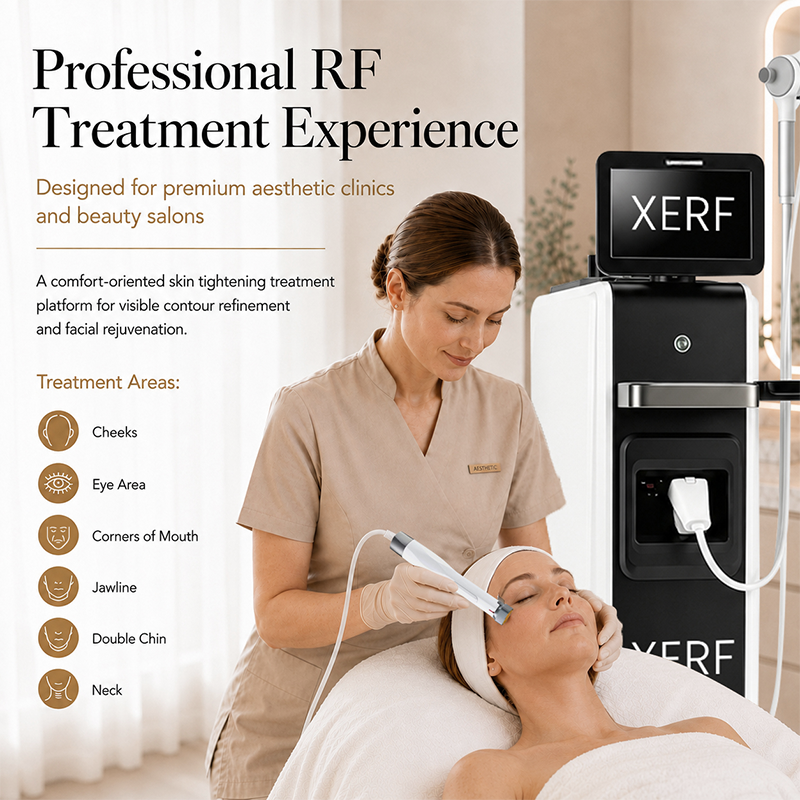
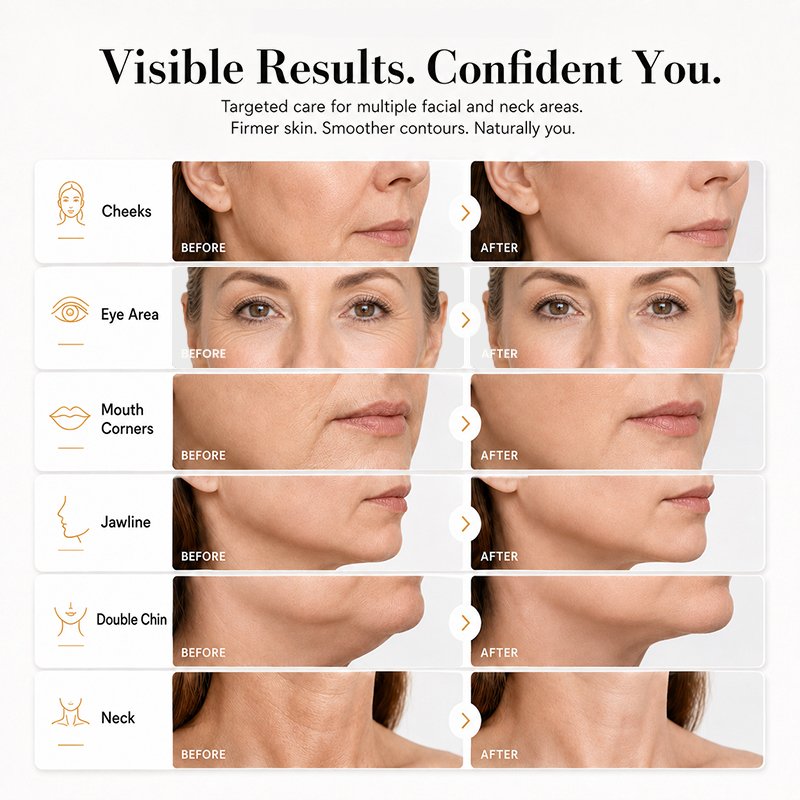
Cheeks — Broad, relatively flat surface typically treated at shallow-to-middle depth with a 20×20mm effector for general firmness support.
Eye area — Requires the smallest effector given thin, delicate tissue; shallow depth setting only.
Corners of the mouth — Common early textural concern area; typically treated with the smallest or second-smallest effector.
Jawline — Usually treated at the deep (4.5mm) setting to support contour definition along the mandibular line, where 2MHz penetration does the structural work.
Double chin — Larger surface area calls for the 20×20mm or 20×30mm effector, typically at middle-to-deep depth.
Neck — The largest effector (20×30mm) paired with the deep setting is standard here, given the neck’s greater surface area and generally thicker tissue.
Session length varies by protocol scope, but most single-zone treatments run 20–40 minutes, with full-face-and-neck protocols extending toward the upper end of that range or requiring split sessions.
Technical Specs to Verify Before Buying
Before comparing quotes across suppliers, confirm the following in writing rather than relying on marketing copy alone:
- Frequency configuration. Ask specifically whether the machine is single-frequency or dual-frequency, and get the exact MHz values documented — “monopolar RF” alone doesn’t specify depth capability.
- Depth range and control. Confirm the number of selectable depth levels and their mm values, since some machines advertise “adjustable depth” without specifying what that range actually covers.
- Cooling and comfort mechanisms. Monopolar RF generates surface heat as a byproduct of reaching deeper tissue; ask what temperature range the system maintains and whether cooling is synchronized with energy delivery or a separate manual step.
- Certifications. Request CE and/or FDA documentation with verifiable certificate numbers before committing to an order.
- Effector count and sizing. Confirm exactly how many effector sizes ship with the base unit versus which are sold as separate accessories — this materially affects the real cost of a functional multi-zone setup.
- Grounding pad and setup requirements. Since monopolar systems require a grounding pad, confirm what’s included and whether replacement pads are a recurring consumable cost.
- If you’d rather skip the comparison process, MNLT’s XERF Dual-Frequency Monopolar RF System ships with all of the above specified in writing — 6.78MHz + 2MHz dual frequency, 3 selectable depths, and 4 effector sizes included as standard.
Clinic ROI Model: 3-Scenario Breakdown
The table below models a dual-frequency monopolar RF system (approx. USD 6,000 factory-direct) across three utilization scenarios, assuming an average session price of USD 150 and minimal per-session cost (estimated USD 8 for grounding pads and general maintenance).
| Scenario | Sessions/Month | Monthly Revenue | Est. Monthly Consumable Cost | Est. Net Monthly Contribution | Approx. Breakeven Timeline |
|---|---|---|---|---|---|
| Conservative | 12 | USD 1,800 | USD 96 | USD 1,704 | ~3.5–4 months |
| Standard | 25 | USD 3,750 | USD 200 | USD 3,550 | ~1.5–2 months |
| Full Capacity | 45 | USD 6,750 | USD 360 | USD 6,390 | <1 month |
These figures are illustrative projections, not financial guarantees. Actual results depend on local market pricing, how the service is bundled with existing offerings, marketing spend, staff scheduling capacity, and regional client demand for RF skin tightening. Clinics should model their own numbers using local session pricing and realistic booking rates before purchasing.
Ready to compare monopolar RF configurations for your clinic? Contact the MNLT Laser team with your target treatment zones and expected session volume for a tailored recommendation.
Why does monopolar RF reach deeper than bipolar RF?
What do the two frequencies (6.78MHz and 2MHz) do differently?
How many effector sizes are needed for a full treatment menu?
What temperature range should a monopolar RF machine maintain during treatment?
What should clinics verify before buying a monopolar RF machine?
With 15+ years of expertise in optoelectronic and medical aesthetic engineering, David leads MNLT's R&D team across the full professional aesthetic device portfolio, ensuring all technical content meets the highest standards of accuracy and clinical safety.