
Buying a Cryoskin machine is one decision. Building a team that can operate it safely, consistently, and profitably is another — and it is the one most clinic managers underinvest in. Inconsistent treatment delivery is the leading cause of poor client outcomes, negative reviews, and underperforming revenue from body contouring equipment. This guide gives clinic owners and salon managers a complete framework for Cryoskin staff training in 2026: structured onboarding, competency benchmarks, hands-on assessment protocols, and the certification standards that protect your clinic and your clients.
5 Training Benchmarks Every Clinic Should Hit
- New Cryoskin operators should complete minimum 8 hours of structured training before their first unsupervised client session — 4 hours theory, 4 hours supervised hands-on
- A competent operator should be able to set up, run, and document a full body session (pads + wand) in under 55 minutes total, including client prep and post-treatment care
- Staff turnover in aesthetics averages 35–45% annually in most EU/NA markets — your training programme must be documented well enough to onboard a replacement in under 2 weeks
- Every Cryoskin operator should pass a written contraindications assessment (minimum 90% pass mark) before operating on any client
- Clinics that maintain a documented training record per operator see 40% fewer client complaints related to treatment delivery inconsistency, based on industry operator feedback surveys
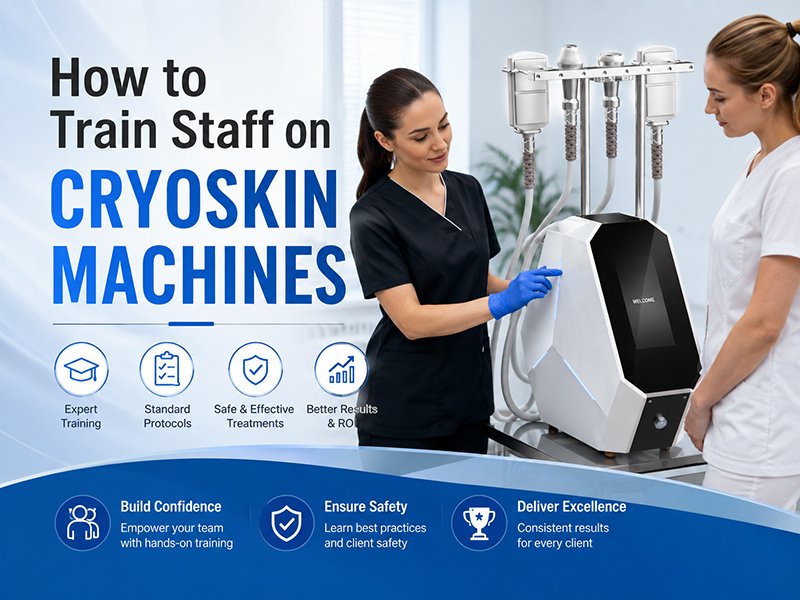
Why Cryoskin Training Is a Business Asset, Not Just a Compliance Exercise
Many clinic managers approach staff training as a box to tick before a new hire starts seeing clients. In practice, the quality of your training programme determines three measurable business outcomes: client retention, treatment consistency, and liability exposure.
Client retention: A client who experiences inconsistent results across sessions — different temperatures, different wand technique, different duration — is unlikely to rebook for a full course. Consistent protocol delivery depends on consistent operator training. Without a structured programme, variation between staff members is inevitable.
Treatment consistency: Cryoskin’s thermal shock mechanism (alternating heat and cold cycles) requires precise parameter management. An operator who does not understand why the machine alternates temperature phases, not just how to press the buttons, will make poor real-time judgement calls when a client reports discomfort or the temperature reading drifts from the target.
Liability protection: In most EU and North American regulatory environments, the clinic or salon — not the device manufacturer — bears responsibility for the training and competency of the operators delivering treatments. A documented training programme with signed assessment records is your primary defence if a treatment outcome is ever disputed.
The Four-Stage Cryoskin Staff Training Framework
A reliable Cryoskin machine training programme moves through four stages, regardless of whether the new operator has prior aesthetics experience or is completely new to body contouring technology.
Stage 1 — Technology Foundation (Theory, 3–4 Hours)
Before any operator touches the machine, they must understand the technology they are working with. This stage covers:
What the Cryoskin machine does — and why it works
- The Triple Thermal Shock mechanism: alternating heat (up to 43°C) and cold (down to −10°C) and how the thermal contrast effect supports fat cell apoptosis and skin tightening
- The difference between the static cryo pads (hands-free body application) and the manual wand (active body and facial protocols)
- How the EMS function integrates with thermal delivery and what it adds to specific protocols
Client physiology basics
- How subcutaneous fat responds to thermal stress
- Why treatment spacing (minimum 72 hours per area) is a clinical requirement, not a recommendation
- Skin type considerations and how they affect protocol selection
Contraindications — non-negotiable knowledge Every operator must be able to identify and explain each contraindication from memory before proceeding to hands-on training. Key contraindications include:
- Raynaud’s disease, cold urticaria, cryoglobulinaemia
- Pregnancy (all trimesters)
- Active malignancy in or near the treatment area
- Implanted electronic devices (pacemaker, ICD, neurostimulator) — especially critical for EMS protocols
- Active infection or open wounds in the treatment area
- Anticoagulant medication (requires elevated caution, not automatic exclusion — establish your clinic’s policy)
Assessment gate: Written contraindications quiz — minimum 90% pass mark required before proceeding to Stage 2.
Stage 2 — Machine Familiarisation (Supervised, 2 Hours)
The operator spends dedicated time with the machine without a client present. This stage covers:
- Power-on sequence and pre-session checklist (cable connections, pad seating, gel availability, screen configuration)
- Navigating the 10.4-inch touchscreen: mode selection, temperature setting, duration programming, EMS toggle
- Pad placement technique on a mannequin or practice model: gel application, pad positioning, strap securing, contact verification
- Manual wand grip, movement speed, and sweeping pattern for body protocols
- Facial wand attachment and the parameter differences between facial and body modes
- Emergency stop procedures and what to do if a temperature reading deviates from the set point
The trainer should observe and document the operator’s comfort level with each function. This is not a pass/fail stage — it is diagnostic. Identify gaps before the client session, not during it.
Stage 3 — Supervised Client Sessions (Minimum 4 Sessions)
The new operator delivers treatments under direct trainer observation. The structure:
| Session | Focus | Trainer Role |
|---|---|---|
| Session 1 | Full body pad session, observer present throughout | Active guidance — intervenes when needed |
| Session 2 | Body pad + manual wand combination | Guidance on request only |
| Session 3 | Facial protocol (wand, low temperature range) | Observation, notes only |
| Session 4 | Full independent session — client intake to post-care | Assessment mode — no intervention unless safety concern |
After each supervised session, the trainer completes a structured observation form covering: client communication quality, parameter selection accuracy, wand technique consistency, post-treatment documentation, and time management.
Stage 4 — Competency Sign-Off and Ongoing Development
At the end of Stage 3, the trainer conducts a formal competency review covering:
Practical assessment criteria:
- Complete session setup in under 10 minutes
- Correct parameter selection without prompting for a standard body protocol
- Demonstrates correct wand technique (no stationary hold during cooling phase, correct sweep speed)
- Correctly identifies and screens a mock contraindicated client scenario
- Completes post-session documentation within the session record template
Sign-off documentation:
- Signed operator competency record (trainer + operator)
- Copy of contraindications assessment result
- Date of first unsupervised session authorisation
Ongoing development (quarterly):
- Protocol update briefing when manufacturer releases new guidance
- Peer observation sessions between operators to standardise technique
- Annual competency re-assessment (written + practical)
Building Your Cryoskin Training Documentation Pack
A training programme that exists only in the trainer’s memory is not a training programme — it is a key-person dependency. Every clinic should maintain a physical or digital training pack containing:
Core Documents
| Document | Purpose | Review Frequency |
|---|---|---|
| Cryoskin Operator Manual (manufacturer-issued) | Technical reference | When firmware/protocol updates issued |
| Clinic Protocol Card | Clinic-specific parameters (temperatures, durations, session spacing) | Annually or when protocols change |
| Contraindications Checklist | Pre-treatment client screening | Annually |
| Client Intake & Consent Form | Documents client disclosure and agreement | When regulatory requirements change |
| Session Record Template | Documents parameters used per session | — |
| Operator Competency Record | Signed assessment and authorisation | Per operator, at sign-off |
| Incident Log Template | Documents any treatment anomaly for clinical governance | — |
Protocol Cards: What to Include
Each clinic’s protocol card should specify:
- Temperature range for each treatment mode (body slimming, body toning, facial lifting, skin tightening)
- Session duration per area
- Number of pulses per session (if applicable to your protocol)
- Minimum inter-session spacing (body: 72 hours, facial: 7 days per zone)
- EMS settings per treatment type
- Post-treatment care instructions given to every client
This card lives at the treatment station — not in a binder in the back office.
Cryoskin Technician Certification: What Standards Should You Require?
In 2026, there is no universally mandated Cryoskin certification for non-medical practitioners in most EU or North American markets — the regulatory requirement is that the device is operated safely by a trained individual, and the clinic is responsible for defining what “trained” means. This is both a freedom and a responsibility.
Minimum internal certification standard (recommended):
- Completion of all four training stages documented above
- Written assessment pass (contraindications + machine parameters) — minimum 90%
- Supervised session sign-off by a qualified trainer
- Annual re-assessment and refresher
Optional external certifications to consider:
- Manufacturer-issued operator certification (where available from your device supplier — ask MNLT for protocol documentation and training support options)
- Aesthetics association membership with CPD requirements (e.g., BABTAC in the UK, CIDESCO internationally)
- First Aid / CPR certification for all client-facing staff (standard clinical governance practice)
For clinics building a Cryoskin machine service from the ground up, MNLT provides operator training documentation, protocol libraries, and technical support as part of the equipment package — ask about the full post-purchase support offer before finalising your sourcing decision.
Managing Staff Turnover: The Resilient Training System
With aesthetics staff turnover averaging 35–45% annually in many markets, your training programme must be designed to survive the departure of any individual, including your most experienced operator.
The “bus test” for training documentation: Could a competent aesthetics professional follow your written training materials and be client-ready in under two weeks, without any verbal handover from the departing staff member? If the answer is no, your documentation needs work.
Practical resilience measures:
- Keep all protocol cards, assessment forms, and competency records in a shared digital folder accessible to the clinic manager at all times
- Video record at least one supervised session (with client consent) as a reference for future onboarding
- Cross-train a minimum of two operators on all protocols so no single session type is dependent on one person
- Build a 1-week “shadow onboarding” into your standard new hire process — new operators observe full sessions before they begin Stage 1 training
FAQ: Cryoskin Staff Training for Clinic Managers
How long does Cryoskin staff training take before an operator can see clients independently?
A structured Cryoskin machine training program typically takes 5–7 business days from start to independent sign-off: 3–4 hours of theory and contraindications training, 2 hours of machine familiarisation without a client, and a minimum of 4 supervised client sessions. Operators should not begin unsupervised client sessions until they have passed a written contraindications assessment (minimum 90% pass mark) and received a signed competency sign-off from the supervising trainer. Rushing this timeline increases the risk of inconsistent treatment delivery and client complaints.
Is there an official Cryoskin technician certification that clinics must obtain?
In most EU and North American markets in 2026, there is no single mandatory Cryoskin technician certification required by law for non-medical practitioners. The regulatory responsibility sits with the clinic: you must ensure operators are trained to use the device safely, and you must be able to demonstrate that training if questioned. Best practice is to implement an internal certification standard — including written assessment, supervised session sign-off, and annual re-assessment — plus any external CPD credentials relevant to your market (e.g. BABTAC in the UK). Ask your Cryoskin machine supplier for manufacturer-issued training documentation and protocol libraries, which form the technical basis of your programme.
What should a Cryoskin staff training programme include at minimum?
A minimum-viable Cryoskin machine training program should cover: (1) Technology foundation — how the Triple Thermal Shock mechanism works, why the machine alternates heat and cold, and what each applicator (static pads and manual wand) is designed to do. (2) Contraindications — a complete checklist that operators can apply from memory to every new client. (3) Machine operation — hands-on familiarisation with the touchscreen, parameter settings, pad placement, and wand technique without a client present. (4) Supervised sessions — a minimum of 4 observed client treatments before independent operation. (5) Documentation — session records, client intake forms, and a signed competency record per operator. Clinics that skip or abbreviate any of these stages increase both their liability exposure and their client complaint rate.
How do I handle Cryoskin staff training when a trained operator leaves the clinic?
The key to resilient Cryoskin technician training under high staff turnover is documentation that survives any individual departure. All protocol cards, assessment forms, competency records, and training materials should be stored in a shared digital folder accessible to the clinic manager — not held by the outgoing operator. Cross-train a minimum of two staff on all treatment protocols so no session type is dependent on one person. Build a 1-week shadow onboarding into your new hire process. If your training documentation is complete, a replacement operator with prior aesthetics experience should reach independent sign-off within two weeks of starting.
Does the Cryoskin machine supplier provide training materials for clinic operators?
Training support varies significantly by supplier. Factory-direct suppliers like MNLT Laser provide operator training documentation, clinical protocol libraries, and post-purchase technical support as part of the equipment package — this includes parameter guidance for each treatment mode (body slimming, body toning, facial lifting) and contraindications documentation. Before finalising any Cryoskin machine purchase, confirm explicitly what training materials are included, whether live or video training sessions are available, and what the after-sales technical support structure looks like. A device delivered without operator documentation creates an immediate gap in your training programme that the clinic must fill independently.
Reviewed by David Ma
CTO & Chief Engineer, MNLT Laser (Shandong Moonlight Electronics Tech Co., Ltd.) — 19 years in aesthetic device manufacturing. David leads MNLT's R&D team across the full professional aesthetic device portfolio, ensuring all technical content meets the highest standards of accuracy and clinical safety.