
- Budget-tier 3D/4D units typically list between USD 2,500 and 4,000, while fully-loaded 7D/12D/22D MMFU systems with 10+ cartridges can reach USD 6,000–8,500.
- Buying factory-direct from a certified plant instead of through a Western-branded distributor can lower acquisition spend by 40–80% for equivalent transducer specs.
- Cartridge lifespan varies widely — a single treatment head may deliver anywhere from 300 to 20,000 shots, and this number, not the sticker price, usually determines your real cost per treatment.
- A clinic booking 8–15 HIFU sessions monthly at an average ticket of USD 300–600 can typically recover a mid-range machine’s cost within 3–9 months, excluding staffing and marketing overhead.
- Devices without valid CE, FDA, or MDR paperwork should be treated as a customs and liability risk in most regulated markets, regardless of how attractive the quoted price looks.
A HIFU machine price in 2026 ranges from USD 2,500 for an entry-level 3-cartridge system to USD 8,000+ for a full 7D/12D/22D MMFU configuration with sliding scan technology. Factory-direct pricing from certified Chinese manufacturers typically runs 40–80% below equivalent Western-brand retail pricing for clinically comparable specifications. For clinic owners and distributors budgeting a HIFU machine purchase, the three cost variables that matter most are configuration (D-count and cartridge set), certification level (CE/FDA/MDR), and after-sales support structure — not brand recognition alone.
HIFU Technology: What You're Actually Paying For
HIFU (High-Intensity Focused Ultrasound) equipment channels focused acoustic energy to precise sub-surface depths — commonly the SMAS (superficial musculoaponeurotic system) layer near 4.5mm, the deep dermis around 3.0mm, and the superficial dermis at roughly 1.5mm. Each focal point generates a controlled thermal coagulation zone that prompts the body’s own collagen-building response — which is why HIFU sits in the non-invasive skin tightening category rather than the surgical lifting one.
Three engineering factors explain almost all of the price spread between models:
1. Transducer count, or the "D" figure.
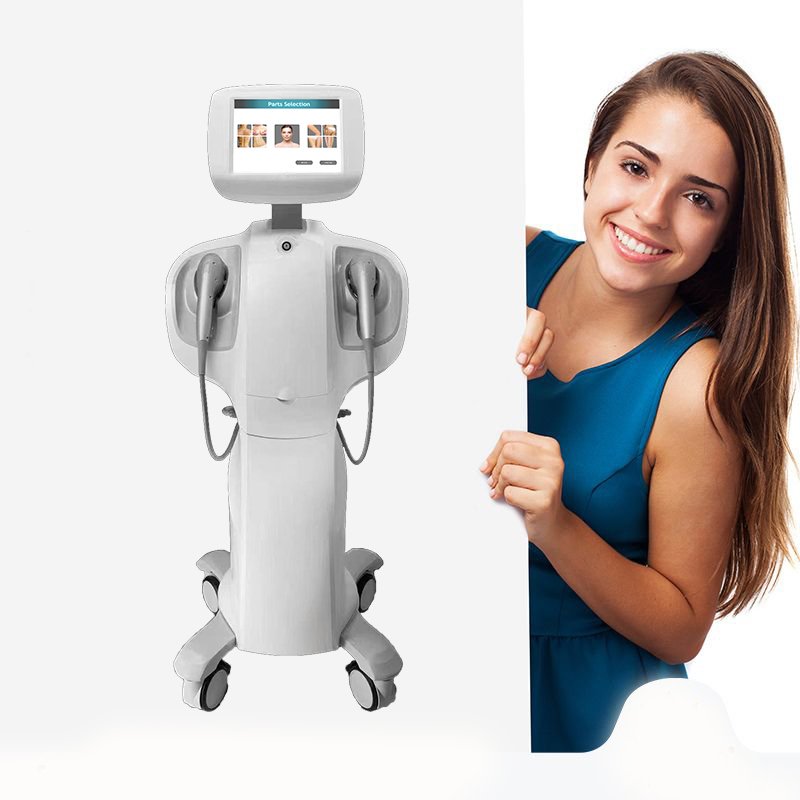
Terms like 4D, 7D, 12D, and 22D describe how many separate transducer cartridges ship with the unit, each tuned to a specific depth or body zone (face, neck, brow line, or torso/limb contouring). A larger cartridge library gives a clinic more service flexibility, but the unit cost climbs accordingly.
2. MMFU versus single-point focusing.
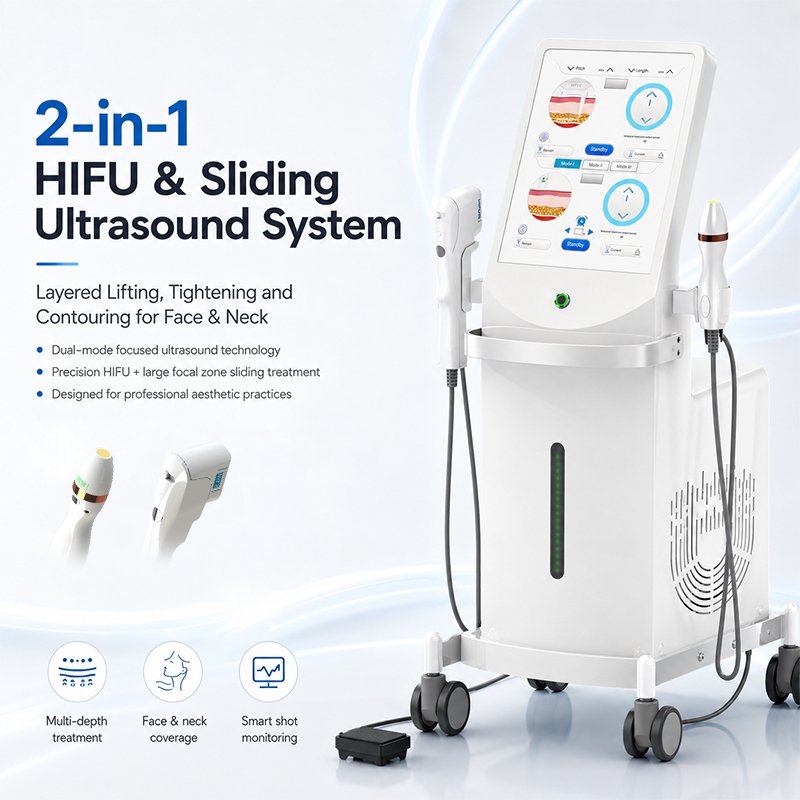
Micro-and-Macro Focused Ultrasound (MMFU) platforms layer several focal depths into one pass and frequently pair this with a sliding or scanning applicator that covers larger areas per stroke than fixed-point heads. That translates into shorter chair time per client — valuable for throughput — but it also raises the bill of materials.
3. Power delivery and thermal management.
Units built with real-time temperature feedback, higher-spec transducer chips, and active cooling cost more upfront, largely because these features cut misfire rates and stretch transducer service life — a factor that compounds over a 3–5 year ownership window.
One area buyers frequently overlook: cartridge and shot-count economics. A machine that appears inexpensive at checkout but burns through cartridges priced at USD 150–400 each can quietly cost more over two years than a pricier unit with a higher shots-per-cartridge rating.
HIFU Machine Configuration Comparison
| Dimension | Entry-Level (3D/4D) | Mid-Range (7D) | Full Configuration (12D/22D MMFU) |
|---|---|---|---|
| Typical factory-direct price | USD 2,500–4,000 | USD 4,000–6,000 | USD 6,000–8,500+ |
| Cartridge/transducer count | 3–4 | 7 | 10–22 |
| Treatment lines covered | Face only | Face + neck + brow | Face + neck + body contouring |
| Shot count per cartridge | 300–3,000 | 3,000–10,000 | 10,000–20,000 |
| Scanning technology | Fixed-point manual | Fixed-point, multi-depth | Sliding/scanning MMFU head |
| Real-time cooling/monitoring | Basic or none | Standard | Advanced with temperature feedback |
| Typical clinic throughput/day | 2–4 sessions | 4–8 sessions | 8–15 sessions |
| Recommended buyer profile | New med-spa, low volume | Established clinic, mixed services | High-volume clinic or multi-branch operator |
Comparison built across eight dimensions: price, transducer count, treatment coverage, shot count, scanning method, cooling system, daily throughput, and ideal buyer profile.
Whenever you’re stacking quotes side by side, normalize for shot count and cartridge replacement cost first. A cheaper machine paired with a low shot count often loses the cost-per-treatment race within the first year of use.
Clinic ROI Model: 3-Scenario Breakdown
The table below models a mid-range 7D HIFU unit (roughly USD 5,000 factory-direct) across three utilization levels. Assumptions used: USD 400 average session price, USD 250 cartridge replacement cost every 300 shots, and no incremental staffing expense beyond current headcount.
| Scenario | Sessions/Month | Monthly Revenue | Est. Monthly Consumable Cost | Est. Net Monthly Contribution | Approx. Breakeven Timeline |
|---|---|---|---|---|---|
| Conservative | 6 | USD 2,400 | USD 500 | USD 1,900 | ~9–11 months |
| Standard | 12 | USD 4,800 | USD 900 | USD 3,900 | ~4–5 months |
| Full Capacity | 20 | USD 8,000 | USD 1,400 | USD 6,600 | ~2–3 months |
These figures are illustrative projections, not financial guarantees. Real outcomes will shift based on local pricing norms, marketing investment, staff proficiency, client acquisition cost, equipment uptime, and jurisdiction-specific regulatory obligations. Run the numbers again with your own local session pricing and realistic booking assumptions before committing to a purchase.
Who Should Be Buying a HIFU Machine in 2026
This guide is built primarily around four buyer profiles:
- Medical spa and aesthetic clinic owners adding HIFU as a new non-invasive skin tightening line, whether as a standalone offering or paired with RF microneedling and other contouring services.
- Regional distributors stocking HIFU inventory for resale across Southeast Asia, the Middle East, Latin America, and Eastern Europe, where factory-direct relationships have an outsized effect on margin.
- Multi-branch clinic groups standardizing equipment across several locations, where total cost of ownership across 5–10 units makes cartridge economics and warranty terms a material budget line.
- New market entrants who need CE/FDA/MDR-compliant paperwork on hand to clear customs and satisfy local device registration rules.
This isn’t a consumer buying guide — commercial HIFU equipment is engineered for clinical throughput and requires trained operators, not home use.
Buying Checklist: What to Verify Before You Order
1.Certification paperwork
Ask for the CE certificate, FDA clearance or listing status, and MDR technical file references before any deposit changes hands. Where possible, cross-check certificate numbers against public regulatory registries.
2.Transducer origin and warranty terms
Confirm whether transducers are built in-house or sourced from a third-party supplier, and get warranty coverage in writing (commonly 12–24 months on the main console, shorter on consumable cartridges).
3.Documented shot count per cartridge
This figure needs to be in the written quotation, not just spoken assurance — it’s the single largest driver of your actual cost per treatment.
4.After-sales support structure
Find out whether technical support, spare parts, and replacement cartridges route through a regional office or distributor, or whether you’ll be contacting the factory directly with longer shipping lead times.
5.Training and protocol materials
Make sure the supplier includes operator training resources or remote onboarding, since incorrect depth settings affect both outcomes and how safe clients perceive the treatment to be.
6.Demo units or trial orders
Where the supplier allows it, request a demo unit or a live factory video walkthrough before signing off on a bulk distributor order.
7.Full landed cost
Add shipping, import duties, and any local certification/registration fees on top of the quoted price — the factory-direct number rarely reflects what it costs to get the machine running in your clinic.
Ready to compare configurations for your specific market? Reach out to the MNLT Laser team with your target treatment lines and volume expectations for a tailored quotation.
Frequently Asked Questions
How much does a professional HIFU machine cost in 2026?
What does the "D" number (4D, 7D, 12D, 22D) mean in HIFU machines?
Is factory-direct HIFU machine sourcing safe for clinics and distributors?
How long does it take a clinic to break even on a HIFU machine?
What certifications should a HIFU machine have before import?
With 15+ years of expertise in optoelectronic and medical aesthetic engineering, David leads MNLT's R&D team across the full professional aesthetic device portfolio, ensuring all technical content meets the highest standards of accuracy and clinical safety.
Get a Factory-Direct HIFU Machine Quotation
Picking the right HIFU configuration comes down to your clinic’s treatment volume, target markets, and the consumable budget you’re comfortable carrying over the machine’s lifecycle. MNLT Laser brings 19 years of manufacturing experience and CE/FDA/MDR-certified production, supplying HIFU machines factory-direct to clinics and distributors across 120+ countries. For a configuration recommendation and a formal price quotation matched to your treatment-line needs, get in touch with the MNLT Laser team for current pricing and lead times.