

At a Glance: Key Findings for Clinic Decision-Makers
- Brand Acquisition Premium: Brand-name systems like BTL Emsella typically cost between $45,000 and $65,000 USD, burdened with territory restrictions and mandatory annual maintenance agreements.
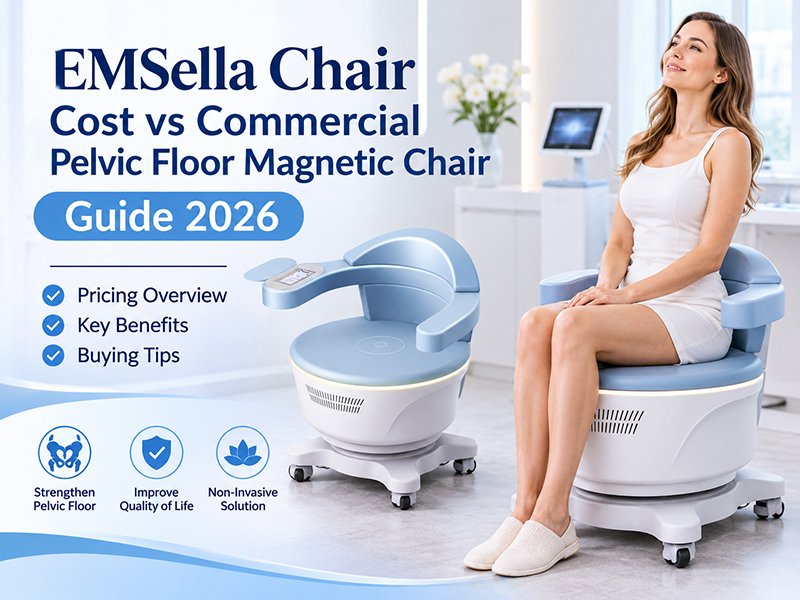
- Direct-Manufacturer Commercial Cost: Certified commercial-grade pelvic floor magnetic chairs provide equivalent bio-electromagnetic induction (up to 7.0 Tesla coil capacity, 50Hz, 10 cm penetration) for just $1,500 to $2,000 USD ex-factory.
- Zero Recurring Consumables: Commercial pelvic chairs operate with absolute zero consumable cards, RFID tokens, or handpiece renewal fees—ensuring a 98%+ gross operating margin per treatment.
- Clinical Therapeutic Parity: Both platforms deliver approximately 12,000 supramaximal contractions per 30-minute session, activating deep pubococcygeus and iliococcygeus motor units impossible to isolate through voluntary exercise.
- Unmatched Payback Velocity: While brand-name systems require 8 to 14 months to break even, a direct-from-factory chair breaks even after treating just 1 to 2 patient packages (typically within 7 to 14 days).
- Multi-Condition Versatility: Advanced commercial platforms integrate dedicated Dual Clinical Modes: Female Postpartum Laxity/SUI and Male Prostate Rehabilitation/Core Vitality.
For modern medical spas, pelvic health centers, and aesthetic clinics, non-invasive body wellness has expanded far beyond superficial fat reduction. Today, pelvic floor muscle rehabilitation and intimate wellness represent one of the highest-growth, highest-retention cash-pay services in elective medicine.
When researching equipment to treat urinary incontinence and postpartum laxity, practitioners inevitably encounter the market’s pioneer: the BTL Emsella chair. However, as capital expenditure budgets face heightened scrutiny in 2026, clinic owners are asking a crucial financial question: What is the true total cost of ownership for an Emsella chair, and how does it compare to modern commercial-grade pelvic floor magnetic chairs direct from certified medical equipment manufacturers?
In this technical buying and return-on-investment (ROI) analysis, we dissect equipment pricing, electromagnetic coil engineering, ongoing operational overhead, and multi-protocol clinical utility to help your practice make an evidence-based capital investment.
1. The Technology Foundation: How Focused Magnetic Stimulation Re-Educates Pelvic Floor Muscles
To understand the clinical equivalence between systems, clinic owners must examine the underlying bio-electromagnetic mechanics. Both proprietary pioneer devices and industrial-grade commercial chairs rely on High-Intensity Focused Electromagnetic (HI-EMT / PEMF) induction.
Unlike surface electrical muscle stimulation (EMS) or transvaginal probes that cause localized discomfort, focused magnetic flux lines pass completely uninhibited through human clothing, adipose tissue, and pelvic bones:
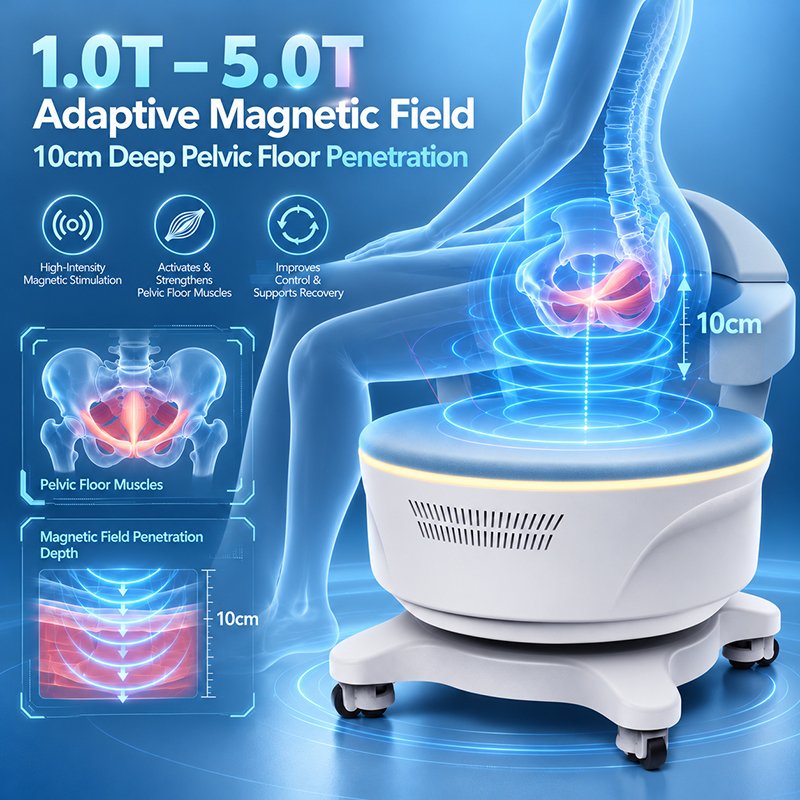
- 10 cm Deep Tissue Penetration: The circular magnetic coil embedded beneath the ergonomic seat creates a localized, alternating magnetic field. This field penetrates up to 10 centimeters into the pelvic cavity.
- Motor Neuron Depolarization: The alternating flux induces secondary micro-electrical currents within pelvic tissue, depolarizing the peripheral motor neurons of the pudendal nerve branch.
- 12,000 Supramaximal Contractions: The muscle fibers respond with rapid, continuous “supramaximal” contractions—tension levels approximately 100% higher than the maximum physiological capacity achievable through voluntary Kegel exercises.
- Structural Myofibril Remodeling: These contractions trigger mechanotransduction pathways, accelerating actin and myosin synthesis, tightening the endopelvic fascia, and elevating the bladder neck to restore mechanical continence.
From an engineering standpoint, the physiological outcome depends strictly on magnetic flux density (Tesla rating), pulse frequency (Hz), and coil geometry—not the brand logo printed on the exterior chassis.

2. Comprehensive Capital & Operational Cost Comparison
When investing in medical aesthetic hardware, clinic profitability hinges on both the initial capital expenditure (CapEx) and recurring operational expenditure (OpEx). Below is an objective commercial comparison between brand-name Emsella systems and certified OEM/ODM medical-grade pelvic floor magnetic chairs.
| Commercial Parameter | Brand-Name System (e.g., BTL Emsella) | Commercial Pelvic Magnetic Chair (MNLT S1) |
|---|---|---|
| Initial Capital Cost (CapEx) | $45,000 – $65,000 USD (Base Unit) | $1,500 – $2,000 USD (Direct Factory Pricing) |
| Magnetic Intensity Capacity | 2.5 – 3.0 Tesla Clinical Output | 1.0 – 5.0 Tesla Adaptive (7.0 Tesla Peak Coil Capacity) |
| Pulse Frequency Output | Up to 50 Hz | 50 Hz Multi-Frequency Adaptive Protocols |
| Recurring Consumables / Cards | Card/token lock systems on select models ($15–$30/cycle) | $0.00 (Absolute Zero Consumables / Unlocked) |
| Clinical Operating Modes | Urinary Incontinence Standard Presets | Dual Dedicated Suites: Female Postpartum & Male Intimate |
| Mobility & Space Planning | Stationary Chair Base / Separate Console Cart | Integrated Chassis + 4 Step-Lock 360° Omnidirectional Wheels |
| Warranty & Service Model | Annual service contracts ($3,500+/yr after Year 1) | 2-Year Direct Factory Warranty + Modular Component Swap |
| Average Break-Even Timeline | 8 – 14 Months (at 10 sessions/week) | 7 – 14 Days (Just 1–2 Patient Packages) |
3. Clinic Financial Modeling: 30-Day and 12-Month ROI Breakdown
Because pelvic floor re-education requires a cumulative clinical course, patient packages are traditionally sold in series of 6 to 8 sessions (typically scheduled as two 30-minute treatments per week for 3 to 4 weeks).
Standard Market Pricing Benchmark (North America & Western Europe)
- Single Treatment Session: 175–175–250 USD
- Full 6-Session Clinical Package: 1,200–1,200–1,800 USD
- Maintenance Subscription (1 session/month): $150 USD/month
The 12-Month Revenue Simulation (Conservative 2 Clients Per Day Model)
Assuming a modest clinic flow of just 10 completed sessions per week (equivalent to completing 1.6 patient packages per week):
- Weekly Gross Revenue: 10 sessions × 200average=200average=2,000 USD / week
- Monthly Gross Revenue: 4 weeks × 2,000=2,000=8,000 USD / month
- Direct Operational Overhead: Paper liners, sanitization wipes, and electricity (≈ 30/month)=30/month)=30 USD
- Net Monthly Operating Margin: $7,970 USD / month (99.6% gross margin)
With an investment in a factory-direct pelvic floor magnetic chair at approximately $6,500 USD landed cost, the clinic achieves 100% equipment payback in less than 5 weeks. Every dollar generated from Week 6 onward flows directly into practice profit.
4. Clinical Synergy: Bundling Pelvic Rehabilitation with Body Contouring
Forward-thinking medspas maximize revenue per square foot by designing comprehensive wellness pathways. Rather than offering pelvic floor therapy as an isolated service, leading clinics pair it synergistically with existing non-invasive devices:
- The Complete “Mommy Makeover” Bundle: Combine pelvic floor rehabilitation with localized sub-zero cryotherapy using Cryoskin body contouring systems. While cryotherapy eliminates stubborn postpartum abdominal fat pockets and stimulates dermal collagen, the magnetic chair simultaneously tightens separated pelvic muscle groups. This dual-action package easily commands 2,800to2,800to4,000 USD.
- Systemic Recovery & Longevity Packages: In holistic wellness centers, pairing pelvic therapy with regenerative hyperbaric oxygen therapy via medical mild hyperbaric oxygen chambers accelerates cellular mitochondrial repair, reduces systemic inflammation, and speeds neuromuscular recovery.
- Executive Men’s Vitality Suites: Combine the magnetic chair’s Male Prostate Mode with acoustic shockwave protocols to treat chronic pelvic pain syndrome (CPPS), nocturia, and erectile dysfunction without pharmaceutical side effects.
5. Key Engineering Criteria When Sourcing Direct-from-Factory
When bypassing distributor markups to procure direct from manufacturing leaders like Shandong Moonlight Electronics (MNLT), clinicians should verify five critical quality benchmarks:
- Continuous Power Supply Capacity: Ensure the power module delivers ≥ 1200W of sustained energy to prevent magnetic field drop-off during peak supramaximal contraction cycles.
- Thermal Management Architecture: High-density copper coils generate substantial thermal energy. Ensure the chassis features high-airflow louvers and digital microprocessor temperature cut-offs to prevent treatment interruptions.
- Ergonomic Contour & Weight Rating: Look for an integrated structural steel skeleton rated for patient weights up to 150 kg (330 lbs), covered in antimicrobial, hospital-grade vegan leather that withstands medical-grade disinfectants.
- Independent Medical Certification: Verify compliance with CE Electrical Safety Standards, Class I / BF Type shock protection, and ISO 13485 medical device quality management systems.
- Mobility Engineering: Select a system equipped with 360° omnidirectional wheels and mechanical step-locks. This allows a single operator to effortlessly move the chair between treatment suites.
Inquire Now
Fill out the form for more information, and an MNLT product manager will contact you shortly!
Frequently Asked Questions (FAQ)
How much does an Emsella chair typically cost compared to commercial alternatives?
A new BTL Emsella chair generally costs between $45,000 and $65,000 USD from authorized distributors, with additional annual service contracts. In contrast, certified medical-grade commercial pelvic floor magnetic chairs offering equivalent High-Intensity Focused Electromagnetic output (up to 7.0 Tesla, 50Hz, 12,000 contractions per session) cost approximately $5,500 to $8,500 USD direct from manufacturing facilities, eliminating distributor overhead while delivering identical physiological results.
Are there any recurring consumable costs or locked treatment activation fees?
The MNLT S1 Professional Pelvic Floor Magnetic Chair operates with absolute zero consumable overhead. Unlike some brand systems that utilize RFID card activation tokens or per-click licensing fees, our factory-direct platform has no software locks, no disposable applicators, and no licensing charges. Clinics maintain a 99%+ gross profit margin on every session.
Does the treatment require patients to undress or use disposable internal probes?
No. The treatment is completely non-invasive and dignified. Focused electromagnetic flux lines penetrate up to 10 cm deep through normal everyday clothing into the pelvic floor musculature. Patients remain fully dressed throughout the entire 30-minute session, with no requirement for conductive gels, probes, or post-treatment recovery downtime.
Can pelvic floor magnetic chairs be used effectively for male patients?
Yes. While initially popularized for female postpartum recovery and stress urinary incontinence, the MNLT S1 features a specialized Male Clinical Mode. It is widely utilized in urology and men's health practices to alleviate post-prostatectomy urinary incontinence, relieve chronic pelvic pain syndrome, and improve erectile rigidity by strengthening the bulbocavernosus and ischiocavernosus musculature.
How long does it take for a clinic to recover the equipment investment?
Based on standard market rates of $1,200 to $1,800 USD for a 6-session clinical package, a clinic treating just 2 to 3 clients per day (10 to 15 sessions weekly) achieves complete capital payback on a factory-direct pelvic magnetic chair within 4 to 6 weeks. In comparison, a $55,000 USD brand-name platform typically requires 8 to 14 months to reach break-even under identical patient volume.
Reviewed by David Ma
CTO & Chief Bio-Electromagnetic Systems Engineer, MNLT Laser (Shandong Moonlight Electronics Tech Co., Ltd.)
With over 19 years of medical-aesthetic equipment manufacturing experience, David directs technical compliance, high-density magnetic flux coil testing, and international certification standards across MNLT's medical device product portfolio.