
At a Glance
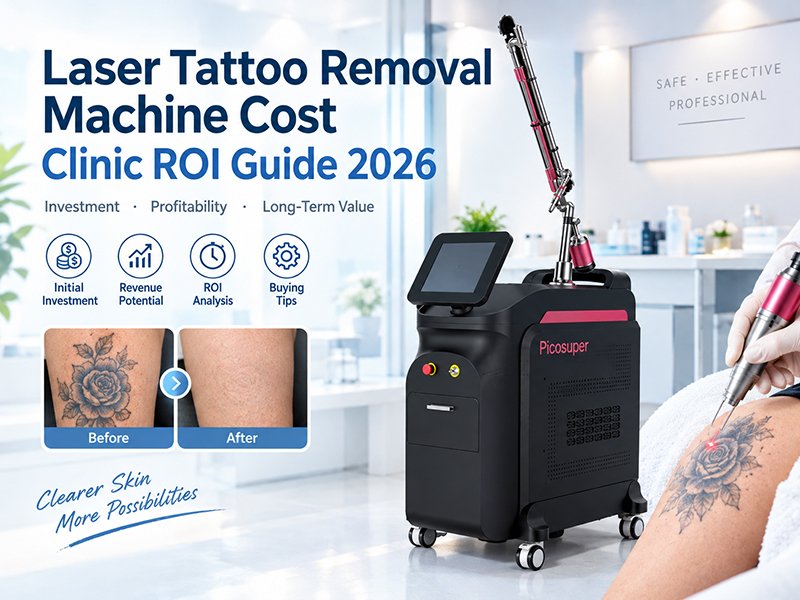
- Commercial laser tattoo removal machine capital costs range from $3,500 to $6,500 for entry-level Q-switched Nd:YAG systems, and $8,500 to $16,000 for medical-grade picosecond workstations via certified factory-direct sourcing, compared to $60,000–$140,000 through Western brand distributors.
- Optical technology dictates clinical efficacy: nanosecond Q-switched lasers break ink into coarse fragments requiring 8–12 sessions, while picosecond platforms deliver acoustic shockwaves that shatter pigment into micro-fine dust, cutting clearance cycles to 4–6 treatments.
- Hidden operational costs—including flashlamp pulse degradation, optical delivery arm realignment, deionized water filtration, and high-flow skin cooling systems—account for $1,200 to $2,800 annually if not factored into equipment selection.
- A single-room clinic or medical spa treating 4 tattoo removal patients daily (at an average package price of $1,200 for 6 sessions) generates $19,200 to $28,800 in gross monthly revenue, achieving 100% capital break-even within 35 to 60 operating days.
- Factory-direct procurement from an established manufacturer eliminates multi-tier distributor markups (typically 250% to 400%) while securing direct access to replacement laser cavities, optical lenses, and 24/7 engineering diagnostics.
- MNLT Laser (Shandong Moonlight Electronic Technology Co., Ltd.) brings 19 years of medical and aesthetic laser manufacturing experience, verified by CE, ISO 13485, and international safety compliance.
Laser tattoo removal represents one of the fastest-growing and highest-margin clinical procedures in modern aesthetic medicine. With more than 30% of tattooed adults in North America and Europe expressing tattoo regret, medical spas, dermatology clinics, and dedicated aesthetic centers face unprecedented patient demand.
However, prospective equipment buyers encounter extreme pricing discrepancies in the global market: domestic Western brand distributors quote 65,000to65,000to150,000 for brand-name laser systems, while overseas online marketplaces list desktop devices for under $2,000. Navigating this pricing landscape requires understanding laser physics, component build quality, hidden maintenance expenditures, and clinical treatment volume.
This definitive 2026 commercial buyer guide dissects the true costs of professional tattoo removal machines, contrasts Q-switched Nd:YAG with picosecond platforms, outlines hidden recurring expenses, and provides an actionable financial ROI model to guide your capital investment.
1. Capital Cost Spectrum: Factory-Direct vs. Distributor Markups
The price of a professional tattoo removal laser is primarily determined by its optical pulse duration, laser cavity engineering, pulse repetition stability, and distribution supply chain.
Supply Chain Markups vs. Factory-Direct Pricing:
┌────────────────────────────────────────────────────────────────────────┐
│ Western Distributor Retail Channel: │
│ Component Cost ──▶ OEM Factory ($10K) ──▶ Brand Distributor ($75K+) │
├────────────────────────────────────────────────────────────────────────┤
│ Certified Factory-Direct Procurement (MNLT Model): │
│ R&D + Precision Assembly ──▶ Direct Clinic Delivery ($4K – $14K) │
└────────────────────────────────────────────────────────────────────────┘
Commercial laser systems fall into four broad market tiers:
Tier 1: Portable Desktop Units ( 1 , 500 – 1,500–3,000)
Often marketed to small beauty salons, these compact desktop Q-switched units feature passive water cooling and small single-lamp laser cavities.
- Limitations: Prone to overheating after 15 minutes of continuous firing; unstable pulse energy output causes unpredictable tissue responses; maximum spot sizes rarely exceed 3 mm, making large tattoo treatments tedious and commercially impractical.
- Verdict: Not recommended for high-volume aesthetic clinics or licensed medical practices.
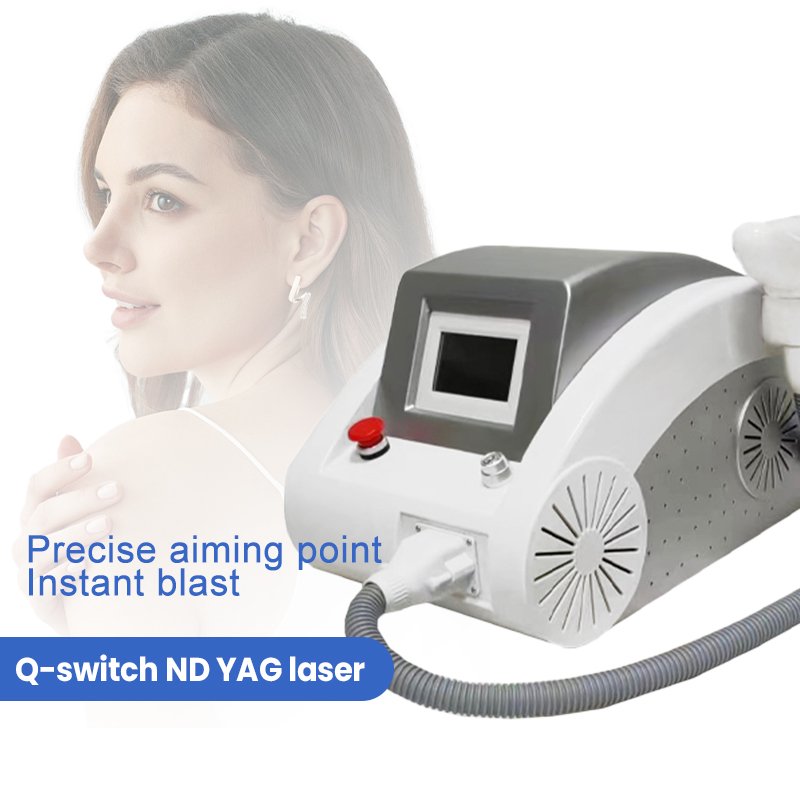
Tier 2: Commercial Q-Switched Nd:YAG Workstations ( 3 , 500 – 3,500–6,500 Factory-Direct)
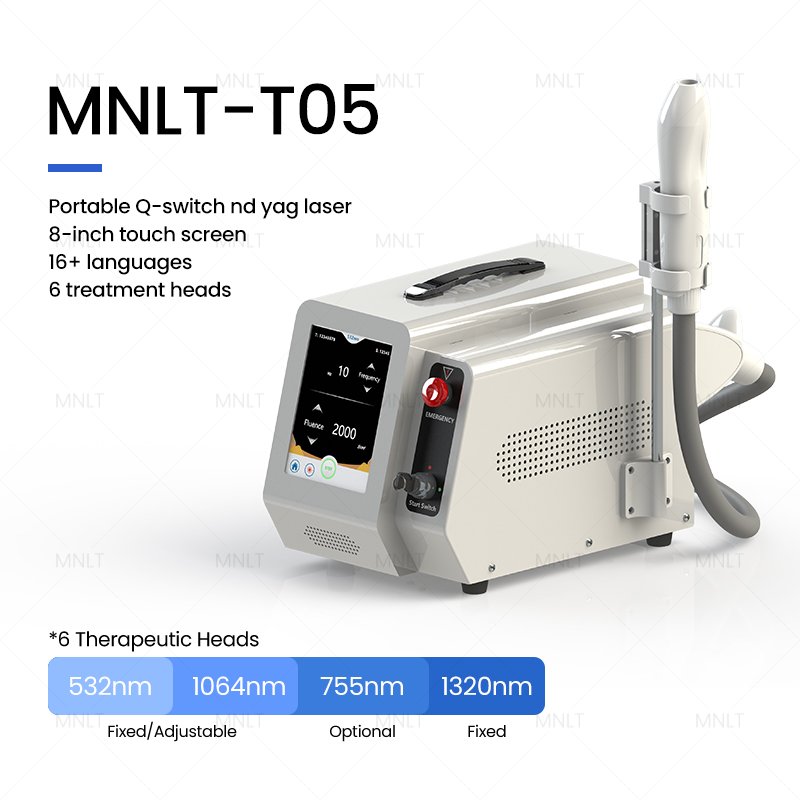
Industrial-grade vertical chassis systems equipped with external articulated optical arms or high-durability handpieces, dual rod/dual lamp cavities, and continuous closed-loop compressor cooling.
- Capabilities: Operates reliably at 1064nm and 532nm with fluences up to 15 J/cm215 J/cm2; capable of handling back-to-back 30-minute appointments without beam degradation.
- Verdict: The most cost-effective entry point for medical spas adding tattoo removal and carbon laser facials to their treatment menu.
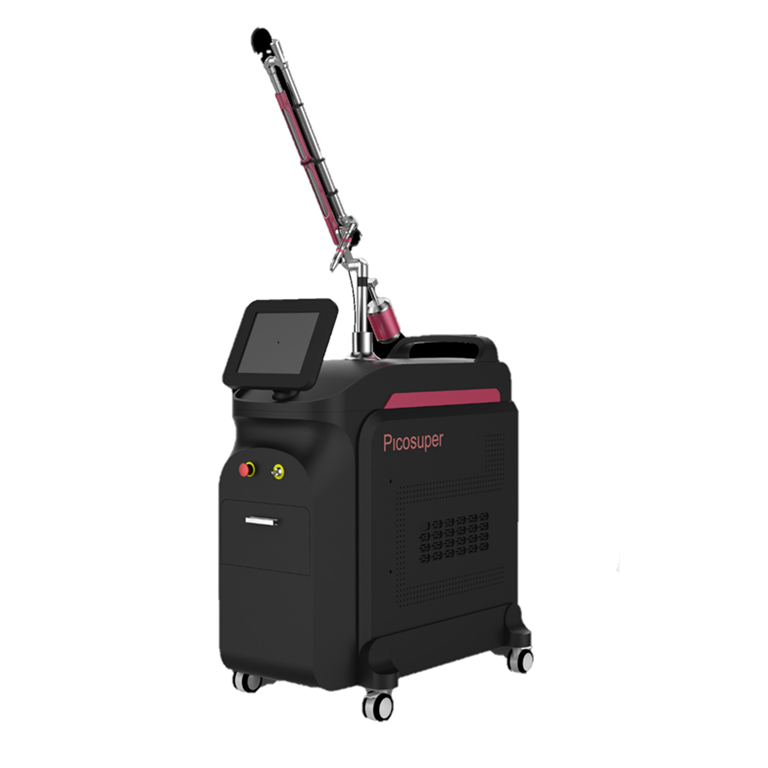
Tier 3: Industrial-Grade Picosecond Workstations ( 8 , 500 – 8,500–16,000 Factory-Direct)
Advanced platforms operating in the true sub-nanosecond domain (300 to 750 picoseconds). These systems utilize electro-optic seed-injection cavities, high-precision 7-joint articulated light guide arms imported from South Korea, and honeycomb Micro-Lens Array (MLA) handpieces.
- Capabilities: Delivers pure photoacoustic pigment pulverization; treats recalcitrant blue, green, and purple inks; safe on darker skin phototypes (Fitzpatrick IV–VI); commands premium treatment pricing.
- Verdict: The gold standard for dedicated tattoo removal specialty clinics and dermatology centers.
Tier 4: Western Brand Distribution Channels ( 65 , 000 – 65,000–140,000+)
Systems sold by major Western laser distributors (such as Candela, Cynosure, or Quanta) carry multi-tier distributor markups (typically 300% to 500%), expensive mandatory annual service contracts (8,000–8,000–15,000/year), and locked proprietary software.
- Verdict: Unnecessary capital expenditure for independent clinics that can source equivalent optical hardware directly from certified ISO 13485 manufacturers.
To explore certified clinical hardware specifications across different power classes, explore MNLT’s complete collection of professional tattoo removal machines.
2. Technology Selection: Q-Switched Nanosecond vs. Picosecond Laser
The biological mechanism of tattoo ink clearance determines how many sessions a patient requires, directly impacting clinic reputation, word-of-mouth referrals, and package pricing power.
Ink Disruption Mechanics Comparison:
Q-Switched Nanosecond Laser (Photothermal):
Laser Pulse (10⁻⁹ s) ──▶ Thermal Heating ──▶ Fractures Ink into “Pebbles” (8-12 Sessions)
Picosecond Laser (Photoacoustic Shockwave):
Laser Pulse (10⁻¹² s) ──▶ Acoustic Shockwave ──▶ Pulverizes Ink into “Fine Dust” (4-6 Sessions)
Photothermal vs. Photoacoustic Shockwaves:
- Q-Switched Nd:YAG (Nanosecond): Emits pulses between 5 and 20 nanoseconds (10−9 s10−9 s). The energy duration exceeds the acoustic stress relaxation time of pigment granules, heating the ink until it fractures through thermal expansion into coarse, sand-like fragments. Dermal macrophages clear these larger particles slowly, requiring 8 to 14 clinical sessions.
- Picosecond Lasers: Compress identical optical energies into 300 to 750 picoseconds (10−12 s10−12 s). This ultra-short duration creates extreme photomechanical shockwaves without thermal diffusion. The ink is pulverized into microscopic dust particles (<20 nm<20 nm), which are engulfed and eliminated by the lymphatic system up to 60% faster.
Wavelength Diversity & Chromatic Spectrum:
- 1064nm: Penetrates deepest into the reticular dermis; targets black, dark blue, and dense carbon ink while bypassing epidermal melanin, ensuring maximum safety on dark skin (Fitzpatrick IV–VI).
- 532nm (Frequency-Doubled KTP): Highly absorbed by superficial red, orange, and purple pigments, as well as epidermal freckles and sun spots.
- 755nm / 660nm / 585nm Dye Converters: Essential for breaking down stubborn green, turquoise, and sky-blue tattoo dyes that do not respond to 1064nm or 532nm.
- For a detailed clinical breakdown of pulse widths, spot sizes, and epidermal safety, read our companion clinical guide on Nd:YAG vs. Picosecond Laser for Tattoo Removal.
3. Technology & Pricing Comparison Matrix
The table below details procurement costs, optical specifications, and clinical capabilities across major laser tattoo removal technologies:
| Laser Technology | Wavelengths | Pulse Duration | Factory-Direct Cost | Distributor Price | Avg. Clearance Cycles |
|---|---|---|---|---|---|
| Q-Switched Nd:YAG (Standard) | 1064nm, 532nm | 5 – 20 ns | $3,500 – $6,500 | $35,000 – $65,000 | 8 – 14 Sessions |
| Medical Picosecond Laser | 1064nm, 532nm (opt. 755nm) | 300 – 750 ps | $8,500 – $16,000 | $75,000 – $140,000 | 4 – 6 Sessions |
| Q-Switched Ruby Laser | 694nm | 20 – 40 ns | $9,000 – $14,000 | $55,000 – $85,000 | 6 – 10 Sessions (Green/Blue only) |
| Q-Switched Alexandrite Laser | 755nm | 30 – 50 ns | $11,000 – $18,000 | $70,000 – $110,000 | 6 – 9 Sessions (Green/Teal) |
4. The Hidden Costs of Laser Ownership: What Distributors Don't Disclose
When budgeting for a commercial tattoo removal system, the upfront purchase price is only one component of your total cost of ownership (TCO). Operators must account for recurring operational expenses:
Total Cost of Ownership (TCO) Breakdown:
┌────────────────────────────────────────────────────────┐
│ Capital Equipment Cost (One-time, 70-80% of budget) │
├────────────────────────────────────────────────────────┤
│ Annual Consumables & Flashlamp Wear (~$600 – $1,200) │
├────────────────────────────────────────────────────────┤
│ Specialized Optical Articulated Arm Care (~$300 – $500)│
├────────────────────────────────────────────────────────┤
│ External Forced-Air Skin Cooling Unit ($1,800 – $2,500)│
└────────────────────────────────────────────────────────┘
Xenon Flashlamp Replacement Cycles:
- Solid-state laser rods (Nd:YAG crystals) are excited by high-voltage xenon flashlamps. A premium flashlamp delivers between 1,000,000 and 3,000,000 shots before energy output degrades by more than 15%.
- Replacement factory-direct lamps for professional Q-switched Nd:YAG laser machines cost approximately 250to250to450, whereas brand distributors charge up to $1,800 for the identical lamp assembly.
Optical Articulated Arm Realignment:
- High-end picosecond systems use a 7-joint articulated mirror arm to transmit the laser beam from the internal resonator cavity to the treatment handpiece.
- If the machine is moved roughly or subjected to thermal shock, the internal dielectric mirrors can drift out of alignment. Ensuring the manufacturer uses rigid gimbal mounts with anti-vibration locking screws eliminates the need for expensive technician service visits.
Deionized Water & Cooling Maintenance:
- High-power laser cavities generate significant waste heat. Using ordinary tap or bottled mineral water causes mineral scaling on the laser rod, leading to catastrophic crystal cracking.
- Systems require medical-grade deionized water (20/year)andannualinlinedeionizationfilterreplacements(20/year)andannualinlinedeionizationfilterreplacements(40/year).
Active Cryo Skin Cooling Systems:
- Laser tattoo removal generates intense localized thermal spikes in the epidermis. To minimize patient discomfort and prevent thermal blistering, clinics pair their laser with an external cold-air chiller delivering −30∘C−30∘C air flow.
- Sourcing a dedicated cold-air chiller adds approximately 1,800to1,800to2,500 to initial capital equipment budgets.
5. Clinic ROI & Payback Financial Modeling
Tattoo removal commands high procedural margins because it requires zero per-treatment consumables (unlike cartridges, chemical peels, or single-use tips). Once the capital equipment is installed, direct operating costs are limited to treatment room sanitization, barrier film, gauze, and electricity.
The financial model below illustrates the revenue potential and capital payback period for a clinic operating an MNLT commercial picosecond workstation:
| Operational & Financial Variable | Conservative Scenario | Moderate Growth Scenario | High-Volume Center |
|---|---|---|---|
| Initial Equipment Investment (Picosecond) | $11,500 (Turnkey unit) | $11,500 (Turnkey unit) | $11,500 (Turnkey unit) |
| Daily Patient Treatments | 2 patients / day | 4 patients / day | 8 patients / day |
| Monthly Operating Days | 22 days | 24 days | 26 days |
| Total Monthly Completed Sessions | 44 sessions | 96 sessions | 208 sessions |
| Average Charge per Session (Medium Tattoo) | $175 | $200 | $225 |
| Direct Consumable & Electric Cost / Session | $3.50 | $3.50 | $3.50 |
| Gross Monthly Treatment Revenue | $7,700 | $19,200 | $46,800 |
| Net Monthly Operating Profit | $7,546 | $18,864 | $46,072 |
| Full Capital Payback Period | 1.5 Months (46 days) | 0.6 Months (18 days) | 0.25 Months (< 8 days) |
Financial Modeling Takeaways
- Near-Zero Marginal Cost: Because solid-state laser treatments require no single-use consumables, operating gross profit margins exceed 97%.
- Rapid Payback Velocity: Even in a conservative startup scenario seeing only 2 clients daily, the entire $11,500 equipment investment is fully recovered within 46 operational days.
- Cross-Selling Revenue: Once tattoo removal clients achieve initial ink fading, clinics cross-sell lucrative skin rejuvenation procedures, including carbon laser peels and fractional acne scar remodeling.
6. Sourcing Strategy: 5 Critical Due-Diligence Checkpoints
Before signing a purchase order or sending a wire transfer, clinic buyers should evaluate prospective laser manufacturers against five objective criteria:
Manufacturing Verification Checklist:
[1] ISO 13485 & CE Directives ──▶ Verify Medical Quality System Audit
[2] Optical Resonator Build ──▶ Dual Lamp / AuSn Bonded Cavity
[3] Real Articulated Arm ──▶ Korean 7-Joint Precision Bearings
[4] Factory Cleanroom Staging ──▶ Class 10,000 Dust-Free Assembly
[5] Warranty & Engineering ──▶ 2-Year Core Warranty + 24/7 Remote Video
- Verify Genuine ISO 13485 & CE Certification: Ensure the manufacturer holds authentic ISO 13485 medical device quality certifications, not merely standard ISO 9001 factory certificates. Request third-party test reports verifying compliance with international electrical and laser safety directives.
- Inspect Resonator Cavity Architecture: Inquire whether the machine utilizes a single-lamp or dual-lamp cavity. Dual-lamp cavities provide consistent optical flattop beam profiles and sustain high repetition rates (10 Hz10 Hz) without pulse energy drop-off.
- Examine the Optical Light Guide Arm: High-precision picosecond systems must feature a counterbalanced 7-joint articulated arm imported from specialized optical fabricators in South Korea or Japan, ensuring minimal photon attenuation (<10%<10%) from resonator to handpiece.
- Demand Video Cleanroom Inspection: Authentic tier-one manufacturers assemble optical cavities within Class 10,000 dust-free cleanrooms. Request an unedited live video walkthrough of the factory’s production and testing bays.
- Evaluate Remote Technical Support: Ensure your purchase contract guarantees 24/7 direct remote video support with qualified optical engineers, modular plug-and-play replacement components, and fast-track courier dispatch (DHL/FedEx) within 48 hours.
7. The MNLT Manufacturing Advantage: 19 Years of Quality Assurance
Sourcing directly from Shandong Moonlight Electronic Technology Co., Ltd. (MNLT Laser) bridges the gap between high distributor markups and unverified low-end suppliers. Backed by 19 years of medical and aesthetic laser manufacturing experience, MNLT provides clinic owners with unmatched engineering reliability:
- Direct Factory-to-Clinic Pricing: Sourcing directly from our precision assembly facilities in Shandong eliminates 200% to 400% distributor markups, saving clinics tens of thousands of dollars in initial capital outlay.
- Engineered for Longevity: Every MNLT laser resonator is built with high-purity Nd:YAG crystals, UK-imported xenon flashlamps rated for millions of pulses, and internal Japanese compressor refrigeration for uninterrupted commercial operation.
- Comprehensive Clinical Training & Marketing Collateral: Every system includes certified clinical operating protocols, parameter recommendation guides, and white-label patient marketing assets to accelerate client acquisition from day one.
- Complete OEM/ODM Customization: We offer private-label industrial chassis styling, clinic software branding, and localized multilingual user interfaces for multi-location practices.
To receive an itemized factory quotation, schedule a live video demonstration, or discuss custom clinic financing options, contact the MNLT engineering team today.
Inquire Now
Fill out the form for more information, and an MNLT product manager will contact you shortly!
Frequently Asked Questions: Tattoo Removal Machine Procurement & ROI
Why do brand-name tattoo removal lasers cost over $80,000 while factory-direct models cost under $15,000?
The vast price discrepancy in the laser industry is largely driven by multi-tiered distribution networks, substantial marketing budgets, corporate overhead, and high distributor commissions rather than intrinsic component costs. Certified medical laser manufacturers assemble optical cavities using identical high-grade Nd:YAG crystals, UK xenon flashlamps, and Korean articulated arms. Purchasing directly from a vetted manufacturer eliminates third-party markups while delivering equivalent clinical performance and reliability.
How long does a laser flashlamp last, and what does it cost to replace?
A high-quality xenon flashlamp integrated into an MNLT laser resonator is rated for 1,000,000 to 3,000,000 shots, which translates to approximately 1 to 2 years of active commercial operation in a busy clinic. When the lamp reaches the end of its optical lifespan, replacement factory-direct lamps cost between $250 and $450. Replacing the lamp is a simple maintenance procedure supported by MNLT's modular plug-and-play cavity architecture and step-by-step video guidance.
Can a single tattoo removal laser remove all ink colors effectively?
A dual-wavelength 1064nm and 532nm system successfully eliminates over 90% of tattoos, including dense black, charcoal, navy, red, orange, and warm brown pigments. However, vibrant greens, light blues, and turquoise pigments do not absorb 1064nm or 532nm efficiently. For clinics seeking 100% full-color clearance, adding specialized dye handpieces (660nm and 585nm) or an optional 755nm Alexandrite wavelength is recommended to target stubborn cold-spectrum inks.
What additional equipment should a clinic purchase alongside a tattoo removal laser?
To ensure maximum patient comfort and procedural safety, clinics should invest in an external cold-air skin chiller (which blows -30°C air over the treatment area during laser delivery to prevent blistering and reduce pain), an industrial smoke evacuator with ULPA filtration to capture plume particles and laser odors, and certified optical safety goggles (OD 7+) calibrated specifically to 1064nm and 532nm wavelengths for both the practitioner and patient.
How quickly can a new clinic break even on an MNLT tattoo removal workstation?
Because laser tattoo removal involves negligible per-procedure consumable costs (approx. $3.50 per session for sanitation and protective supplies), gross profit margins exceed 97%. A clinic charging $200 per session and treating an average of 4 clients per day generates approximately $19,200 in monthly revenue, achieving 100% capital break-even on an $11,500 picosecond workstation in less than 20 operating days.
Reviewed by David Ma
CTO & Chief Engineer, MNLT Laser (Shandong Moonlight Electronic Technology Co., Ltd.)
19 years of medical and aesthetic laser manufacturing experience. David oversees MNLT's optical engineering and R&D laboratories, directing high-power diode bar development, multi-wavelength matrix architectures, and advanced clinical laser safety compliance.