

At a Glance
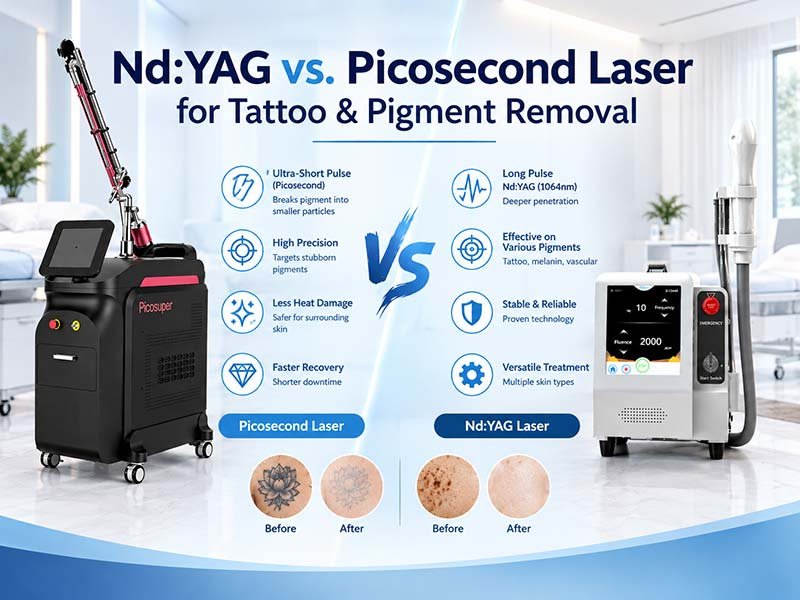
- Q-switched Nd:YAG lasers operate in the nanosecond pulse domain (10⁻⁹ s), primarily relying on photothermal heating to fracture exogenous tattoo ink and endogenous melanin into pebble-sized fragments requiring 8–12 treatment sessions.
- Picosecond lasers compress optical energy into trillionths of a second (10⁻¹² s), delivering an ultra-short pulse duration that falls below the acoustic stress relaxation time of pigment granules, generating pure photoacoustic shockwaves.
- The photoacoustic mechanism pulverizes pigment into micro-fine dust particles, accelerating phagocytosis by dermal macrophages and reducing complete clearance cycles to just 3–5 sessions.
- Picosecond technology drastically limits thermal diffusion into adjacent basal structures, reducing Post-Inflammatory Hyperpigmentation (PIH), epidermal blistering, and dermal scarring risks by up to 70% in darker Fitzpatrick IV–VI skin types.
- Wavelength distribution determines chromatic clearance: 1064 nm penetrates deepest for black/navy ink and dermal melasma; 532 nm targets superficial red/orange pigments; and fractional 755 nm / MLA honeycomb arrays stimulate neo-collagenesis for acne scar remodeling.
- From an equipment procurement perspective, nanosecond Q-switched Nd:YAG systems ($3,500–$6,500) serve entry-level salons with modest budgets, while medical-grade picosecond platforms ($8,500–$15,000) command higher treatment fees and deliver complete capital payback within 3–5 months.
- MNLT Laser provides certified factory-direct engineering, offering high-stability articulated arms, dual-pulse configurations, and comprehensive clinical training across all pigment-clearing platforms.
Laser tattoo removal and benign cutaneous pigment clearance represent one of the fastest-growing sectors in medical aesthetic dermatology. However, clinic owners, medical spa directors, and dermatologists face a critical capital expenditure dilemma: should you invest in an established, cost-effective Q-switched Nd:YAG laser, or upgrade to an advanced ultra-short picosecond laser platform?
Understanding the physics of laser-tissue interactions, chromatic absorption spectra, macrophage clearance kinetics, and total cost of ownership (TCO) is essential for selecting the right device. This comprehensive 2026 clinical guide analyzes the mechanical, biological, and economic distinctions between nanosecond Q-switched Nd:YAG and picosecond lasers to assist aesthetic practices in maximizing patient outcomes and capital return.
1. Laser Physics & Chromophore Interaction: Photothermal vs. Photoacoustic Mechanics
The clinical efficacy of any laser-based pigment removal system depends on the principle of Selective Photothermolysis, first conceptualized by Anderson and Parrish. However, the exact mechanism of pigment destruction diverges dramatically between nanosecond and picosecond pulse durations.
Nanosecond Pulse (5-20 ns):
Optical Energy ──▶ Photothermal Heating ──▶ Thermal Expansion ──▶ Pebble-Sized Granules
Picosecond Pulse (300-800 ps):
Optical Energy ──▶ Acoustic Shockwave ──▶ Stress Confinement ──▶ Micro-Dust Particles
The Nanosecond Regime: Photothermal Fragmentation
Traditional Q-switched Nd:YAG systems emit laser pulses in the nanosecond range (10−910−9 seconds, typically 5–20 ns). When targeted chromophores—such as exogenous tattoo pigments or endogenous melanin—absorb this optical energy, rapid thermal heating occurs.
- The target heats to temperatures exceeding several hundred degrees Celsius.
- Thermal expansion fractures the ink particle via thermo-mechanical cracking.
- However, because nanosecond pulses exceed the acoustic stress relaxation time of tiny ink granules (typically sub-nanosecond), substantial thermal energy diffuses outward into adjacent tissue.
- This leaves ink fractured into relatively coarse, “pebble-like” or sand-sized debris, requiring substantial enzymatic and lymphatic macrophage activity over extended 6- to 8-week intervals.
The Picosecond Regime: Photoacoustic Stress Confinement
Picosecond lasers deliver energy in trillionths of a second (10−1210−12 seconds, typically 300–750 ps). By compressing immense peak power into a pulse duration shorter than the acoustic transit time across the target chromophore, the system achieves optical stress confinement:
- Acoustic Wave Generation: The speed of energy delivery exceeds the rate at which mechanical stress can dissipate from the particle.
- Brittle Shockwave Shattering: Intense acoustic pressure waves (shockwaves) build instantaneously within the pigment granule, shattering it mechanically rather than boiling it thermally.
- Dust-Particle Fractionation: Instead of pebble-like fragments, the picosecond shockwave pulverizes ink into an ultra-fine, dust-like consistency (often less than 10–20 nm in diameter).
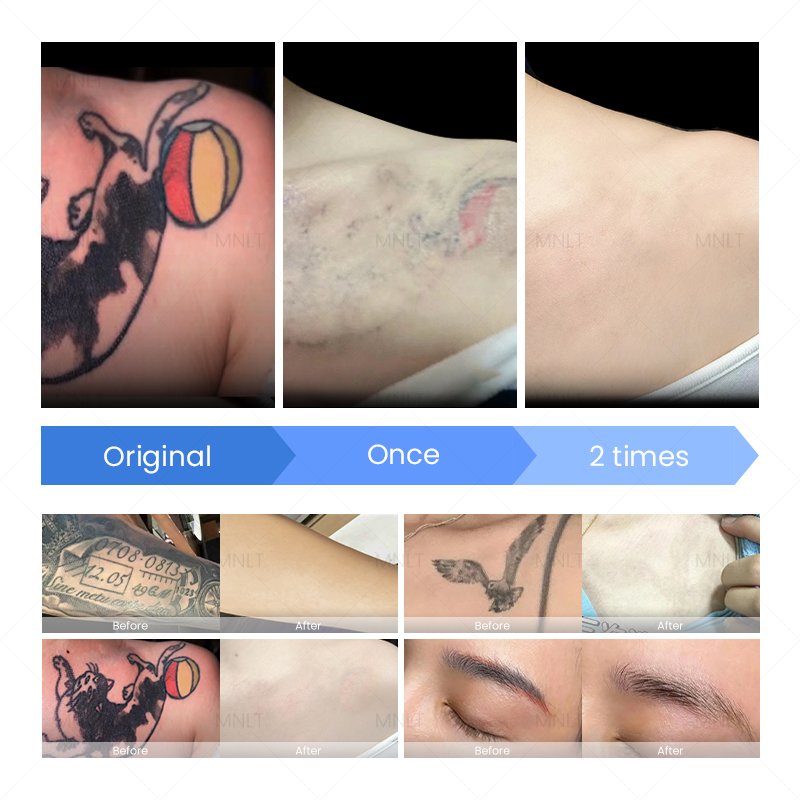
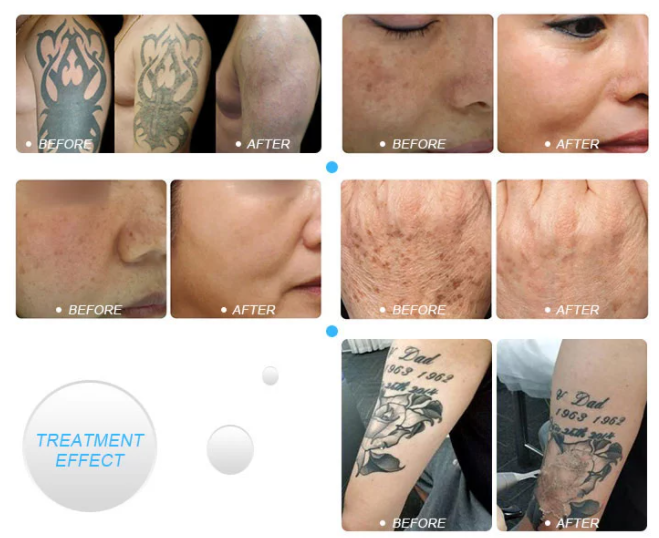
Because micro-dust particles present an exponentially greater surface-area-to-volume ratio, scavenging dermal macrophages engulf and transport the shattered pigment through the lymphatic drainage system significantly faster. Consequently, complete tattoo clearance that previously required 10–14 nanosecond sessions can often be achieved in 4–6 picosecond treatments.
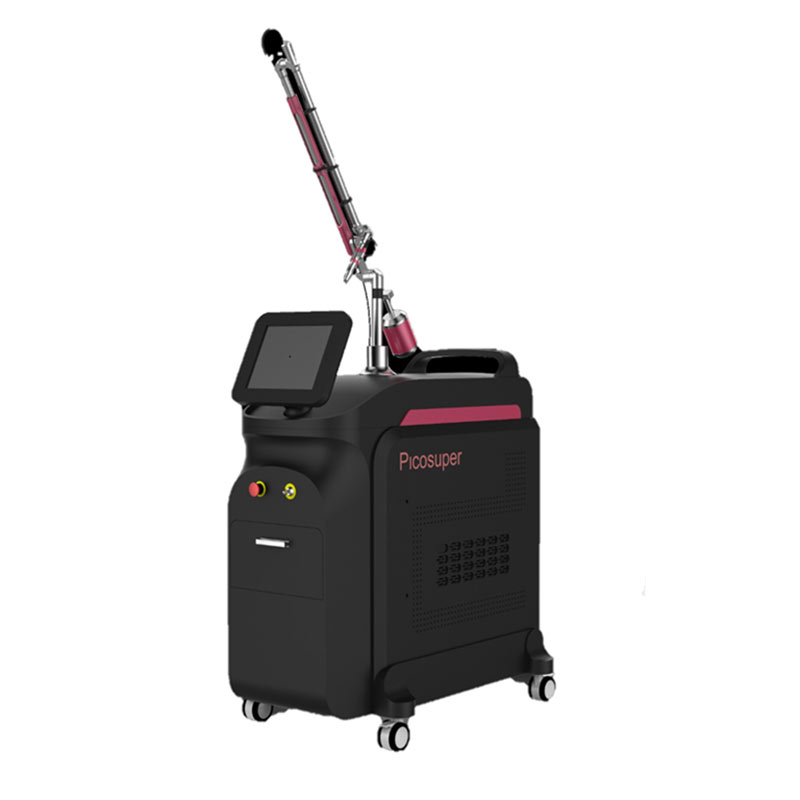
For clinics planning a broader treatment menu, explore MNLT’s complete range of certified professional tattoo removal machines.
2. Comprehensive Technology & Performance Comparison
The following engineering and clinical matrix delineates the technical parameters between standard Q-switched Nd:YAG lasers and industrial-grade picosecond platforms:
| Clinical Specification | Q-Switched Nd:YAG Laser | Professional Picosecond Laser |
|---|---|---|
| Pulse Duration | 5 – 20 nanoseconds (10⁻⁹ s) | 300 – 750 picoseconds (10⁻¹² s) |
| Primary Disruption Mechanism | Photothermal (heat absorption + cracking) | Photoacoustic / Photomechanical (pressure shockwave) |
| Average Clearance Sessions | 8 – 14 sessions | 3 – 6 sessions (approx. 50% fewer visits) |
| Post-Shatter Particle Size | Coarse sand / pebble-sized debris | Micro-fine dust powder (<20 nm) |
| Collateral Thermal Diffusion | Moderate to High (requires inter-pulse cooling) | Negligible (thermal confinement verified) |
| Risk of PIH (Fitzpatrick IV–VI) | 18% – 32% incidence rate | 4% – 9% incidence rate (>70% risk reduction) |
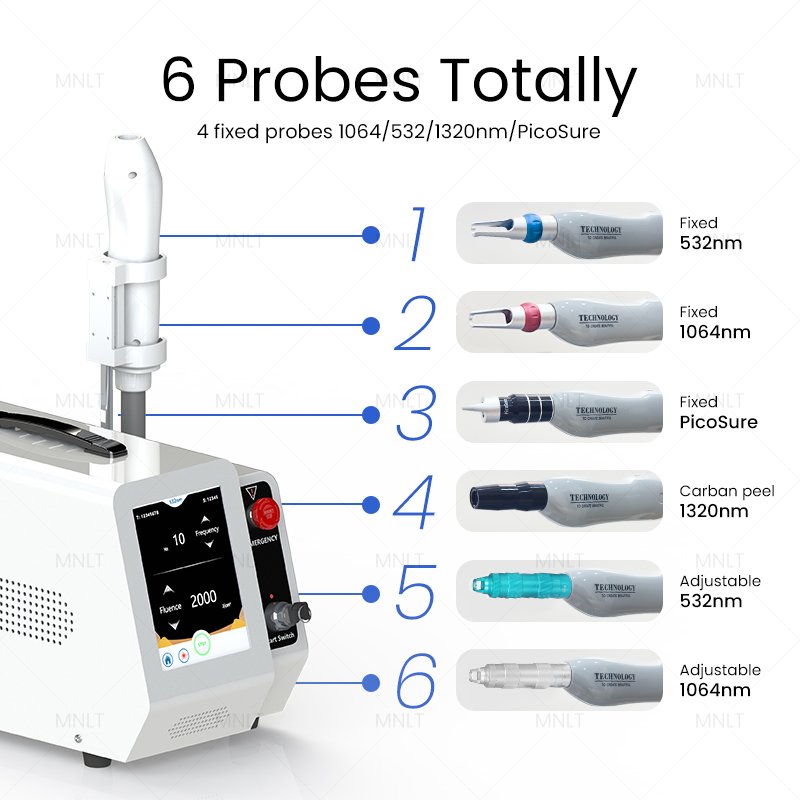
| Standard Optical Wavelengths | 1064 nm & 532 nm (KTP crystal) | 1064 nm, 532 nm, optional 755 nm & 660 nm/585 nm dye |
| Ghosting / Recalcitrant Tattoo Clearance | Frequent plateau after 6–8 sessions | High efficacy on faded/recalcitrant inks |
| Rejuvenation / Scar Remodeling | Carbon peel ("Hollywood Peel") only | LIOB (Laser-Induced Optical Breakdown) via MLA lens |
| Capital Investment (Equipment Cost) | $3,500 – $6,500 (Factory-direct) | $8,500 – $15,000 (Factory-direct industrial grade) |
3. Chromatic Wavelength Breakdown: Matching Laser Spectrum to Ink & Melanin
Neither pulse duration can compensate for optical mismatch. Successful clearance requires pairing the appropriate laser wavelength with the specific target absorption profile.
Wavelength Selection Guide:
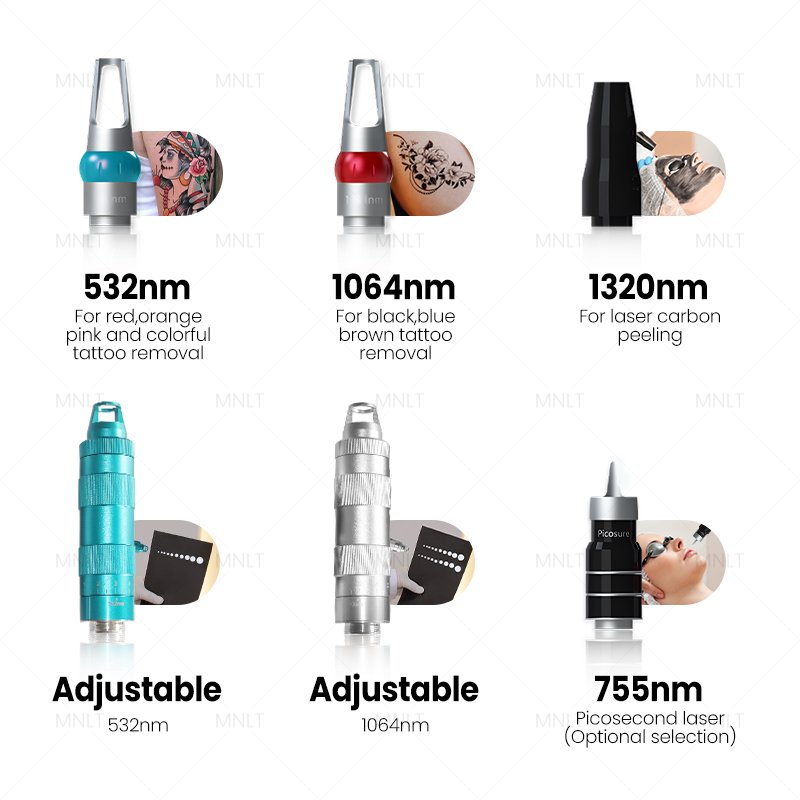
1064 nm ──────▶ Black, Dark Blue, Grey Inks | Deep Dermal Melasma | Fitzpatrick IV-VI Safe
532 nm ──────▶ Red, Orange, Yellow Inks | Epidermal Freckles, Lentigines, Sun Spots
755 nm ──────▶ Green, Cyan, Sky Blue Inks | Dermal Neo-Collagenesis (with MLA Lens)
1064 nm Fundamental Infrared Wavelength
- Primary Indications: Dense black, dark blue, charcoal, and grey tattoo pigments; deep dermal melanocytosis (Nevus of Ota, Hori’s nevus, refractory dermal melasma).
- Clinical Advantage: 1064 nm penetrates deeply into the reticular dermis with minimal absorption by epidermal melanin. This makes 1064 nm the gold-standard wavelength for safely treating darker skin phototypes (Fitzpatrick IV–VI) without inducing hypopigmentation or epidermal stripping.
532 nm Frequency-Doubled KTP Wavelength
- Primary Indications: Red, orange, purple, and brown inks; superficial epidermal lesions (ephelides/freckles, cafe-au-lait macules, solar lentigines).
- Clinical Advantage: 532 nm exhibits an exceptionally high absorption peak for both hemoglobin and red/brown pigment. However, due to competing epidermal melanin absorption, 532 nm requires conservative fluence and precise clinical judgment on Fitzpatrick III–VI skin to avoid blistering.
755 nm Alexandrite & Dye Handpieces (660 nm / 585 nm)
- Primary Indications: Recalcitrant green, lime, turquoise, and sky-blue tattoo inks that reflect 1064 nm and 532 nm light.
- Fractional Rejuvenation (LIOB): When equipped with a Micro-Lens Array (MLA) or honeycomb diffractive lens, picosecond output creates Laser-Induced Optical Breakdown (LIOB) in the epidermis and papillary dermis. LIOB creates microscopic acoustic cavitation vacuoles without thermal epidermal ablation, stimulating rapid fibroblast neocollagenesis and elastin synthesis for acne scar remodeling and pore tightening with near-zero downtime.
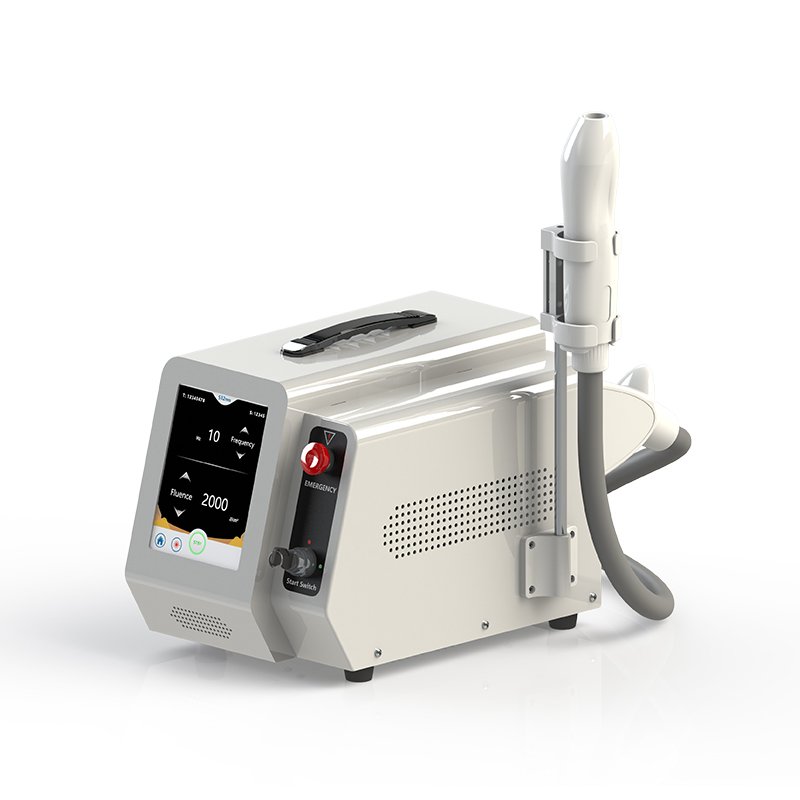
Clinics focusing primarily on classic pigment removal can review specifications for MNLT’s dedicated Q-switched Nd:YAG laser machine configurations.
4. Clinical Safety & Darker Phototypes (Fitzpatrick IV–VI)
In multi-ethnic aesthetic practices across Europe, North America, Southeast Asia, and the Middle East, safety on darker skin tones (Fitzpatrick IV–VI) determines clinic reputation and legal compliance.
Thermal Injury Risk Comparison:
Nanosecond: [==== Extended Heat ====] ──▶ Melanocyte Irritation ──▶ High PIH Risk
Picosecond: [=Spike=] ──▶ Minimal Heat Spread ──▶ Low PIH Risk
The Mechanism of Post-Inflammatory Hyperpigmentation (PIH)
When nanosecond pulses heat dermal pigment, peripheral thermal dissipation warms surrounding basal melanocytes. In Fitzpatrick IV–VI skin, heat-stressed melanocytes release prostaglandins, leukotrienes, and endothelin-1, triggering reactive hyper-melanogenesis.
- Clinical Outcome with Nanosecond Nd:YAG: Clinicians must space treatments 8–10 weeks apart, apply lower fluences, and still accept a 20%–30% risk of transient or persistent PIH.
- Clinical Outcome with Picosecond Lasers: The ultra-short pulse duration traps optical energy strictly within the chromophore. Because thermal relaxation is negligible, basal melanocytes remain undisturbed by heat shocks. Peer-reviewed clinical literature demonstrates a greater than 70% reduction in PIH incidence when clearing pigments with picosecond pulses compared to nanosecond protocols on darker phototypes.
5. Economic & ROI Analysis: Nanosecond vs. Picosecond Capital Expenditure
Investing in laser technology requires balancing initial acquisition cost against operational velocity, patient turnover, and revenue per treatment hour.
| Financial Dimension | Q-Switched Nd:YAG Laser | Industrial Picosecond Laser |
|---|---|---|
| Initial Factory-Direct Investment | $4,500 – $6,000 | $9,500 – $13,500 |
| Average Charge per Tattoo Session | $100 – $150 (Standard market rate) | $200 – $350 (Premium rapid clearance rate) |
| Total Package Revenue per Patient | $1,000 (10 sessions @ $100) | $1,250 (5 sessions @ $250) |
| Patient Treatment Cycle Time | 12 – 18 months total elapsed time | 4 – 6 months total elapsed time |
| Monthly Patients Required for Payback | 10–12 active patients (4–5 months) | 8–10 active patients (3–4 months) |
| Ancillary Service Revenue | Carbon Peels ($120/session) | Pico Skin Toning & Scar Remodeling ($300/session) |
ROI Takeaway for Clinic Planners
While a Q-switched Nd:YAG laser requires less upfront capital, a picosecond laser dramatically accelerates clinic cash flow. Because picosecond patients finish their packages in 4–6 months instead of 18 months, clinical satisfaction and referral velocity multiply. Furthermore, adding the MLA honeycomb fractional lens opens an entire medical facial menu (pore minimization, melasma control, acne scar restoration) that commands 250–250–400 per 30-minute session with zero consumable costs.
For practices expanding their aesthetic services across hair removal and body contouring, pairing a picosecond workstation with our flagship diode laser hair removal systems creates a comprehensive clinical offering.
6. How to Choose: Decision Framework for Your Practice
Clinic Procurement Decision:
├─ Budget < $7,000 OR Entry-Level Salon ────────────▶ Q-Switched Nd:YAG
└─ High-Volume Clinic OR Darker Phototypes (IV-VI) ──▶ Industrial Picosecond Laser
Scenario A: Choose a Q-Switched Nd:YAG Laser If:
- Budget Constraints: Your initial equipment budget is strictly capped below $7,000.
- Basic Service Demand: Your patient base primarily requests standard black ink tattoo removal and popular carbon laser facial peels (“China Doll” / “Hollywood Facial”).
- Established Tattoo Studio: You operate a tattoo parlor providing cover-up prep work, where complete skin clearance down to the last ink pigment is not strictly required.
Scenario B: Choose an Industrial Picosecond Laser If:
- Medical Aesthetics Clinic / MedSpa: You position your brand as a cutting-edge clinical destination and wish to charge premium prices.
- Diverse Demographic: You regularly treat Fitzpatrick IV–VI skin types and demand minimum PIH and blistering risk.
- Multicolor Ink & Recalcitrant Tattoos: You need to remove complex artistic inks (reds, greens, blues) and treat patients who plateaued on older nanosecond systems.
- Skin Rejuvenation Expansion: You want a dual-purpose platform capable of non-ablative acne scar revision, melasma toning, and texture smoothing via diffractive honeycomb lenses.
7. The MNLT Manufacturing Advantage: Engineering Reliability
For 19 years, Shandong Moonlight Electronic Technology Co., Ltd. (MNLT Laser) has manufactured medical aesthetic laser platforms complying with international CE, ISO 13485, and FDA standards. When sourcing pigment removal equipment directly from our Shandong production facilities, clinic owners secure vital technical advantages:
- Precision 7-Joint Articulated Arms: Our picosecond systems employ Korean-imported optical guide arms with 360-degree rotation, dual counterbalances, and high-transmission dielectric mirrors, delivering 100% round flat-top beam profiles without hot spots.
- Dual-Lamp, Dual-Rod Cavities: High-output laser resonators ensure stable energy output even during continuous back-to-back clinical treatments, avoiding pulse degradation and laser bar burnout.
- Smart Android Clinical UI: Intuitive software pre-programmed with skin phototypes, lesion depths, and pigment color protocols allows operators to calibrate spot sizes (2–10 mm adjustable) and energy densities safely.
- Direct Global Factory Support: Benefit from 24/7 technical engineering dispatch, comprehensive OEM/ODM exterior casing and logo customization, and an inventory of modular spare parts ready for immediate international delivery.
To evaluate technical specifications or receive an itemized factory-direct quote, contact the MNLT international engineering team today.
Inquire Now
Fill out the form for more information, and an MNLT product manager will contact you shortly!
Frequently Asked Questions: Laser Pigment & Tattoo Removal
Can a picosecond laser completely remove all tattoo ink colors?
A picosecond laser significantly outperforms nanosecond technology across a broad chromatic range, but successful clearance depends on matching laser wavelengths to ink pigments. Dual-wavelength (1064 nm and 532 nm) picosecond lasers clear black, dark blue, red, and warm inks effectively. For bright green, turquoise, and sky blue pigments, adding a 755 nm Alexandrite wavelength or specialized dye handpieces (660 nm / 585 nm) is required for complete clearance.
Why do picosecond treatments require fewer sessions than Q-switched Nd:YAG lasers?
Picosecond pulses deliver optical energy in trillionths of a second, creating intense photoacoustic shockwaves that pulverize pigment granules into microscopic dust-like particles. In contrast, nanosecond lasers break ink into larger pebble-sized fragments via photothermal cracking. Because the resulting picosecond particles are exponentially smaller, dermal macrophages can engulf and transport them through the lymphatic system much faster, reducing the average treatment cycle from 10–12 sessions down to 4–6 sessions.
Is picosecond laser treatment safer for darker skin tones (Fitzpatrick IV–VI)?
Yes. Because picosecond lasers rely primarily on photoacoustic shattering rather than photothermal heating, thermal energy does not diffuse into surrounding epidermal tissue. This prevents unnecessary heat stimulation of basal melanocytes, reducing the incidence of Post-Inflammatory Hyperpigmentation (PIH), blistering, and scarring by more than 70% compared to traditional nanosecond Q-switched lasers on darker skin types.
What is the clinical role of the MLA (Honeycomb) lens on a picosecond laser?
The Micro-Lens Array (MLA) or honeycomb diffractive lens focuses picosecond energy into concentrated micro-beams. This initiates Laser-Induced Optical Breakdown (LIOB) in the epidermis and upper dermis, creating localized plasma cavitation bubbles without breaking the stratum corneum. The acoustic pressure triggers a wound-healing response that stimulates collagen and elastin remodeling, making it exceptionally effective for acne scar revision, enlarged pores, and skin texture revitalization with minimal patient downtime.
What is the typical lifespan and maintenance requirement for MNLT laser systems?
MNLT professional laser resonators are engineered with premium xenon flashlamps rated for over 2,000,000 to 5,000,000 shots. Routine maintenance involves periodic distilled water replacement for the internal closed-loop cooling circuit, keeping optical protective lenses clean, and ensuring room temperature is maintained between 18°C and 25°C. MNLT provides 24/7 technical engineering dispatch and modular plug-and-play replacement components globally.
Reviewed by David Ma
CTO & Chief Engineer, MNLT Laser (Shandong Moonlight Electronics Tech Co., Ltd.)
19 years in aesthetic device manufacturing. David leads MNLT's R&D team across the full professional aesthetic device portfolio, ensuring all technical content meets the highest standards of accuracy and clinical safety.