Latest Trends in Aesthetic Technology
Innovations in Laser Hair Removal & Skincare Devices
Click Here

How to Buy a Dermapen 4 Machine for Your Clinic: A Professional Sourcing Guide 2026

Adding professional microneedling to your clinic’s service menu is one of the highest-ROI equipment decisions available in 2026 — but only if you source the right device from the right supplier. The Dermapen 4 category spans everything from sub-$100 consumer tools to factory-direct clinical-grade systems holding CE, FDA, and ISO 13485 certification. This guide cuts through that range to give clinic owners, salon managers, and aesthetic equipment distributors a clear, structured framework for making the right purchase decision — and avoiding the sourcing mistakes that result in underperforming devices, regulatory exposure, and poor client outcomes.

Why Dermapen 4 Belongs in Your Clinic's Treatment Menu

Professional microneedling remains one of the most consistently demanded non-invasive skin treatment categories in EU and North American clinic markets. The reasons are straightforward:

  • Broad applicability: fine lines and wrinkles, acne scarring, hyperpigmentation, stretch marks, enlarged pores, and general skin texture improvement — a single device addresses the majority of skin concerns your clients present
  • Repeat booking profile: clinical protocols for collagen induction therapy require 3–6 sessions spaced 4–6 weeks apart, meaning each new microneedling client generates a predictable multi-session course commitment
  • Low consumable cost: single-use sterile needle cartridges cost 3–12 per session — the lowest consumable overhead of any professional skin treatment technology
  • Complementary positioning: microneedling pairs naturally with existing treatments (RF, HIFU, chemical peels, LED) without competing — it extends your client’s treatment journey rather than replacing it

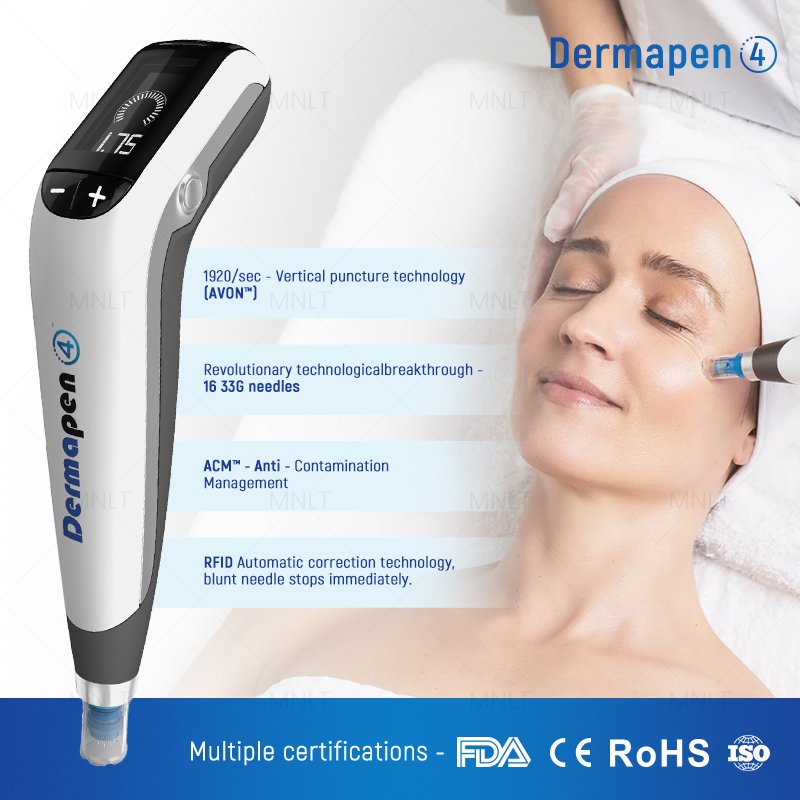
The Dermapen 4 class of devices — professional automated microneedling systems with clinical-grade motors, precision depth control, and single-use cartridge systems — is the standard for delivering these outcomes consistently at clinic volume.

Key Specifications: What a Clinical-Grade Dermapen 4 Must Deliver

Not all devices marketed as “Dermapen 4” or “professional microneedling pens” meet the specification required for clinical-grade deployment. Before evaluating any supplier, establish the minimum specification your clinic requires:

SpecificationClinical-Grade StandardRed Flag
Needle depth range0.25–2.5mm, fine incrementFixed depth or coarse steps only
Oscillation frequency100–120 pulses/secondBelow 80/sec or undisclosed
Motor consistencyMaintained speed under full session loadSpeed declines mid-session
Needle cartridge systemSingle-use sterile, anti-backflowReusable heads or unspecified
Cartridge compatibility9-pin, 16-pin, 36-pin, nano optionsSingle cartridge count only
CertificationCE, FDA 510(k), ISO 13485 — traceable numbersCertificate image without registry number
Voltage compatibilityDual-voltage (100–240V / 50–60Hz)Single voltage only
Handpiece ergonomicsBalanced grip, low vibration transfer to operatorHeavy, unbalanced, or high-vibration

The 5-Point Dermapen 4 Supplier Evaluation Framework

When comparing Dermapen 4 machine suppliers, clinic owners should evaluate on these five dimensions — not on price alone.

1. Certification Depth and Traceability

CE marking and FDA clearance are the regulatory baseline for professional aesthetic devices in EU and North American markets. But the critical word is traceable: a certificate image or a claim on a product page is not sufficient. Request the CE certificate number and verify it through the EU NANDO (New Approach Notified and Designated Organisations) database. Request the FDA 510(k) clearance number and verify it through the FDA’s public CDRH database.

ISO 13485 Quality Management System certification is the third credential to verify — it covers the manufacturer’s production process, not just the end product. A manufacturer holding genuine ISO 13485 certification has documented quality control across component sourcing, production, and delivery. This is the difference between a factory that has the right certifications and one that manufactures reliably enough to sustain them.

2. Accessory System Completeness

A Dermapen 4 machine is only as clinically versatile as its accessory ecosystem. Before purchasing, confirm the full cartridge range available:

  • 9-pin cartridge: precision work, small areas (perioral, periorbital, nose)
  • 16-pin cartridge: general facial microneedling
  • 36-pin cartridge: larger treatment areas, body applications
  • Nano cartridge: epidermal infusion and superficial skin renewal without full penetration depth

Also confirm: carrying case, power supply with your market’s voltage standard, spare stylus tips, and protocol reference cards. A device delivered without a complete accessory set requires sourcing from third-party suppliers — which introduces compatibility and quality control risk.

3. After-Sales Support Infrastructure

Professional microneedling devices require consistent maintenance and occasional component replacement (stylus housing, drive mechanism, charging contacts) over their service life. Before finalising a supplier, establish:

  • What is the warranty period and what does it cover?
  • What is the lead time for spare parts to reach your market?
  • Is 24/7 technical support available, or only within the manufacturer’s business hours?
  • Is remote diagnostics or troubleshooting support available?
  • What training documentation is included — operator manual, protocol cards, contraindications guide?

A manufacturer who cannot answer these questions with specifics is not equipped to support a long-term clinic deployment.

4. OEM/Private Label Capability

For clinics building a proprietary service identity — or distributors sourcing for private-label resale — OEM capability is a material consideration. Confirm whether the manufacturer offers:

  • Custom branding on the device body and packaging
  • Localised documentation (operator manual, cartridge packaging) in your language
  • Branded accessories under your clinic or distribution label
  • Design approval process and sample review before production

OEM orders typically carry a minimum order quantity above standard stock unit pricing. Establish this threshold and the OEM lead time before including private-label sourcing in your operational timeline.

5. Reference Accounts and Track Record

A manufacturer claiming 10+ years of production experience should have verifiable reference accounts in markets similar to yours. Request direct contact with 2–3 existing clinic or distributor partners in your region. A legitimate, established manufacturer will accommodate this without hesitation. Reluctance to provide references is a reliable indicator of a limited or problematic track record.

Dermapen 4 Accessory System: What Your Clinic Actually Needs

Beyond the core device, a functional Dermapen 4 clinical setup requires:

ItemPurposePer-Session Cost
9-pin cartridgePrecision facial treatment4–8
16-pin cartridgeStandard facial microneedling4–8
36-pin cartridgeLarge-area treatment, body6–12
Nano cartridgeEpidermal infusion protocol5–10
Topical serum / hydrating solutionTreatment medium and post-protocol careVariable
Numbing creamClient comfort for sensitive areasVariable
Sterile gloves and drapingClinical hygiene standard< $1

The total consumable cost per session — cartridge plus topical product — typically ranges from 8–20, depending on cartridge type and product selection. At a session pricing of 150–300 in EU/NA markets, this represents a gross margin of 90%+ once equipment cost is recovered.

The Clinic Procurement Process: Step by Step

For clinic owners purchasing a professional microneedling device for the first time, the procurement process should follow this sequence:

Step 1 — Specification confirmation. Define your target treatment protocols (facial only, body included, combination with serums or RF), session volume per day, and any OEM requirements. This determines whether an entry configuration or full clinical package is appropriate.

Step 2 — Supplier shortlisting. Identify 3–5 candidates. Eliminate any supplier who cannot provide traceable CE and ISO 13485 certificate numbers. Eliminate any whose response to technical questions is vague or delayed.

Step 3 — Sample evaluation. For orders above a minimum threshold, request a sample unit for evaluation. Test motor consistency, depth calibration, cartridge feed mechanism, and handpiece balance across a simulated full-day session load.

Step 4 — Reference verification. Contact at least one existing client or distributor in a comparable market. Ask specifically about after-sales support response time and parts availability — not just initial product quality.

Step 5 — Written commercial proposal. Obtain a written proposal covering: unit price, cartridge pricing, MOQ, OEM lead time (if applicable), shipping terms, warranty terms, and after-sales support structure. Do not finalise any purchase based on verbal commitments alone.

Step 6 — Order placement and tracking. Confirm production start date, expected completion, and shipping method in writing. Establish the point of contact for any production or delivery issues before funds transfer.

Explore the MNLT Dermapen 4 professional microneedling machine for full technical specifications, certification documentation, and configuration options before initiating your procurement process.

Why Clinic Owners Choose MNLT as Their Dermapen 4 Supplier

MNLT Laser (Shandong Moonlight Electronics Tech Co., Ltd.) has been manufacturing professional aesthetic devices for 19 years, supplying clinics, salons, and distributors across 120+ countries and 20,000+ clinic installations globally. The Dermapen 4 professional microneedling range is produced in an ISO 13485-certified facility with CE marking, FDA clearance, and MDR compliance — all certifications verifiable through their respective public registries.

What makes MNLT the preferred factory-direct source for Dermapen 4 machines:

  • 19 years of manufacturing depth: component selection, motor engineering, and quality control expertise built across two decades of aesthetic device production
  • Full certification suite: CE, FDA, MDR, ISO 13485 — traceable certificate numbers provided with every order
  • Complete accessory ecosystem: all cartridge types (9-pin, 16-pin, 36-pin, nano), carrying case, multi-voltage power supply, and protocol documentation included as standard
  • OEM/ODM capability: custom branding for clinic groups and distributors — device, packaging, and documentation under your label
  • 24/7 technical support: global after-sales coverage, remote diagnostics, spare parts logistics
  • Flexible MOQ: accessible entry-level distributor and clinic orders, with volume pricing available at scale

Get a free Dermapen 4 quote for your clinic →

Inquire Now

Fill out the form for more information, and an MNLT product manager will contact you shortly!

FAQ: Buying a Dermapen 4 Machine for Your Clinic

What certifications should a professional Dermapen 4 machine have?

The minimum certification baseline for a clinical-grade Dermapen 4 machine deployed in EU or North American markets is: CE marking (EU market access), FDA 510(k) clearance (US market access), MDR compliance (EU Medical Device Regulation — required for clinical positioning in European markets), and ISO 13485 Quality Management System certification. Crucially, request the certificate number for each credential and verify it independently through the issuing body's public database — not just from the manufacturer's product page. A traceable certificate number is the only valid form of certification evidence; a certificate image without a registry number does not constitute verified compliance.

What needle depth range does a Dermapen 4 need for clinical use?

A clinical-grade Dermapen 4 should offer needle depth adjustment from 0.25mm to 2.5mm in fine increments. Shallow depths (0.25–0.5mm) are used for epidermal infusion and superficial skin renewal. Mid-range depths (0.5–1.5mm) are standard for general collagen induction facial protocols. Deeper settings (1.5–2.5mm) are used for acne scarring, stretch marks, and body applications. A device that only offers coarse depth steps (e.g., 0.5mm / 1.0mm / 1.5mm) cannot fine-tune the treatment for different skin zones and client sensitivities — limiting both clinical outcomes and client comfort.

What is the MOQ for Dermapen 4 machines from a factory-direct supplier?

MOQ varies by supplier and order configuration. For standard (non-OEM) stock units, many factory-direct manufacturers offer single-unit or low-MOQ purchasing suitable for individual clinic evaluation. For OEM/branded configurations — custom logo, packaging, and documentation — MOQ is typically higher to cover customisation costs, and the specific threshold varies by the scope of branding required. MNLT Laser offers flexible MOQ structures for both clinic direct and distributor wholesale orders. Contact the MNLT commercial team with your target volume and configuration requirements to receive a written MOQ and pricing proposal.

What after-sales support should I expect from a Dermapen 4 supplier?

Minimum after-sales support for a professional microneedling device deployment includes: a written warranty (minimum 12 months, covering manufacturing defects and motor failure), 24/7 or business-hours-aligned technical support, spare parts availability with committed lead times, remote diagnostics capability for software or performance issues, and a comprehensive operator training documentation pack (device manual, treatment protocol cards, contraindications guide, cartridge selection reference). A supplier who cannot commit to these in writing before the purchase order is signed is not structured to support a multi-year clinic deployment reliably.

Can I get a Dermapen 4 machine with my own clinic branding (OEM)?

Yes — OEM and ODM customisation is available from factory-direct manufacturers like MNLT Laser. Customisation options typically include: your clinic or brand logo on the device handpiece and charging base, custom colour scheme, branded packaging and carry case, and localised operator documentation in your preferred language. OEM orders follow a design review and sample approval process before full production. Lead time for OEM configurations is typically 30–45 days versus 15–30 days for standard stock units. Establish MOQ, design approval steps, and production timeline in writing before committing to an OEM order.

How do I verify that a Dermapen 4 supplier is a legitimate manufacturer?

Four verification steps identify a legitimate Dermapen 4 manufacturer: (1) Request CE and ISO 13485 certificate numbers and verify them through the EU NANDO database and the ISO certification body's public registry respectively. (2) Request FDA 510(k) clearance and verify through the FDA CDRH public database. (3) Request a virtual or in-person factory tour — a legitimate manufacturer will accommodate this. (4) Ask for contact details of 2–3 existing distributor or clinic partners in markets comparable to yours, and speak to them directly about their experience with product quality, delivery reliability, and after-sales support. Resistance to any of these verification steps is a reliable warning sign.

How quickly does a Dermapen 4 machine pay for itself in a clinic?

At factory-direct pricing of $400–$900 for a certified clinical-grade Dermapen 4 machine, and session pricing of $150–$300 in EU/NA markets, a clinic running 3 microneedling sessions per day breaks even within 1–3 working days of the device entering service. The ongoing consumable cost (cartridges and topical products) of $8–$20 per session leaves a gross margin of 90%+ on every session after break-even. For context, the per-session cartridge cost on a factory-direct Dermapen 4 is $4–$12 — compared to $150–$300 per session in licensing fees on some branded systems. This consumable cost structure is the primary financial argument for factory-direct sourcing over branded licensed platforms.

Reviewed by David Ma

CTO & Chief Engineer, MNLT Laser (Shandong Moonlight Electronics Tech Co., Ltd.) — 19 years in aesthetic device manufacturing. David leads MNLT's R&D team across the full professional aesthetic device portfolio, ensuring all technical content meets the highest standards of accuracy and clinical safety.

Get A Free Quote